




Evaluating a Data Clustering Approach for Lifecycle Facility Control
This model provides accurate results for comparing actual and planned building resource utilization.
Given the current emphasis on sustainability, there is a growing interest in monitoring various facets of building resource consumption. Building monitoring and automation systems most commonly exist as closed-loop systems for security, fire safety, water, electrical, and HVAC (Heating, Ventilation, and Air-Conditioning). One of the fundamental requirements of a mature engineering process model is the comparison of planned versus actual results for cost, risk, and quality control. For facility engineering, this implies that there must be a structured specification of building space requirements and a mechanism for detecting divergent system and occupant behaviors. Such a mechanism would have broad applicability for commissioning, energy efficiency, sustainability, diagnostics, maintenance, and a variety of other problems.
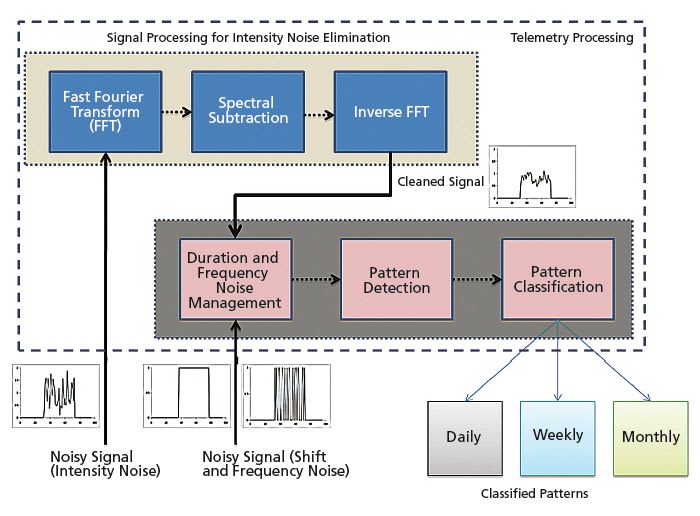
Experiments were conducted to test this hypothesis on an algorithm using simulated and real data, and ultimately to determine the algorithm’s expected accuracy, sensitivity to noise, and its general applicability. While there is extensive research in all aspects of data mining, this work focuses on the topics of noise reduction and clustering (relevant to multiple data mining phases).
Interpolation (e.g., cubic splines) is a noise reduction method for supplying missing data in the data set. Essentially, such an interpolation technique is used to smooth out jumps in the original data set. Discrete Fourier Transformation (DFT) is used to transform a time-domain input signal into its frequency-domain components. Using this transformation, one can detect and eliminate unwanted frequency components.
Clustering is used throughout the data mining process to detect similarities between data points. In clustering, a score function measures similarity between two data points. Fuzzy clustering is a portioning method whereby a single data point may belong to more than one cluster. Each data point is assigned a set of membership level values. These values indicate the strength of the membership of the data point with each of the clusters.
A lifecycle information exchange was developed for the entire life of a facility. This lifecycle information exchange model is based on the Industry Foundation Class (IFC) and the related Construction Operators Building information exchange (COBie) international building information model standards. Given the lifecycle information exchange integration between facility requirements and sensor data, it is possible to compare expected and actual utilization of facility resources. To this end, an algorithm that categorizes daily utilization data and may be compared to expected resource utilization was developed and evaluated that schedules at an appropriate resolution. Algorithm design decisions were based on considerations about resource utilization data and a general representation of expected/actual data.
An initial set of reference patterns was created that was used during development testing and in later experiments. When compared with actual resource waveforms, these patterns represent the usage characteristics of long-duration-use electrical devices such as a lighting system, desktop computers, or exhaust fans. Typically, these devices stay operational (on) for long intervals during facility occupancy and remain inoperative (off) otherwise.
The approach implements the first two phases of data mining (data dimension/noise reduction and data set partitioning) to extract patterns in observed telemetry comparable to the reference patterns. The intensity noise reduction algorithm consists of three steps: (1) Fast Fourier Transformation (FFT), (2) Spectral Subtraction, and (3) Inverse Fast Fourier Transformation. The Fast Fourier Transformation is a popular algorithm that implements discrete Fourier transformation.
Results from the experiments reveal that accuracies of 90% and greater may be achieved through various combinations of noise where frequency noise is between 0-30%, intensity noise is 0-40%, and shift noise is 0-5%. Given a minimum to moderate amount of noise, the accuracy typically increases as the cluster threshold increases. However, this is not true for shift noise.
The approximation of accuracy between artificial and real data provides a prediction of noise levels in the real data as well as an approximation of expected accuracy. While the algorithm was evaluated for a multitude of artificial noise conditions, the artificial noise seems unrealistically disruptive when compared to the relatively clean recurring patterns observed in the real sensor data. The proposed approach is beneficial because it requires low resolution, unit-neutral data that is not likely to place additional constraints on the sampling programs of installed building automation and monitoring systems – reprogramming of data logging equipment may be cost-prohibitive in some circumstances.
This work was done by A. Christopher Bogen, Mahbubur Rashid, E. William East, and James Ross of the Army Corps of Engineers. ARL-0155
This Brief includes a Technical Support Package (TSP).
Evaluating a Data Clustering Approach for Lifecycle Facility Control
(reference ARL-0155) is currently available for download from the TSP library.
Don't have an account?
More From SAE Media Group
Aerospace & Defense Tech Briefs
Manifold-Based Image Understanding
Tech Briefs
An Automated Flying-Insect Detection System
Photonics & Imaging Technology
New Upgrade Will Supercharge Atomic Vision of the World’s Most Powerful X-Ray Laser
Aerospace & Defense Tech Briefs
Robust Quantum Sensors Program

Tech Briefs
AI Helps UAVs Predict Oncoming Turbulence
Aerospace & Defense Tech Briefs
Adaptive Deblurring of Noisy Images
Tech Briefs
Compact Infrasonic Windscreen
Motion Design
Flexible Conductive Skin Gives Robots the Human Touch
Motion Design INSIDER
Programming Robots with Rubber Bands
Tech Briefs
When Mushrooms Control Robots
Robotics & Automation INSIDER
Researchers Explore the Phenomenon of Holonomy
Motion Design INSIDER
Computer Simulation Accurately Models Moving Cars
Aerospace & Defense Tech Briefs
Target Detection and Classification Using Seismic and PIR Sensors
Electronics & Sensors INSIDER
Next-Gen Automotive Semiconductors Are Critical for Level 5 Driverless Cars
Tech Briefs
PGUOM Can Block Noise Without Blocking Air

Tech Briefs
A Robot with the ‘Brains’ to Morph Mid-Air
Electronics & Sensors INSIDER
Careful Heating Unlocks Unprecedented Sensitivity to Pressure in Semiconductor Materials

Power Electronics INSIDER
Perovskite Solar Cells — From the Lab to the Manufacturing Floor
Aerospace & Defense Tech Briefs
Considerations of Aeroacoustics in Turbojet-Engine Testing
Aerospace & Defense Tech Briefs
Two-Camera Imaging System for Kinematic Measurements
Electronics & Sensors INSIDER
Self-Powered Sensor Automatically Harvests Magnetic Energy

Aerospace & Defense Tech Briefs
Portable Data Recorder for Measuring Sand Grain Fracture After Blasts
Aerospace & Defense Tech Briefs
GigE Advanced Imaging Sensor
Overview
The document titled "Evaluating a Data Clustering Approach for Life-Cycle Facility Control" discusses the integration of data from various building automation systems to enhance facility management and performance monitoring. With a growing emphasis on sustainability and efficient resource consumption, the need for effective monitoring systems has become increasingly critical. The authors highlight that building monitoring systems often operate as closed-loop systems for security, fire safety, water, electrical, and HVAC (Heating, Ventilation, and Air-Conditioning), but without proper planning, the complexity and volume of data can overwhelm users.
The study emphasizes the importance of comparing planned versus actual results in terms of cost, risk, and quality control within facility engineering. A structured specification of building space requirements and mechanisms for detecting divergent system and occupant behaviors are essential for effective commissioning, energy efficiency, and maintenance. The U.S. federal government, as a significant player in the capital facility industry, aims to minimize its facility footprint based on current building utilization, necessitating quantifiable metrics for accurate reporting.
The authors propose a model that connects sensor data with various building models—geometrical, functional, structural, and managerial. This integration allows for the comparison of expected and actual resource utilization, facilitating better decision-making. They developed an algorithm to categorize daily utilization data, which can be compared to expected schedules, thus providing insights into resource usage patterns.
The document also discusses the unexpected findings regarding the variation in sensor readings, particularly noting that the main office lighting level sensor exhibited low variation due to the influence of ambient light. In contrast, cooling and air handling units showed substantial variation due to seasonal temperature changes.
Overall, the research presents a promising approach to data clustering that enhances the ability to monitor and manage building resources effectively. By improving data integration and analysis, the proposed methods can lead to better anomaly detection, resource management, and ultimately contribute to the sustainability goals of modern facilities. The findings underscore the necessity of continuous commissioning and the potential for advanced data analytics in optimizing building operations.
Top Stories
INSIDERManufacturing & Prototyping
 How Airbus is Using w-DED to 3D Print Larger Titanium Airplane Parts
INSIDERManned Systems
 FAA to Replace Aging Network of Ground-Based Radars
NewsTransportation
 CES 2026: Bosch is Ready to Bring AI to Your (Likely ICE-powered) Vehicle
NewsSoftware
 Accelerating Down the Road to Autonomy
EditorialDesign
 DarkSky One Wants to Make the World a Darker Place
INSIDERMaterials
 Can This Self-Healing Composite Make Airplane and Spacecraft Components Last...
Webcasts
Defense
 How Sift's Unified Observability Platform Accelerates Drone Innovation
Automotive
 E/E Architecture Redefined: Building Smarter, Safer, and Scalable...
Power
 Hydrogen Engines Are Heating Up for Heavy Duty
Electronics & Computers
 Advantages of Smart Power Distribution Unit Design for Automotive...
Unmanned Systems
 Quiet, Please: NVH Improvement Opportunities in the Early Design...
