




GigE Advanced Imaging Sensor
The sensor is intended for use in military surveillance and survivability system cameras.
The Wide-Field Dynamic Range (WFDR) camera is a high-sensitivity, wide-field-of-regard sensor of importance to future military surveillance and survivability systems. It is intended to be used in harsh, noisy military platforms with multiple camera streams simultaneously gathered. By developing a Gigabit Ethernet (GigE) video transport solution for multiple cameras with low latency and high data reliability, a flexible processing architecture will be developed that allows optimization of processor throughput for real-time imaging in defense applications.
The following innovative features of this concept include:
- Digital Data Distribution — The goal was a 200x reduction in data noise, insulating the data from interference in electrically noisy military platforms. Prior military systems make use of analog point-to-point designs: a nominal 8-bit data acquisition of analog transmissions at best had produced six effective bits of analog signal. Using direct digital distribution achieves at least 14 effective bits with a 16-bit resolution.
- Multiplexed Control and Synchronization — Multiple video data streams can be sequenced, allowing a single-board computer to gather data from multiple sensors as the host is ready for data, while the sensors operate independently in parallel. The sensors provide metadata in the digital stream, allowing knowledge of precise timing of frame acquisition. This allows images to be synchronized with platform motion.
- Embedded Design — Design for use in real-time systems that meet deterministic schedules for host applications. Current analog-based systems have to estimate latency for when a commanded change to a camera setting has actually taken place. An analog frame grabber runs open loop and continuously grabs frames regardless of their generation. A digital network allows the host to initiate exposures on command, as well as to know, with certainty, that a commanded change is in effect and data is available.
- Military Ruggedization — Operation of surveillance video in harsh military environments, to include temperature extremes. A reliable iris drive, with precise index sensing, allows the camera to be used under both day and night conditions.
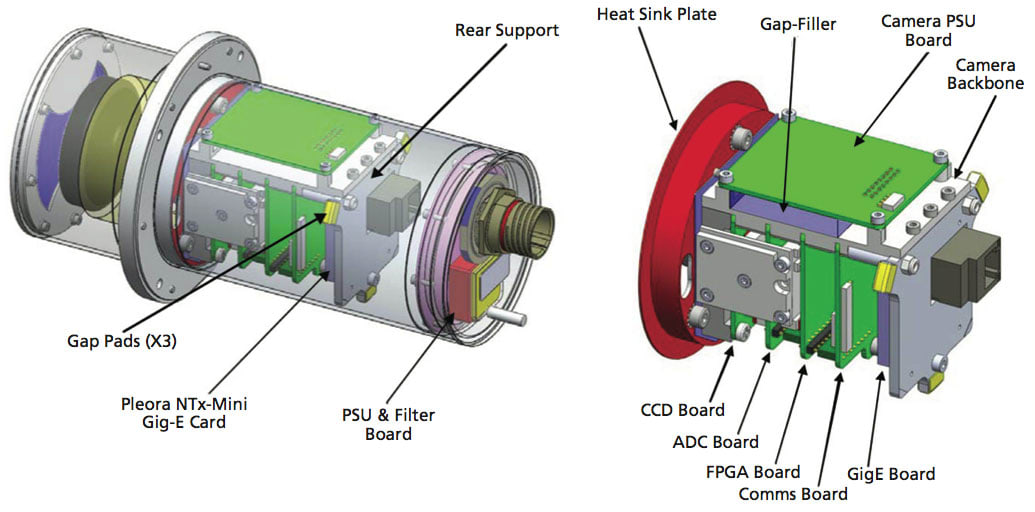
The digital WFDR provides the desired high-resolution, high- speed imaging capability. Due to the possibility of setting the cam- era to long integration times and high EM gain, as well as to short integration times with closed iris, the camera is capable of surveil- lance applications from the darkest night to the brightest day.
The camera is capable of rapid switching between different set- tings to grab frames. While the manufacturer’s requirements allow 100 ms for the camera to reach a new operating condition, up-changing exposure time or EM gain, it appears that both these transitions occur much faster, enabling the camera to produce images at a new gain state at its maximum rate of over 30 Hz.
This work was done by Lon Sunshine and Peter van Ham of BAE Systems Technology. For more information, download the Technical Support Package (free white paper) at www.defensetechbriefs.com/tsp under the Physical Sciences category. DARPA-0009
This Brief includes a Technical Support Package (TSP).

GigE Advanced Imaging Sensor
(reference DARPA-0009) is currently available for download from the TSP library.
Don't have an account?
More From SAE Media Group

Photonics & Imaging Technology
Researchers Use Inkjet Printing to Make a Portable Multispectral 3D Camera
Tech Briefs
Vision Sensing is Becoming More Accessible
Photonics & Imaging Technology
Extended Dynamic Range Camera Imaging
Imaging Technology
USB 3.0: Addressing New Challenges in Machine Vision
Aerospace & Defense Tech Briefs
GigE Vision and Video Transmission in Military Vehicles
Tech Briefs
Robot Reads Braille Twice as Fast as Humans

Aerospace & Defense Tech Briefs
Time-Coding of Asynchronous Data Transmissions
Imaging Technology
Choosing the Right Camera Bus
Medical Design Briefs
Sensor Uses Computer Vision-Based Optical Strain Technology
Aerospace & Defense Tech Briefs
3D Data Acquisition Platform for Human Activity Understanding
Tech Briefs
Making the Move to Digital in Machine Vision
Photonics & Imaging Technology
Standard Digital Camera and AI to Monitor Soil Moisture
Photonics & Imaging Technology
Using CoaXPress-over-Fiber for High-Speed Machine Vision
Sensor Technology
Artificial Intelligence in Cars — Inside the Brains
Autonomous Vehicle Engineering
MIPI Phone Alliance Standard Aims at Automotive Sensors
Photonics Tech Briefs
Has the Ultimate Camera Interface Finally Arrived?

Photonics & Imaging Technology
New Products
Photonics & Imaging Technology
Detecting Threats Beyond the Limits of Human, Sensor Sight

Aerospace & Defense Tech Briefs
Distributed, Collaborative Human- Robotic Networks for Search, Identify, and Track
Aerospace & Defense Tech Briefs
Fusion of Image- and Inertial-Sensor Data for Navigation
Photonics & Imaging Technology
Analysis and Simulation of Low-Light INL in CMOS Image Sensors
Tech Briefs
RF Innovations Give Batteries New Life
Aerospace & Defense Tech Briefs
Gesture-Directed Sensor-Information Fusion Gloves
Tech Briefs
Solar-Powered Airplane With Cameras and WLAN

Overview
The document is a final report on the GigE Advanced Imaging Sensor program, sponsored by the Defense Advanced Research Projects Agency (DARPA). The program aimed to enhance communication capabilities for advanced imaging sensors, focusing on high-speed video data transmission.
BAE Systems led the project, which involved the development of a high-speed video transport camera suitable for military applications. The camera was based on an existing commercial design from Raptor Photonics, specifically the EM247 model, and was modified to meet military environmental and packaging requirements. Key features of the redesigned camera include a low-light, monochrome electron-multiplication charged-coupled device (EMCCD) sensor, a reliable iris drive for day and night use, and a streamlined architecture with only five boards for improved performance.
The primary goal was to achieve real-time video data collection from three cameras over GigE (Gigabit Ethernet) at a frame rate of 30 Hz. The firmware developed exceeded this target, producing data at approximately 35 Hz. This advancement allows for the integration of high-speed digital imaging into embedded processing applications and data recording systems.
The report discusses the technical challenges and solutions encountered during the project, including the need for a GigE Vision driver to facilitate communication between the camera and a Commercial Off-the-Shelf (COTS) Single Board Computer (SBC). The GigE standard allows for cable lengths of up to 100 meters, enabling flexible sensor placement, although it requires more wiring compared to previous analog systems.
The document also highlights the implications for further research, emphasizing the need for rigorous testing of the GigE Vision interface under various conditions to ensure reliability and performance. Future work may include exploring the feasibility of multiplexing multiple devices onto a single Ethernet connection and addressing issues related to power supply noise.
Overall, the report showcases significant advancements in imaging technology, emphasizing the potential for military applications and the importance of ongoing research to refine and expand the capabilities of these advanced imaging sensors.
Top Stories
NewsSensors/Data Acquisition
 Microvision Aquires Luminar, Plans Relationship Restoration, Multi-industry Push
INSIDERRF & Microwave Electronics
 A Next Generation Helmet System for Navy Pilots
INSIDERWeapons Systems
 New Raytheon and Lockheed Martin Agreements Expand Missile Defense Production
NewsAutomotive
 Ford Announces 48-Volt Architecture for Future Electric Truck
INSIDERAerospace
 Active Strake System Cuts Cruise Drag, Boosts Flight Efficiency
ArticlesTransportation

Webcasts
Aerospace
 Cooling a New Generation of Aerospace and Defense Embedded...
Energy
 Battery Abuse Testing: Pushing to Failure
Power
 A FREE Two-Day Event Dedicated to Connected Mobility
Automotive
 Quiet, Please: NVH Improvement Opportunities in the Early Design Cycle
Electronics & Computers
 Advantages of Smart Power Distribution Unit Design for Automotive &...
Unmanned Systems
 Sesame Solar's Nanogrid Tech Promises Major Gains in Drone Endurance