




High-Resolution, Measurement-Based, Phase-Resolved Prediction of Ocean Wavefields
This technique could increase the survivability of naval ships by integrating this capability with ship-motion prediction and control tools.
Given remote and direct physical measurements of a realistic ocean wavefield, the goal of this work was to obtain a high-resolution description of the wavefield by integrating the measurements with phase-resolved wave prediction models including realistic environmental effects such as wind forcing and wave breaking dissipation. The measurements necessary for achieving this reconstruction were guided, and the validity, accuracy, and limitations of such wavefield reconstructions were addressed.
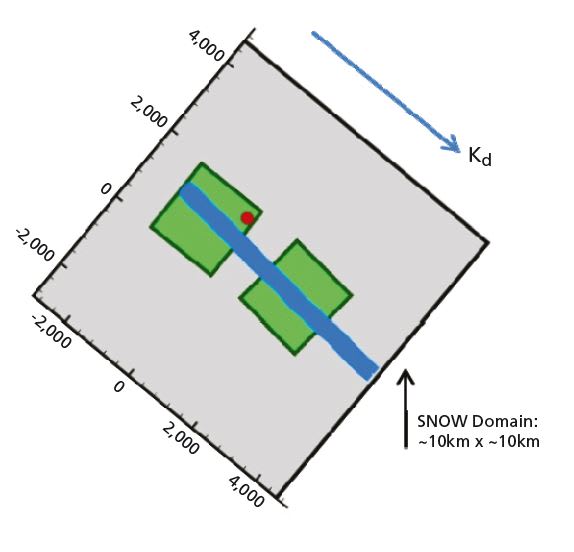
Nonlinear wavefield reconstruction is based on an iterative optimization approach using multilevel phase-resolved wave models of different nonlinearity orders. Specifically, for low-level optimization sufficient for mild waves, the linear and secondorder Stokes solutions are used. For high-level optimization necessary for steep waves, an efficient nonlinear wave simulation model (SNOW) based on a high-order spectral method is employed. Once the wavefield is reconstructed, its future evolution is given by the wave propagation model using the reconstructed wavefield as the initial condition. In wave modeling, wind forcing is included through a pressure forcing on the free surface, and wave-breaking dissipation is considered by applying an effective low-pass filter to the wave elevation and surface potential in the spectral space. Other physical effects such as those of current and finite depth are also directly considered in wave modeling.
To assess the performance of wave measurements and model predictions, direct comparisons between wave model predictions and HiRes field measurements are obtained. The comparisons indicate that phase-resolved reconstruction and forecasting of realistic ocean wavefields can be achieved by this wave prediction model and non-coherence marine radar sensed wave data. The resolution of the reconstructed and forecasted wavefield depends critically on the accuracy of sensed wave data, which is largely affected by radar-data inversion algorithm and the platform motion. Based on the reconstructed and forecasted large-scale wavefields, this work shows that it is of importance to include nonlinear effects in wavefield evolution for accurately predicting the temporal-spatial information of rogue waves and nonlinear wave statistics.
To address the key question of whether a phase-resolved wave prediction can be achieved using radar data, the reconstructed and forecasted wavefield are compared to the independent buoy measurement. For this purpose, HiRes measurements in which radar data, buoy data, and ATM data are all available were used.
Based on radar sensed wave data, a phase-resolved nonlinear wavefield was reconstructed and compared to the independent buoy data in both the time history of the wave elevation and the wave spectrum. The comparison shows that for the wave spectrum, the agreement between the radar-databased prediction and the buoy measurement is very good. The predicted time-variation of the wave elevation has a ~45% correlation with the buoy measurement.
For the wave spectrum, the radar-data-based prediction agrees very well with the independent ATM measurement. For the phase-resolved sea surface, the nonlinear phase-resolved prediction (based on radar data) achieves a ~55% correlation with the ATM measurement.
This work was done by Dick K.P. Yue and Yuming Liu of the Massachusetts Institute of Technology for the Office of Naval Research. ONR-0030
More From SAE Media Group
Aerospace & Defense Tech Briefs
Improvements in Measurement of Permeability and Permittivity


Photonics Tech Briefs
Estimating White-Light-lnterferometer Phases in Dim Light

Motion Design INSIDER
AI Shapes Autonomous Underwater “Gliders”
Aerospace & Defense Tech Briefs
New Drone Will Mimic Albatross Flight
Sensing Technology
FAU Engineers Design New Autonomous System to Monitor Arctic Ice Melt
Motion Design INSIDER
Nimble Dimples: Agile Underwater Vehicles Inspired by Golf Balls
Aerospace & Defense Tech Briefs
Through-the-Wall Small Weapon Detection Based on Polarimetric Radar Techniques

Tech Briefs
Ka-Band Radar Terminal Descent Sensor
Aerospace & Defense Tech Briefs
Robust Quantum Sensors Program
Motion Design INSIDER
Computer Simulation Accurately Models Moving Cars


Tech Briefs
When Mushrooms Control Robots

Tech Briefs
AI Helps UAVs Predict Oncoming Turbulence
Battery & Electrification Technology
Examining EV Battery Thermal Management
Power Management INSIDER
Fast Calculation Dials in Better Batteries
Software Tech Briefs
ISSM: Ice Sheet System Model
Tech Briefs
Pneumatic Proboscis Heat-Flow Probe
Aerospace & Defense Tech Briefs
Scaling of Flight Tests of Unmanned Air Vehicles
Aerospace & Defense Tech Briefs
Automatic-Alignment Fiber Optic Coupling System for Optimal Signal Transmission
Aerospace & Defense Tech Briefs
Outdoor Synthetic Aperture Acoustic Ground Target Measurements
Tech Briefs
Levitating Objects with Light

Top Stories
INSIDERManufacturing & Prototyping
 How Airbus is Using w-DED to 3D Print Larger Titanium Airplane Parts
INSIDERManned Systems
 FAA to Replace Aging Network of Ground-Based Radars
NewsTransportation
 CES 2026: Bosch is Ready to Bring AI to Your (Likely ICE-powered) Vehicle
NewsSoftware
 Accelerating Down the Road to Autonomy
EditorialDesign
 DarkSky One Wants to Make the World a Darker Place
INSIDERMaterials
 Can This Self-Healing Composite Make Airplane and Spacecraft Components Last...
Webcasts
Defense
 How Sift's Unified Observability Platform Accelerates Drone Innovation
Automotive
 E/E Architecture Redefined: Building Smarter, Safer, and Scalable...
Power
 Hydrogen Engines Are Heating Up for Heavy Duty
Electronics & Computers
 Advantages of Smart Power Distribution Unit Design for Automotive...
Unmanned Systems
 Quiet, Please: NVH Improvement Opportunities in the Early Design...
