




Outdoor Synthetic Aperture Acoustic Ground Target Measurements
Sound wave reflections distinguish between various substances.
A novel outdoor synthetic aperture acoustic (SAA) system consists of a microphone and loudspeaker traveling along a 6.3-meter rail system. This is an extension of a prior indoor laboratory measurement system in which selected targets were insonified while suspended in air. Here, the loudspeaker and microphone are aimed perpendicular to their direction of travel along the rail. The area next to the rail is insonified and the microphone records the reflected acoustic signal, while the travel of the transceiver along the rail creates a synthetic aperture allowing imaging of the scene.
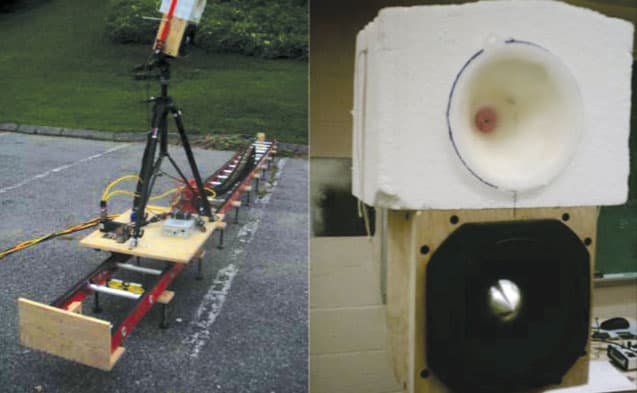
The system supports a desired standoff detection capability by looking perpendicular to the direction of travel. The sensor’s field of view is different from forward-looking radar or other opto-acoustic systems, but addresses the lateral view of the standoff detection objective. Opto-acoustic and other excitation systems have been used successfully to detect buried landmines.
An acoustic transceiver (quasi-monostatic) was constructed and mounted on a 6.3-meter portable rail system to facilitate controlled outdoor measurements (ultimately, the objective is a teleoperated vehicular mounted version). The direct measurement of the transceiver is the acoustic reflectivity found in the synthetic aperture or “acoustic scene.” The acoustic absorption of some materials is frequency-dependent, and the frequency spectrum of the backscatter is also strongly influenced by the target geometry when the target dimensions are comparable to or greater than the acoustic wavelength. A number of targets were imaged, and variations in acoustic reflectivity and phase versus aspect angle were observed.
By moving along the rail, the transceiver can continuously collect data, allowing the generation of synthetic aperture. Several canonical targets were placed on a weathered asphalt surface and image formation, i.e., wavefront reconstruction, was performed. This allows for the image processing techniques to include target and ground surface scattering analyses. Additionally, a digital spotlighting technique was performed on selected targets to produce aspect angle versus frequency plots. This allows for subsequent spatial and spectral analyses to be performed.
Digitally spotlighted and broadside position preliminary assessment of the selected targets indicate different relative magnitudes and frequency responses. As expected, the spherical targets have lower acoustic cross-section magnitudes, and the blocks’ flat surface perpendicular to transceiver travel have significantly larger scattering magnitudes. For example, a manufactured concrete block shows lower broadside-acoustic magnitude compared to three grout-covered foam blocks.
This work was done by Steven Bishop, Jay Marble, and Pete Gugino of the Army RDECOM CERDEC NVESD; Therese-Ann Ngaya, Joseph Vignola, and John Judge of the Catholic University of America; and Erik Rosen and Mehrdad Soumekh. For more information, download the Technical Support Package (free white paper) at www.defensetechbriefs.com/tsp under the Physical Sciences category. ARL-0105
This Brief includes a Technical Support Package (TSP).
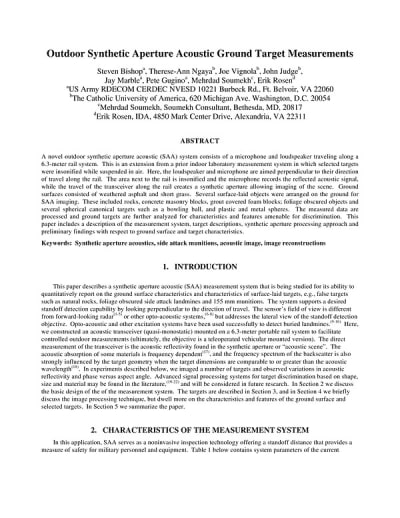
Outdoor Synthetic Aperture Acoustic Ground Target Measurements
(reference ARL-0105) is currently available for download from the TSP library.
Don't have an account?
More From SAE Media Group
Tech Briefs
Active Remote Sensing Radiometer
Photonics & Imaging Technology
Ultra-Narrowband Optical Filters Pushing Boundaries from the UV to the LWIR
Automotive Engineering
MEMS Drive Wants to Shake up Automotive Sensor
Off-Highway Engineering
CES 2024: Aeva Launches 4D Lidar for SAE Level 4 Trucks
Tech Briefs
Depth Sensors for Time-of-Flight Imaging
ADAS & Autonomous Vehicle Engineering
Testing ADAS Functions in Parallel with EMS Measurement
Automotive Engineering
Lumotive’s New LCM Underpins Next-Gen Lidar
Photonics & Imaging Technology
Terahertz Energy Focused by Credit Card-Sized Device to Generate High-Resolution Images

Photonics & Imaging Technology
Monitoring Additive Manufacturing with an Optical Microphone

Photonics & Imaging Technology
NeuWS Camera Overcomes Light Scattering With Full-Motion Video
Tech Briefs
Laser-Light-Based Accelerometer
Tech Briefs
Pseudo-Random Coding Technique for 3D Imaging
Tech Briefs
Q&A: Radar Imaging at Terahertz Frequencies

Tech Briefs
Products of Tomorrow
Tech Briefs
A Laser-Focused Approach to LiDAR
Aerospace & Defense Tech Briefs
Photonic Analog-to-Digital Converters
Sensor Technology
New Depth Sensors Could be Sensitive Enough for Self-Driving Cars
ADAS & Autonomous Vehicle Engineering
Making Sense of Next-Gen ADAS Sensing
Sensor Technology
Active Remote-Sensing Radiometer
Aerospace & Defense Tech Briefs
Pathfinder Radar ISR and SAR Systems: Tactical Eyes for the Warfighter
Tech Briefs
Inkjet Printing of Metamaterials
Photonics & Imaging Technology
How Corning’s Hyperspectral Imaging in the Sky Sees the Unseen
Medical Design Briefs
Optical Design Considerations for Additive Manufacturing
Tech Briefs
Manufacturing Ultra-Thin Camera Lenses
Aerospace & Defense Tech Briefs
Streamlined Microcomb Design Provides Control With The Flip of a Switch
Photonics & Imaging Technology
New Blue Light Technique Could Enable Advances in Understanding Nanoscale Technologies
Aerospace & Defense Tech Briefs
How Laser Communications Innovation is Finally Coming of Age and Driving Innovation in Defense
Overview
The document discusses the development and testing of an outdoor Synthetic Aperture Acoustic (SAA) system designed for ground target measurements. The research, conducted by a team from The Catholic University of America and supported by the U.S. Army RDECOM, focuses on improving target detection and discrimination through advanced acoustic imaging techniques.
The SAA system employs a transceiver mounted on a portable rail, allowing it to move and continuously collect data. This setup enables the generation of synthetic aperture images, which are crucial for analyzing various targets placed on a weathered asphalt surface. The system utilizes a Pyramid® 1200 W TW67 speaker as the acoustic source and an SBWA MPA 416 microphone, which is strategically positioned within a funnel to optimize sound capture. The excitation signals used for the measurements are linear FM chirps with a frequency range of 1-17 kHz and a duration of 10 ms.
Key parameters of the SAA system include a wave propagation speed of 340 m/s, a carrier frequency of 10 kHz, and a range resolution of 0.011 m. The system's design allows for effective data collection and analysis, including target and ground surface scattering assessments. The document highlights the importance of image processing techniques, which facilitate the reconstruction of wavefronts and the analysis of target responses.
Preliminary assessments indicate that different targets exhibit varying acoustic cross-section magnitudes. For instance, spherical targets show lower magnitudes compared to flat surfaces, such as concrete blocks, which have significantly larger scattering responses. The findings suggest that the SAA system can effectively differentiate between various target types based on their acoustic properties.
The document concludes with a call for further development to enhance the system's calibration, improve transceiver positioning accuracy, and expand outdoor data collection under diverse environmental conditions. The research aims to refine structural acoustic techniques for better scene analysis and target detection, ultimately contributing to advancements in military and civilian applications.
Overall, this document presents a comprehensive overview of the SAA system's capabilities, methodologies, and preliminary findings, emphasizing its potential for improving target detection and analysis in various settings.
Top Stories
NewsRF & Microwave Electronics
 Microvision Aquires Luminar, Plans Relationship Restoration, Multi-industry Push
INSIDERAerospace
 A Next Generation Helmet System for Navy Pilots
INSIDERDesign
 New Raytheon and Lockheed Martin Agreements Expand Missile Defense Production
INSIDERMaterials
 How Airbus is Using w-DED to 3D Print Larger Titanium Airplane Parts
NewsPower
 Ford Announces 48-Volt Architecture for Future Electric Truck
ArticlesAR/AI

Webcasts
Electronics & Computers
 Cooling a New Generation of Aerospace and Defense Embedded...
Automotive
 Battery Abuse Testing: Pushing to Failure
Power
 A FREE Two-Day Event Dedicated to Connected Mobility
Unmanned Systems
 Quiet, Please: NVH Improvement Opportunities in the Early Design Cycle
Automotive
 Advantages of Smart Power Distribution Unit Design for Automotive &...
Energy
 Sesame Solar's Nanogrid Tech Promises Major Gains in Drone Endurance