




MEMS Drive Wants to Shake up Automotive Sensor
Optical image stabilization technology from cell phones can find a home in your cars, says MEMS Drive CEO Colin Kwan.
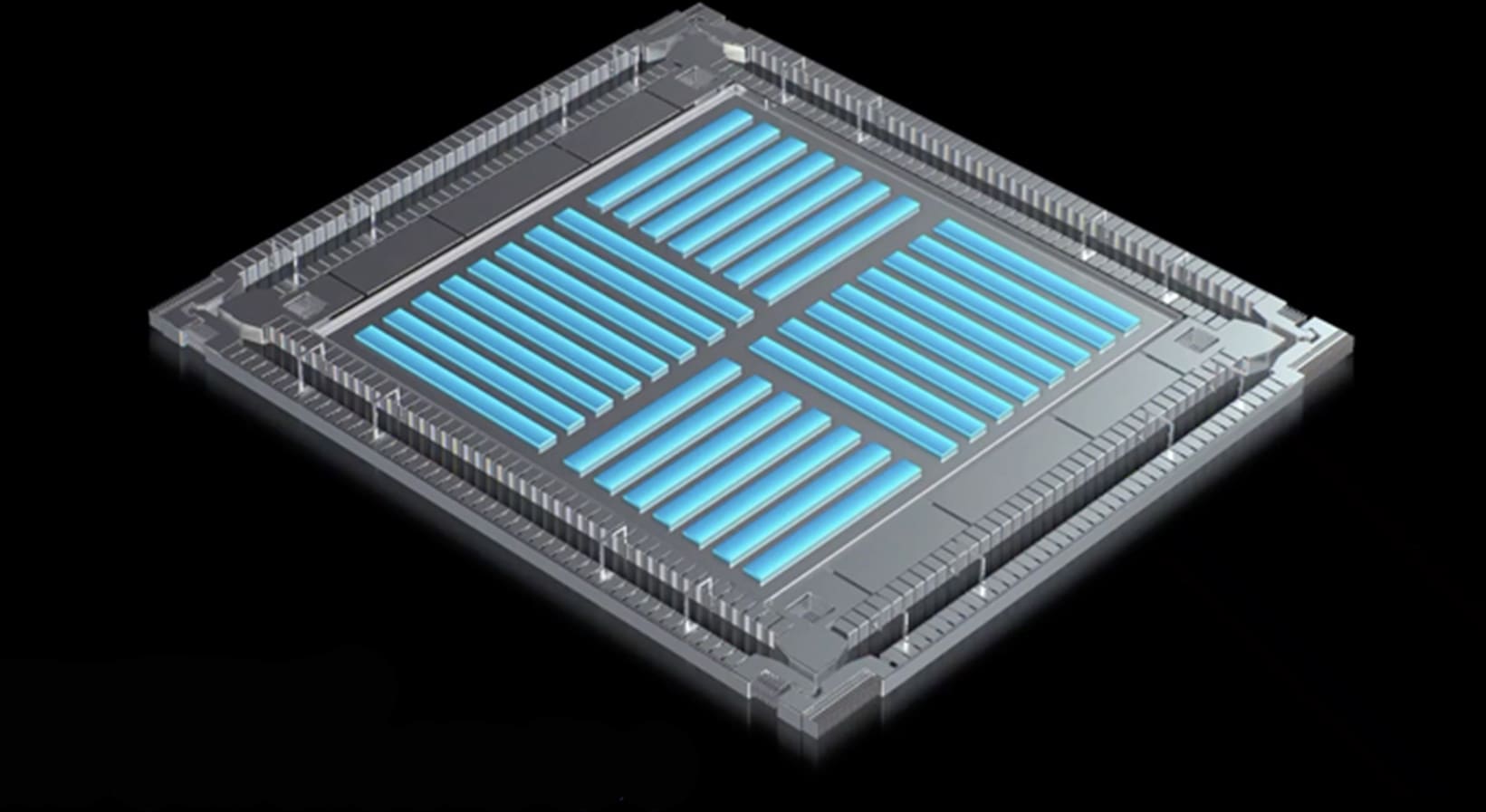
Advanced optical image stabilization (OIS) technology used in mobile phones should have a home in the automotive world. Specifically, using microelectromechanical systems (MEMS) to move an image sensor in the X-Y plane to provide fast and accurate image stabilization against camera motion can make automotive sensors see better, especially in dark conditions.
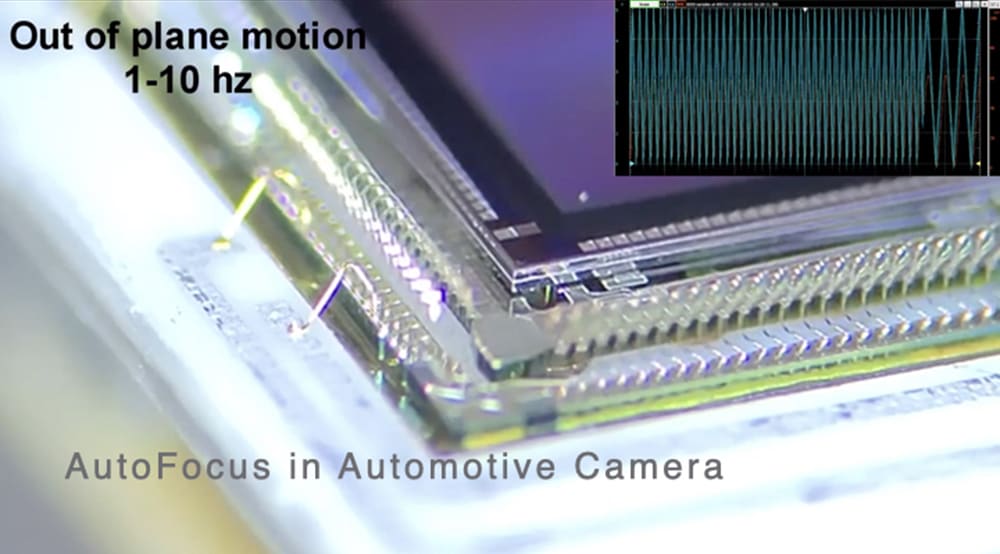
That was the message from MEMS Drive Inc. president and CEO Colin Kwan at AutoSens USA 2024. MEMS Drive is a fabless semiconductor company that develops, manufactures and markets MEMS actuators and has been working on the technology for 25 years. MEMS Drive even designed the first actuator for moving image sensors in a mobile phone compact camera module.
Kwan said MEMS Drive stabilizes an image by moving the sensor and not the lens because the glass in a lens stack in an automotive camera can be a hundred times heavier than the image sensor. Kwan said MEMS Drive’s actuators can move the image sensor with sub-micron movement precision at a high frequency and in a fraction of a millisecond.
“We believe this is the future of automotive sensing,” Kwan said. “You’re talking about moving a few tenths of a milligram of an imager, so the speed can be much higher than moving the lens, obviously.”
The MEMS Drive OIS uses thousands of electrostatic comb drives arranged in four sets of actuators to move the “inner platform” of the sensor in X, Y and roll directions.
Tested two billion times

MEMS Drive is not the only company working on MEMS sensors for automotive use. Bosch’s SMI230 sensor, for example, detects acceleration and angular rates in three perpendicular axes. Silicon Sensing offers the CRH03, a stand-alone gyroscope for precise inertial sensing. MEMS Drive says MEMS technology is now ready for cars.
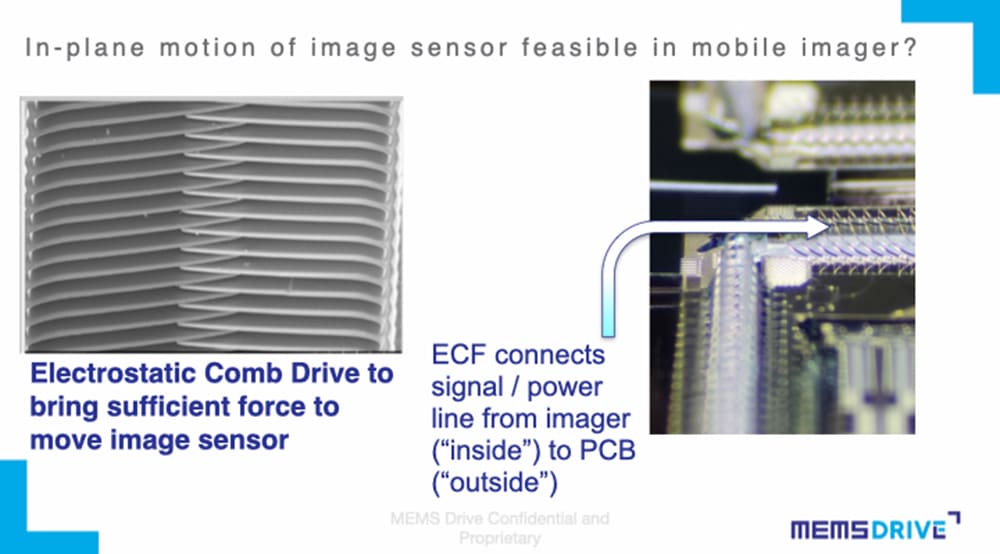
Kwan said MEMS Drive has already tested units with over two billion actuation cycles, enough to give him confidence that this smartphone technology can make the transition to automotive. The secret, he said, is the electrical conductive flexure (ECF). The ECF is what connects the signal/power line from the imager to the printed circuit board.
“ECF is a silicone structure, it’s not metal it’s not gold wire or other metallic element, so you won’t see any fractures,” he said. “That’s why the actuator can perform exactly the same after two billion cycles. You will not experience any problems in terms of signal integrity.”
Other benefits of the MEMS Drive OIS include negligible power consumption (less than 10 milliwatts) that doesn’t generate heat. The actuators can also operate in a wide range of environments because temperature does not impact the performance of the silicone, unlike sheet metal alloys, for example, he said. The system also has strong robustness against vibration, Kwan said, offering shake suppression within one frame.
“There is an increasing number of cameras being used in automotive,” Kwan said. “All these cameras experience similar situations and they have to compensate for different road conditions and then provide a stabilized image for the AI computing and under different lighting conditions to do what you need. This kind of MEMS device can provide a very long life and you needn’t worry about the robustness for vibration, temperature or mechanical shock. You find a lot of shake everywhere, no matter what camera you have, whether that’s a night shot or a drone or, of course, in automotive. This kind of shake can be effectively compensated by sensor movement.”
More From SAE Media Group
Automotive Engineering
New R&D Boss Details RoboSense’s LiDAR Strategy
Automotive Engineering
Q&A: Owl AI Making Better ADAS Systems with Help from Drones
Autonomous Vehicle Engineering
Improving Lidar – or Defeating It
Aerospace & Defense Tech Briefs
Designing for Compressive Sensing: Compressive Art, Camouflage, Fonts, and Quick Response Codes
Aerospace & Defense Tech Briefs
SAE International Extends Call for Abstracts, Seeks Submissions for AeroTech Conference
Sensor Technology
What’s New in MEMS Sensors for Wearables
Sensor Technology
Energy Harvesting for Smart Home Sensing
Photonics & Imaging Technology
Backside Illumination Gets Fast
Tech Briefs
Robot Reads Braille Twice as Fast as Humans
ADAS & Autonomous Vehicle Engineering
Making Sense of Next-Gen ADAS Sensing
Medical Design Briefs
Choosing MEMS Pressure Sensors for Medical Device Applications

Sensor Technology
Researchers Turn iPhone Camera into Optical Sensor

Medical Design Briefs
Micro-Machines for Bionic Body Parts and Medical Devices
Automotive Engineering
Powering the IoT Without Batteries Using Energy Harvesting
Aerospace & Defense Tech Briefs
Outdoor Synthetic Aperture Acoustic Ground Target Measurements
Medical Design Briefs
Molecular Device Uses Novel OPT Arrays

Photonics & Imaging Technology
Novel Flexible Terahertz Camera Can Inspect Objects with Diverse Shapes
ADAS & Autonomous Vehicle Engineering
Lidar Vs. Everybody in the Onboard Sensor Race
Sensor Technology
All-Silicon MEMS Inertial Sensing at Fiber Optic Gyro Performance Levels



Photonics & Imaging Technology
Optical Modules

Photonics & Imaging Technology
This MEMS Scanning Mirror Could Solve LiDAR’s Expensive Autonomous Vehicle Challenges
Autonomous Vehicle Engineering
Flash! Lidar’s Next Generation Arrives
Motion Design
Inductive Non-Contact Position Sensor
Top Stories
INSIDERManufacturing & Prototyping
 How Airbus is Using w-DED to 3D Print Larger Titanium Airplane Parts
INSIDERManned Systems
 FAA to Replace Aging Network of Ground-Based Radars
NewsTransportation
 CES 2026: Bosch is Ready to Bring AI to Your (Likely ICE-powered) Vehicle
NewsSoftware
 Accelerating Down the Road to Autonomy
EditorialDesign
 DarkSky One Wants to Make the World a Darker Place
INSIDERMaterials
 Can This Self-Healing Composite Make Airplane and Spacecraft Components Last...
Webcasts
Defense
 How Sift's Unified Observability Platform Accelerates Drone Innovation
Automotive
 E/E Architecture Redefined: Building Smarter, Safer, and Scalable...
Power
 Hydrogen Engines Are Heating Up for Heavy Duty
Electronics & Computers
 Advantages of Smart Power Distribution Unit Design for Automotive...
Unmanned Systems
 Quiet, Please: NVH Improvement Opportunities in the Early Design...
