




Frangible Polymer Circuit Acts as Tamper Sensor
These sensors create a protected 3D space for components storing critical information
Originally begun as an investigation to detect attempts to tap into an electrical cable, the emergence of modern encryption hardware rendered impractical attempts to protect communication media such as a cable.
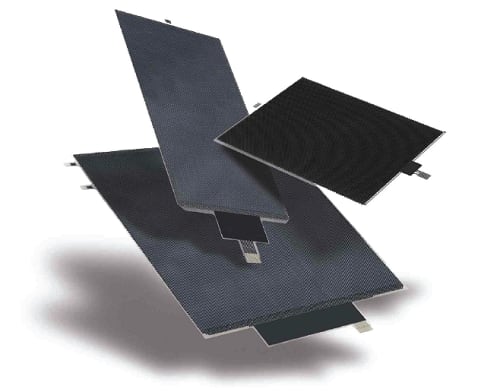
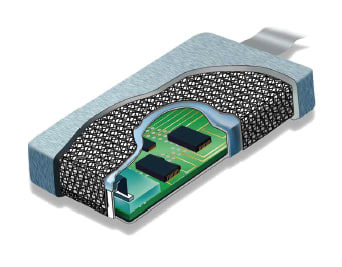
A sensitive tamper envelope was developed to trigger a response upon attempts at physical probing into electronics. A finely honed balance of cohesive and adhesive properties of conductive ink-tracks on a wrappable polymer film provides precise “frangibility” of an all-polymer flex circuit (see Figure 1). Once triggered, an unattended, protected module can initiate a response, typically a zeroization of cryptographic keys or embedded software.
Used to protect modules certified to FIPS 140-2 Level 4 and various other standards, this polymer flex circuit embodies three key attributes within one technology: invisibility to analysis including X-rays [deterrence], high complexity of possible bridging attacks [delay], and sensitivity to fine hole penetration or sensor removal [detection].
As with traditional flex circuitry, many options exist for size, shape, and complexity. Integrated into an OEM’s hardware packaging scheme, GORE™ Tamper Respondent Sensors can be provided in an array of physical formats to create a protected 3D space for the components storing the critical information (see Figure 2). For each physical format and application, sensors can be specified over a range of security protection levels.
Though developed to protect cryptographic keys in hardware security modules, OEMs need to protect intellectual property such as sensitive algorithms in embedded systems. The U.S. Department of Defense requires that such anti-tamper protection deter reverse engineering, technology transfer, and exploitation or countermeasure development of critical technology contained within weapon systems. While all good security is layered, strong security generally requires “active volume protection” with sensing and response.
This work was done by Dale D. Murray of W.L. Gore & Associates. For more information, Click Here .
More From SAE Media Group

Aerospace & Defense Tech Briefs
Information Warfare: Staying Protected at the Edge

Electronics & Sensors INSIDER
Next-Gen Automotive Semiconductors Are Critical for Level 5 Driverless Cars
Motion Design INSIDER
Programming Robots with Rubber Bands

Photonics & Imaging Technology
Photonic Processor Could Enable Ultrafast AI Computations
Tech Briefs
When Mushrooms Control Robots
Electronics & Sensors INSIDER
A New Design Provides the Greatest Precision in Memory to Date
Aerospace & Defense Tech Briefs
A Hardware-Centric Approach to Countering Side-Channel Threats
Aerospace & Defense Tech Briefs
Robot Vision System for Precise Object Retrieval in Unmanned Systems
Aerospace & Defense Tech Briefs
Distributed, Collaborative Human- Robotic Networks for Search, Identify, and Track
Electronics & Sensors INSIDER
Self-Powered Sensor Automatically Harvests Magnetic Energy
Photonics & Imaging Technology
Researchers Use Inkjet Printing to Make a Portable Multispectral 3D Camera
Motion Design INSIDER
Are Shapeshifting “Soft Machines” In Our Future?
Medical Design Briefs
How Quantum Computing Will Impact Healthcare Data Encryption
Tech Briefs
A Robot with the ‘Brains’ to Morph Mid-Air
Aerospace & Defense Tech Briefs
Robust Quantum Sensors Program

Aerospace & Defense Tech Briefs
Implementing a GPS Waveform Under the SCA
Aerospace & Defense Tech Briefs
Implementing Secure Command and Control in Unmanned Systems
Tech Briefs
Products of Tomorrow
Motion Design
Flexible Conductive Skin Gives Robots the Human Touch

Electronics & Sensors INSIDER
World's First Petahertz-Speed Phototransistor in Ambient Conditions
Tech Briefs
New on the Market
NASA Spinoff
Using AI to Predict the Sky
Motion Design INSIDER
RoboBee Comes in for a Landing
Sensor Technology
Access System Senses Finger Vibrations to Verify Users
Top Stories
NewsRF & Microwave Electronics
 Microvision Aquires Luminar, Plans Relationship Restoration, Multi-industry Push
INSIDERAerospace
 A Next Generation Helmet System for Navy Pilots
INSIDERDesign
 New Raytheon and Lockheed Martin Agreements Expand Missile Defense Production
INSIDERMaterials
 How Airbus is Using w-DED to 3D Print Larger Titanium Airplane Parts
NewsPower
 Ford Announces 48-Volt Architecture for Future Electric Truck
ArticlesAR/AI

Webcasts
Electronics & Computers
 Cooling a New Generation of Aerospace and Defense Embedded...
Automotive
 Battery Abuse Testing: Pushing to Failure
Power
 A FREE Two-Day Event Dedicated to Connected Mobility
Unmanned Systems
 Quiet, Please: NVH Improvement Opportunities in the Early Design Cycle
Automotive
 Advantages of Smart Power Distribution Unit Design for Automotive &...
Energy
 Sesame Solar's Nanogrid Tech Promises Major Gains in Drone Endurance