




AUSA 2025: New CMOSS Chassis, Plug-in-Card Prototypes in Development for Army Vehicles

The U.S. Army has selected two companies to develop prototype chassis and plug-in-cards for aviation and ground vehicles. The selection is the Army’s latest milestone accomplishment in an effort to feature Modular Open System Approach (MOSA) -aligned embedded computing systems across all of the new investments it makes in technology upgrades for new and legacy vehicles.
In a September 25 announcement, the Army selected General Dynamics Mission Systems and Pacific Defense as the lead developers for new C5ISR/EW Modular Open Suite of Standards (CMOSS) Mounted Form Factor prototypes. CMOSS is a set of standards developed by the U.S. Army to guide the design of embedded computing networks featured on Army vehicles.
The standards outline the design of a common central rugged computing chassis that is wired for power and networking. This chassis features slots where plug-in-cards configured for various position, navigation and timing (PNT) applications are inserted to enable electronic applications for an aircraft or vehicle. Tactical communications, data sharing between vehicles, and waypoint-to-waypoint navigation are examples of some of the applications the chassis and cards can enable.
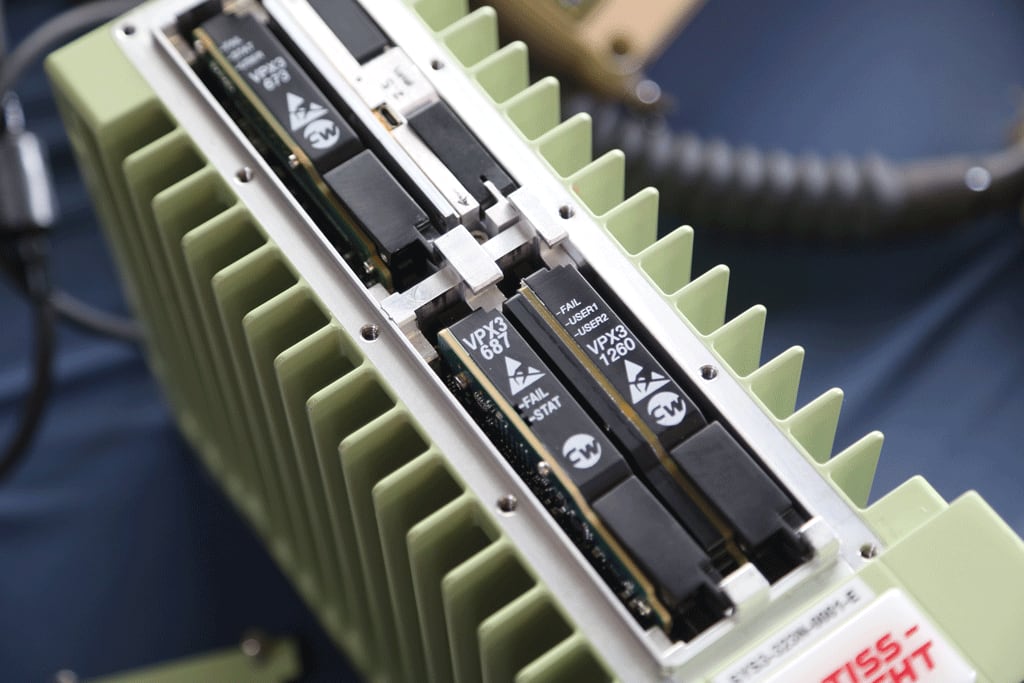
The U.S. Army Program Executive Office for Command, Control and Networks (PEO C3N) selected General Dynamics and Pacific Defense for two separate Middle Tier of Acquisition (MTA) Rapid Prototype Other Transactional Authority (OTA) agreements. Under the agreements, each company will develop prototype CMFF chassis — known as the Mounted Common Infrastructure (MCI) — the plug-in-cards and a smart display or tablet to interface with the chassis.
Ultimately, the PEO C3N goal for the adoption of the CMFF chassis and plug-in-card architecture in Army vehicles is to optimize the size, weight and overall amount of embedded networking infrastructure necessary to perform PNT applications. On a fighter jet for example, instead of having a separate individual computer for all of the communications, navigation and surveillance systems, each of these functions can be enabled by one of the PNT cards inside the chassis.
PEO C3N's prototyping decision comes several months after the Army officially established CMOSS Mounted Form Factor as a program of record this year, making the announcement in an April press release .
“CMFF Mounted Common Infrastructure will transform how we modernize platforms going forward,” said Col. Shermoan Daiyaan, Project Manager for Mission Command at C3N, regarding the April announcement. “It will foster many of the Army’s imperatives to reduce integration challenges and outpace emerging threats.”
Now that Pacific Defense and General Dynamics have been selected as the lead CMFF/CMOSS systems integrators, PEO C3N leadership will validate the prototypes through a series of lab and field-reduction-based events, operational demonstrations and soldier touchpoints. Future integration efforts will include "excursion" within the 4th Infantry Division's fielding of the Next Generation Command and Control ( NGC2 ) prototype technology stack.
Pacific Defense outlined some of the next steps for its participation in the program in an announcement about the Army's CMFF MCI selections last week. The company will deliver its first CMFF prototype systems to the Army next month. Those prototypes will be used to support soldier experimentation, software integration, and user interface development leading to full airborne and ground vehicle-mounted soldier evaluations in 2026. Pacific Defense has also added several industry partners to its CMFF MCI development team, including Thales Defense & Security Inc., BAE Systems, Palantir, MAXISIQ, Regal Technology Partners, and STC.
“We look forward to working with the Army to accelerate user adoption, production, and fielding of this critical, strategic technology in light of recent decisions to re-architect and rapidly re-capitalize Command and Control across echelons,” said Travis Slocumb, CEO of Pacific Defense. “Our CMFF MCI core technology enables EW/SIGINT, robust secure transport and networking, high performance tactical edge compute, APNT, and many C2 applications today with easily provisioned plug and play of cards and software into a variety of existing CMOSS chassis products.”
Separately, General Dynamics also provided some details on the technology it will provide for the program. According to a company press release , General Dynamics is developing a CMOSS system designed to fit within the Single Channel Ground and Airborne Radio System (SINCGARS) radio space of any vehicle or platform. The chassis features individual slots where 3U VPX processor cards can be inserted to provide PNT, radio and EW capabilities.
“This award allows for the rapid fielding of new, best-of breed capability by using field-swappable, commercial open-standard boards for computing, radio, position, navigation, and timing, electronic warfare, and cryptological capabilities,” said Scott Dunderdale, General Dynamics Mission Systems Vice President and General Manager for Land and Air Systems. “The system has already run with boards from more than 20 different vendors, including Abaco, Behlman Electronics, and Pacific Defense, with many more to come. The Army can now continuously develop, test and field capability in DevSecOps mode.”
More From SAE Media Group
Aerospace Manufacturing and Machining INSIDER
Army Launches CMOSS Prototyping Competition for Computer Chassis and Cards

Aerospace & Defense Tech Briefs
New Products
Aerospace INSIDER
Time-Sensitive Networking for the Army’s HADES Jets
Aerospace & Defense Tech Briefs
Military, Suppliers Focus on Long-Term Technical Advances, Compatibility


Aerospace & Defense Tech Briefs
The Role of Prototype/Test Systems in Next-Generation C5ISR Development
Aerospace & Defense Tech Briefs
New Products
Tech Briefs
New on the Market: August 2022
Aerospace & Defense Tech Briefs
SHIP Prototype Computer Chip
Aerospace & Defense Tech Briefs
How SpaceVPX is Influencing the Design of Next Generation Spacecraft Avionics
Tech Briefs
Hyper-Distributed RFID Antenna (HYDRA) System
Defense INSIDER
Army Showcases New Electronic Warfare Tech
Aerospace & Defense Tech Briefs
New Products
Aerospace & Defense Tech Briefs
New Products

Aerospace & Defense Tech Briefs
New Products
Aerospace & Defense Tech Briefs
How Will TSN Ethernet Impact the Future of Embedded Computing?
Aerospace & Defense Tech Briefs
New Products
Aerospace & Defense Tech Briefs
The World’s Largest Real Time EW Test Range
Defense INSIDER
MAPS GEN II: Navigation System Upgrades for Army Vehicles

Aerospace INSIDER
AI-Powered Radar Warning Receiver for Fourth Generation Aircraft
Aerospace & Defense Tech Briefs
US Army Tests Avionics in Effort to Upgrade Black Hawk Helicopters from Analog to Digital Glass Cockpit
Aerospace & Defense Tech Briefs
MOSA Enclosure Design for Military Systems

Aerospace INSIDER
Northrop's New Multifunction Active Electronically Scanned Array
Aerospace & Defense Tech Briefs
Spectrum Processing Subsystems
Top Stories
NewsSensors/Data Acquisition
 Microvision Aquires Luminar, Plans Relationship Restoration, Multi-industry Push
INSIDERRF & Microwave Electronics
 A Next Generation Helmet System for Navy Pilots
INSIDERWeapons Systems
 New Raytheon and Lockheed Martin Agreements Expand Missile Defense Production
NewsAutomotive
 Ford Announces 48-Volt Architecture for Future Electric Truck
INSIDERAerospace
 Active Strake System Cuts Cruise Drag, Boosts Flight Efficiency
ArticlesTransportation

Webcasts
Aerospace
 Cooling a New Generation of Aerospace and Defense Embedded...
Energy
 Battery Abuse Testing: Pushing to Failure
Power
 A FREE Two-Day Event Dedicated to Connected Mobility
Automotive
 Quiet, Please: NVH Improvement Opportunities in the Early Design Cycle
Electronics & Computers
 Advantages of Smart Power Distribution Unit Design for Automotive &...
Unmanned Systems
 Sesame Solar's Nanogrid Tech Promises Major Gains in Drone Endurance