




Automotive Engineering - August 2025
Inside this issue
Supplements
Overview
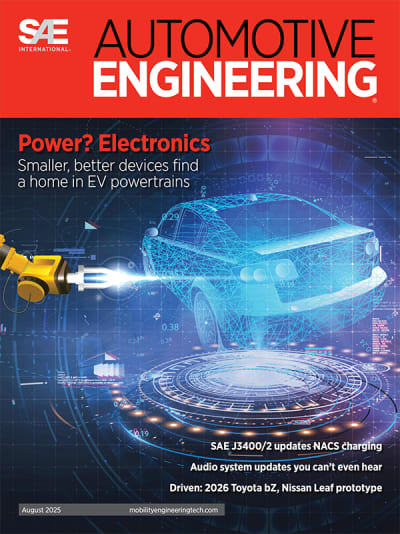
This issue of Automotive Engineering from August 2025 delves into several key advancements and trends in the automotive industry, particularly focusing on electric vehicles (EVs), power electronics, and innovative technologies that are shaping the future of automotive design and performance.
Cover Story: Wide Bandgap Semiconductors
The magazine opens with a detailed exploration of wide bandgap (WBG) semiconductors, specifically Silicon Carbide (SiC) and Gallium Nitride (GaN). These materials are gaining traction due to their superior performance compared to traditional silicon. SiC, with a bandgap of about 3.3 eV, is highlighted for its compactness, excellent thermal management, and high efficiency. Bosch's Baringhaus notes that 800 volts is an optimal operating point for SiC, particularly in applications like traction inverters and onboard chargers. Laboratory tests have shown SiC inverters achieving efficiencies over 98.5%, significantly outperforming silicon counterparts, which typically reach around 97%. The reduced heat generation from SiC components allows for smaller cooling systems, leading to more compact EV powertrains.
The Future of the Nissan Leaf
The magazine also features an article on the Nissan Leaf, which has historically been viewed as a less exciting EV option. However, Nissan is revamping the Leaf for its 2026 model, aiming to enhance its performance and driving experience. The new Leaf is described as a late-stage prototype that promises to be more engaging to drive, reflecting Nissan's commitment to innovation and improvement in its EV lineup.
Advances in Automotive Software
Another significant topic covered is the integration of advanced software tools in automotive engineering. A webinar discussed the use of virtual electronic control units (vECUs) in conjunction with virtual test driving environments. This integration allows manufacturers to initiate validation processes earlier, reducing costs and improving efficiency in the development of automotive software. The focus on software is crucial as vehicles become increasingly reliant on complex electronic systems.
Power Electronics and 48V Architecture
The issue also addresses the shift towards 48V power systems in vehicles. The 48V zonal architecture is presented as a solution that offers design and weight benefits while enhancing power and performance. This architecture utilizes thinner gauge wires and miniature DC-DC converter modules, which contribute to significant space and weight savings. The transition from traditional 12V systems to 48V is seen as a critical step in modern automotive design, enabling manufacturers to improve efficiency and reduce heat loss.
Challenges in GaN Technology
While GaN technology shows promise, the magazine discusses the challenges associated with its cost and manufacturing. Vertical GaN devices, which could offer significant advantages, face hurdles in terms of competitiveness against SiC. The article emphasizes the need for new processes and substrates to make GaN viable for widespread use, with readiness not expected until the end of the decade.
Upcoming Events and Industry Insights
The magazine also highlights upcoming events, including the Brake Colloquium & Exhibition scheduled for September 21-24, 2025, in Grand Rapids, Michigan. This event is positioned as a leading forum for advancements in brake systems and friction materials, showcasing the latest innovations and research in the field.
Conclusion
Overall, this issue of Automotive Engineering provides a comprehensive overview of the current state and future directions of the automotive industry. It emphasizes the importance of technological advancements in semiconductors, software integration, and power systems, all of which are crucial for the evolution of electric vehicles and the broader automotive landscape. As manufacturers continue to innovate and adapt to changing market demands, the insights presented in this issue will be invaluable for industry professionals and enthusiasts alike.
Features
-
Articles
16 Moving Targets: How Improvements to SiC, GaN Power Electronics Will Redefine EV
Regulars
-
Supplier Eye
-
Technology Reports
6 Industry Vet: Rapid Change Required to Catch up to Chinese EV Maker
8 ZF Meets Changing EV Market with Suite of Improved Components
10 Factory Robots See Slight Drop in Growth, but Still Have Momentum
-
Road Ready
Stories
-
News
The Role of Plastic Pallets in the Automotive Supply Chain
China’s True Edge Is Smarter Engineering and Speed to Market
-
Briefs
17 Spray Drying Tech Used in Instant Coffee Applied to High-Capacity Battery Production
18 How Can We Optimize Solid-State Batteries? Try Asking AI
-
Articles
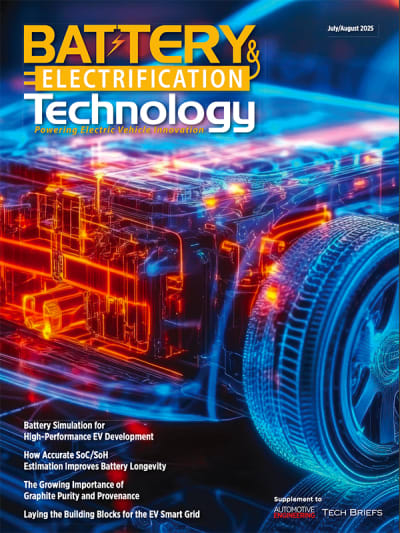
2 How Battery Simulation Is Taking High-Performance EV Development to New Heights
6 Why Accurate SoC and SoH Estimation Is Critical for Battery Longevity and Business Success
10 From Mine to Battery: The Growing Importance of Graphite Purity and Provenance
-
Products
21 New Products
Top Stories
NewsRF & Microwave Electronics
 Microvision Aquires Luminar, Plans Relationship Restoration, Multi-industry Push
INSIDERAerospace
 A Next Generation Helmet System for Navy Pilots
INSIDERDesign
 New Raytheon and Lockheed Martin Agreements Expand Missile Defense Production
INSIDERMaterials
 How Airbus is Using w-DED to 3D Print Larger Titanium Airplane Parts
NewsPower
 Ford Announces 48-Volt Architecture for Future Electric Truck
ArticlesAR/AI

Webcasts
Electronics & Computers
 Cooling a New Generation of Aerospace and Defense Embedded...
Automotive
 Battery Abuse Testing: Pushing to Failure
Power
 A FREE Two-Day Event Dedicated to Connected Mobility
Unmanned Systems
 Quiet, Please: NVH Improvement Opportunities in the Early Design Cycle
Automotive
 Advantages of Smart Power Distribution Unit Design for Automotive &...
Energy
 Sesame Solar's Nanogrid Tech Promises Major Gains in Drone Endurance