




New Products
Silicone Thermal Interface Materials
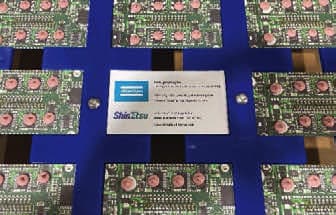
Shin-Etsu Silicones of America offers SDP-6560 A/B liquid-dispensed gap filling, a non-adhesive curing silicone thermal interface material. Part of the high-performing SDP Series, which are two-part, room-temperature cure silicone-based materials, the product acts as a thermal interface gap filler-providing exceptional thermal conductivity and excellent insulation for electronics applications requiring thermal dissipation. SDP-6560 A/B cures at room-temperature when the two components are mixed. After curing, the material has low hardness-translating to less stress on components. Because of the addition reaction, curing time is shortened by heating. Moreover, it can be reworked because it does not adhere to substrates. Notably, its grease-like consistency allows the material to flow into the nooks and crannies lowering the contact resistance over a variety of metal substrates. Developed to provide progressive options to thermal engineers in the growing EV market sector for silicone, SDP-6560 A/B is uniquely suited to transfer the temperature out of the electronic part to the housing. While the gap fillers can be used on a myriad of electronic parts on an EV, they are primarily used around battery cells. Key applications include usage in the battery management systems to the electronic control unit in the cars, or even the entertainment system.
Visit Here
Transistor Outline Leadless Package

Navitas Semiconductor (Torrence, CA) has extended its new portfolio of Gen-3 ‘Fast’ (G3F) 650 V SiC MOSFETs into a thermally enhanced, rugged, high-speed, surface-mount TOLL (Transistor Outline Leadless) package designed for demanding, high-power, high-reliability applications. Combining high-power capability and best-in-class low on-resistance of 20 to 55 mΩ, these 650 V SiC MOSFETs have been optimized for the fastest switching speed, highest efficiency, and increased power density demanded by applications such as AI data center power supplies, EV charging, and energy storage and solar solutions (ESS). Navitas GeneSiC products use a proprietary ‘trench-assisted planar’ technology that provides world-leading efficiency performance over the temperature range, with G3F MOSFETs delivering high-speed, cool-running performance that ensures up to 25 °C lower case temperatures and up to 3x longer life than alternative SiC products. Its latest design features the G3F45MT60L (650V 40 mΩ, TOLL) G3F SiC MOSFET in an interleaved CCM-TP PFC topology. Complemented by the NV6515 (650V, 35mΩ, TOLL) GaNSafe™ Power IC in the LLC stage, the 4.5 kW solution has a peak efficiency above 97 percent and, at 137 W/inch3, it is the world’s highest power density AI PSU. For 400 V-rated EV battery systems, G3F in TOLL is an ideal technology for on-board chargers, DC-DC converters, and traction drives ranging from 6.6 to 22 kW.
Visit Here
Optimized Sealing Material
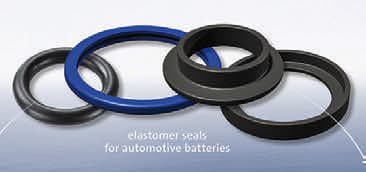
Freudenberg Sealing Technologies (Weinheim, Germany) offers an optimized sealing material for e-mobility applications as an alternative to PFAS-containing thermoplastic and FKM seals. This new material series is processed by injection molding, delivers superior sealing performance, ensures battery life and meets increasingly stringent environmental regulations. This high-performance elastomer material outperforms thermoplastics in the event of thermal runaway and takes battery applications in e-mobility to an entirely new level. The development of new battery materials prioritizes sustainability as well as economic aspects. In general, the longer a battery can be used, the more sustainable the electric vehicles become. The new sealing material from Freudenberg contributes to this goal. When used in customer projects, the new material was able to improve the performance-relevant leakage rate of the battery cells by an order of magnitude — resulting in a tenfold improvement compared to conventional thermoplastic seals. In addition, process engineering has optimized manufacturing techniques to such a degree that it is possible to produce these high-performance battery cell seals in large series.
Visit Here
4G-Connected EV Chargers

Easee (Stavanger, Norway) has announced new plans to support national and regional grid balancing efforts, leveraging its rapidly growing network of over 850,000 4G-connected EV chargers across Europe. As transportation electrifies and renewable energy generation accelerates, the grid faces unprecedented challenges. Easee’s connected charger network offers an immediate and scalable solution. Through advanced load balancing, demand response capabilities, and dynamic charging controls, Easee’s chargers can shift energy usage to times of lower demand and prioritize renewable energy integration, helping to relieve stress on local and national infrastructure. The aim is to empower energy providers and grid operators with new, responsive tools. Easee’s 850,000+ chargers represent one of the largest aggregated fleets of controllable electrical assets in Europe. Its technology supports a smarter, more resilient energy system by enabling features such as smart charging, which adjusts EV charging speeds in real time to respond to grid conditions. It also lays the groundwork for Vehicle-to-Grid readiness, preparing for a future where EVs not only draw energy but also return it to the grid when needed.
Visit Here
More From SAE Media Group
Battery & Electrification Technology
The Path to Smarter Vehicle Charging
Battery Technology
Advancing Battery Technology: THE 2021 BATTERY SHOW Preview
Automotive Engineering
Nano-Based Ultracap Tech Boosts EV Power Density
Battery & Electrification Technology
EV Energy Management Powers Up
Automotive Engineering
EV Energy-Management Powers-Up
Automotive Engineering
Clarios to Build Supercapacitor Plant in U.S.
Power Electronics INSIDER
Small Power Modules, Building Blocks of The Electric Grid
Battery & Electrification Technology
Next-Generation Elastomer Seals: Enhancing Battery Safety and Sustainability in E-Mobility

Battery & Electrification Technology
New Products
Battery & Electrification Technology
Battery Innovation Key for Commercial and Off-Highway EVs
Tech Briefs
Factorial’s Solid-State B-Samples Send a Message
Tech Briefs
New Fluids Coming for EV Thermal Management
Battery & Electrification Technology
Oxygen-Ion Battery: A Solution for Large Energy Storage Systems
Automotive Engineering
Constellium Develops New Alloys for EV Battery Enclosures
Power Electronics INSIDER
Electric Vehicles Play a Surprising Role in Supporting Grid Resiliency
Power Electronics INSIDER
Diamond Transistors
Battery & Electrification Technology
How Test Equipment Is Evolving to Keep Up with EV Batteries
Power Electronics INSIDER
Extensive NREL Power Electronics Capabilities
Battery & Electrification Technology
Using Silver Sintering in Traction Inverter Assembly
Battery & Electrification Technology
Micro-Supercapacitors Enable Fast Charging


Off-Highway Engineering
Sinonus Carbon-Fiber Structural Batteries Would Reduce Weight While Adding Range
Battery & Electrification Technology
The Impact of Fast Charging on the EV Charging Chain

Battery & Electrification Technology
The End of the Beginning: Why the EV Market Will Overcome the Loss of Tax Credits
Aerospace & Defense Tech Briefs
Rolls-Royce and Superdielectrics Explore Supercapacitor Technology
Top Stories
NewsSensors/Data Acquisition
 Microvision Aquires Luminar, Plans Relationship Restoration, Multi-industry Push
INSIDERRF & Microwave Electronics
 A Next Generation Helmet System for Navy Pilots
INSIDERWeapons Systems
 New Raytheon and Lockheed Martin Agreements Expand Missile Defense Production
NewsAutomotive
 Ford Announces 48-Volt Architecture for Future Electric Truck
INSIDERAerospace
 Active Strake System Cuts Cruise Drag, Boosts Flight Efficiency
ArticlesTransportation

Webcasts
Aerospace
 Cooling a New Generation of Aerospace and Defense Embedded...
Energy
 Battery Abuse Testing: Pushing to Failure
Power
 A FREE Two-Day Event Dedicated to Connected Mobility
Automotive
 Quiet, Please: NVH Improvement Opportunities in the Early Design Cycle
Electronics & Computers
 Advantages of Smart Power Distribution Unit Design for Automotive &...
Unmanned Systems
 Sesame Solar's Nanogrid Tech Promises Major Gains in Drone Endurance