




Steel Red-hot for Weight Reduction
The steel industry’s focus to remain a top material choice has not diminished, especially with automakers and suppliers looking for ways to light-weight passenger vehicles to meet the U.S. government’s 54.5-mpg fleet average requirement in 2025.

For safety, performance, and weight reduction, steel remains the top performer among light-weight materials, but the chase for better fuel economy is putting increased pressure on this perennially popular metal.
The steel industry debuted various lightweight demonstration concepts beginning in the late 1990s when aluminum and other lightweight materials challenged steel’s longtime dominance as the top vehicle material by mass.
“This is an exciting time for the steel industry. With tougher fuel economy and emissions regulations already in play, the materials competition is at an all-time high,” said Ronald Krupitzer, Vice President of Automotive Market for the Steel Market Development institute, a business unit of the American iron and Steel institute.
Helping automakers take weight out of vehicles, while maintaining performance and safety considerations, is “priority number one,” Krupitzer stressed during his opening remarks at the 2014 Great Designs In Steel (GDIS) conference in Livonia, MI.

Expansion of tailored products
TWB Company LLC, the leading manufacturer of tailor welded products in North America, has benefited from a steady uptick in body-in-white (BIW) applications made from tailored products. According to Mark Eisenmenger, TWB’s Director of Sales & Product Development, the increase from 2008 to 2014 is tied to “the need for cost-effective weight savings. Nearly 40% of the Corporate Average Fuel Economy (CAFE) improvement that is required by 2025 will come from vehicle weight savings.”
In addition to traditional tailored blanks, tailored products for steel now include hot formed tailored blanks (HFTB) and tailor welded coils (TWC).
“These products expand the material choices and combinations of materials that can be tailored,” Eisenmenger, a manufacturing engineer, told Automotive Engineering.
Standard tailored blank applications in 2008 included door inner panels, B-pillars, body side inner panels, as well as front and rear rails.
“In 2008, the typical tailored blank used the same grade of steel and only varied the thickness between the components of the tailored blank,” said Eisenmenger. “In 2014, we have a much greater material mix where each component of the tailored product has a specific grade and gauge of steel.”
Tailored blank parts now include tie bars, seat kick-up panels, moon roofs, wheelhouse panels, as well as chassis and frame components. There are currently more than 50 tailored-blank vehicle applications, compared to 18 examples in 2008.
“Our TWC product has opened the door to applications that were not considered in the past, such as parts that are typically stamped in a progressive stamping operation or roll formed. These products include BIW and chassis parts, such as roof crossmembers, headers, tie bars, rail closure panels, rocker sills, and frame rails,” Eisenmenger said.
Mustang moves to hydroforming, AHSS

Hydroforming is another production method gaining vehicle applications. The process uses pressurized water to shape a ductile metal into a stiff, lightweight structure. Ford has hydroformed various chassis and body parts on its vehicles in recent years. The 2015 Mustang sports car is new territory for the hydroforming process, according to Shawn Morgans, Ford Motor Co.’s Technical Leader for Body Structures and Manager of the North American Applications Group for Front-end and Underbody.
“A dual phase 1000 hydro-formed tube for the convertible’s A-pillar is a Ford-first. Our typical approach is two stampings for the A-pillar, so you end up with two very long weld joints between those stampings,” Morgans explained to Automotive Engineering.
On the Mustang coupe, a hydroformed tube runs from the A-pillar all the way through to the back of the B-pillar in one continuous member, meaning no joints, no weld flanges, and no discrete loading points from spot welds, Morgans noted.
Mustang’s amount of boron and martensite represents “the highest percentage that we’ve done on a vehicle at Ford to date,” Morgans said. Among the atypical locations for these advanced high-strength steels (AHSSs) are in the crossmember where it meets the B-pillar to help transfer load as well as the front rail where it transitions under the car to the torque box.
“The difference between a sedan and a coupe is that span between the A-pillar and the B-pillar. That area makes it much more difficult to meet certain performance requirements as well as the styling details,” said Morgans. “We went higher strength with steel, and boron does it with less weight. You could do it with lower-grade materials and just add more thickness or more parts. But with boron, we got much higher strength, and we don’t need to add the extra parts, and we don’t have to go quite as thick.”
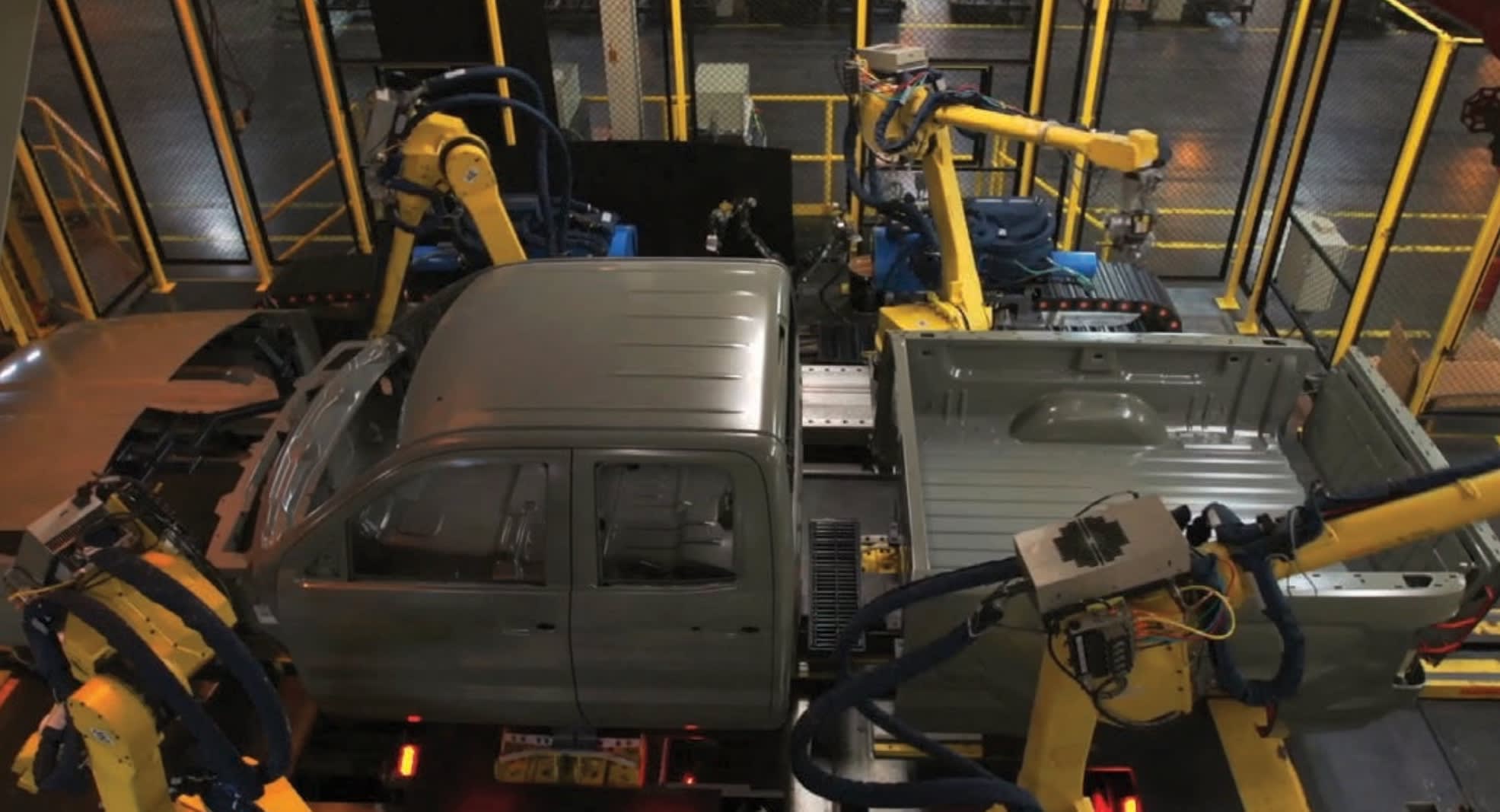
Weight reduction is just one of the reasons Ford engineers choose a particular material. “It’s a holistic approach, so weight, safety, cost, and durability all factor into the final equation,” said Morgans. “But we want to achieve our targets with the least amount of mass as possible. Mass affects many things, ranging from the vehicle’s 0-to-60 time to fuel economy.”
While the 2015 Ford F-150’s fully-boxed ladder frame is using more high-strength steels than in prior model years, the full-size pickup truck employs aluminum alloy throughout the body to help drop the overall vehicle weight by 700 lb (318 kg).
The chevrolet Silverado and GMc Sierra pickup trucks also tap lightweight metals.
3rd-gen grades come aboard
Both the 2013 and 2014 model year GM light-duty pickup trucks use steel extensively in the body and chassis frame, noted Hesham A. Ezzat, PhD, Technical Fellow, Body Lightweighting at General Motors. “However, the 2014 model year pickups leveraged more high-strength, advanced high-strength, and press-hardened steels to deliver the required performance at reduced material thickness and part mass,” Ezzat said.

Steel still has a vital role in vehicle weight reduction, but there are material challengers.
According to John Catterall, GM’s Global Engineering Team Leader, Body Lower Structure and Pickup Box, “In general, all vehicle segments will continue to leverage steel extensively in the body and chassis construction. This is true for both the near and long term. However, the overall percentage of steel by mass may actually reduce due to continued vehicle reduction and some substitution by other materials.”
Aluminum, composites (namely thermoplastics and carbon fiber), as well as magnesium are cited by Catterall as the materials that will replace steel in certain applications.
A light-duty passenger vehicle’s typical subsystem mass distribution breaks down as body (37%), chassis (30%), powertrain (14%), interior (12%), electrical (4%), HVAC and powertrain cooling (3%). Ezzat noted that body and chassis structures “are good candidates for the application of all grades of steel, including future third-generation grades.”
John Ferriola, Chairman, CEO, and President of nucor Corp., said that the Charlotte, NC-headquartered steel producer has invested billions of dollars to expand its specialized product offerings.
“We continue to work with our automotive customers to understand and satisfy their future needs as we design even higher-strength, yet formable, third-generation advanced high-strength products,” Ferriola remarked during his keynote address at the 2014 GDIS conference.

The development of 1.2-GPa AHSS by nippon Steel & Sumitomo Metal Corp., Kobe Steel Ltd., and nissan Motor Co. is an example of using a high tensile steel for application locales that were previously deemed too difficult because of formability constraints.
This third-generation AHSS is used on the 2014 model year infiniti Q50 luxury sports sedan’s center pillar inner; front pillar inner; reinforced center pillar; reinforced roof front, side, and sill center. The Q50’s 1.2-GPa parts are stamped via a conventional cold process. The 1.2 GPa replaces some 590-MPa dual phase steel as well as replacing 780-MPa and 980-MPa dual phase materials, saving 24.25 lb (11 kg), according to Paul Villemonte, engineer in the materials engineering department at the Nissan Technical Center North America.
“The revolutionary 1.2-GPa high-strength material can be applied to complex part shapes that require high biaxial formability,” said Villemonte, adding that this steel’s high formability can replace lower tensile strength materials and reduce part thickness.
According to Villemonte, future North American applications for the 1.2 GPa include Nissan’s Maxima and Altima sedans and the Murano crossover utility. Those vehicles will use the material for various body structure parts.
Nissan’s current in-vehicle usage of AHSS (590 MPa or greater) represents approximately 9% of all BIW materials. But after 2017, the goal is 25% AHSS usage with 1.2 GPa being part of that material mix, noted Villemonte.
“AHSS applications are the most cost-effective method to meet current mass reduction targets,” he said.
The mpg price tag
Mike Robinet, Managing Director of the strategy, planning, and analysis firm ihS Automotive, cited a 2008 Massachusetts institute of Technology study that put the cost for each 1% gain in fuel economy at $130 for diesel technology, $110-$220 for hybrid powertrain technologies, and $80-$180 for vehicle weight reduction.
“Emerging regulations and process efficiencies have altered these cost trade-offs since last decade,” Robinet told Automotive Engineering. The actual trade-offs differ by OEM, program, application, depending on a number of factors.
“Every OEM has mass-reduction goals averaging 3 to 5% per year,” Robinet noted, adding those objectives are influenced by CAFE credits, current vehicle mass, supplier affiliations, and capital infrastructure.
Meeting the U.S. government’s 2025-mpg fleet mandate leaves less than two vehicle cycles to reach the targets.
“Technologies required to meet the fuel-economy gains due for the 2025 period are required to be tested, cost-proven, and design-integrated by the 2017-2019 time frame,” said Robinet.
Nucor’s Ferriola said steel’s value is one of its strengths.
“The automotive production infrastructure is designed for and suited to steel. Retooling has tremendous costs associated with it, namely increased equipment and production costs. Aluminum is two to four times the cost of steel, which will be reflected in the [vehicle’s] purchase price, repair costs, and insurance premiums,” said Ferriola.
Steel’s production capacity is another factor.
“Other materials must increase capacity around the world to provide access to a sufficient amount of product,” said Ferriola. “Steel’s low cost and superior performance are the reasons why it has, and will, remain the dominant material used in vehicles.”
More From SAE Media Group
Automotive Engineering
Steel Stands Tall
Automotive Engineering
Multi-material Structures Move mpg Upward
Off-Highway Engineering
ZM Trucks Starts Production in Fontana, California
Automotive Engineering
2019 Vehicle Technology Review
Automotive Engineering
2015 F-150: Ford Drops an Aluminum Blockbuster
Automotive Engineering
Plastics Key to Mobility Innovations
Automotive Engineering
A Rebel’s Guide to Chassis Engineering
Automotive Engineering
2019 Chevrolet Silverado 2.7L
Automotive Engineering
Top Mass-Cutting Innovations Receive Altair Enlighten Awards
Autonomous Vehicle Engineering
AV Powers Bring May Flowers
Automotive Engineering
A Hundred Innovations for Renault’s Eolab Concept
Automotive Engineering
Toyota Stretches SUV Line-Up with World Debut of Grand Highlander
Automotive Engineering
Toyota Chief Talks Trucks
Automotive Engineering
MAGNA Say Some Hurdles of Seat-reconfiguration System to Be Addressed by OEMs
Automotive Engineering
Aluminum: Toward 50% Body Content
Automotive Engineering
2019 Ford Ranger XL STX
Automotive Engineering
Gearing Up Drive Axle Innovations
Automotive Engineering
With 2019 Sierra, GMC Puts Brand Differentiation Behind It—literally
Automotive Engineering
In Search of the Lightweight, Multi-Material Car
Automotive Engineering
2026 Nissan Sentra Review: Putting the Pieces Together
Automotive Engineering
Advanced Steels Making Inroads
Off-Highway Engineering
Mellor Bus Stresses Lightweight Construction for New Midsized Battery-Electric Buses
Off-Highway Engineering
Digital Tech a Las Vegas Headliner
Automotive Engineering
ICE and Hybrid-Electric Propulsion Show Staying Power
Automotive Engineering
Driving Good Dynamics
Automotive Engineering
ZF's CEO Talks About Lightweight Vehicle Applications
Automotive Engineering
Inside Honda’s New Two-motor 50-mpg Accord Hybrid
Automotive Engineering
Designer Yin Meets Engineer Yang
Off-Highway Engineering
College Students Design Lightweight Steel Wheels
Power Electronics INSIDER
World’s Strongest Battery Paves Way for Light, Energy-Efficient Vehicles
Top Stories
INSIDERManufacturing & Prototyping
 How Airbus is Using w-DED to 3D Print Larger Titanium Airplane Parts
INSIDERManned Systems
 FAA to Replace Aging Network of Ground-Based Radars
NewsTransportation
 CES 2026: Bosch is Ready to Bring AI to Your (Likely ICE-powered) Vehicle
NewsSoftware
 Accelerating Down the Road to Autonomy
EditorialDesign
 DarkSky One Wants to Make the World a Darker Place
INSIDERMaterials
 Can This Self-Healing Composite Make Airplane and Spacecraft Components Last...
Webcasts
Defense
 How Sift's Unified Observability Platform Accelerates Drone Innovation
Automotive
 E/E Architecture Redefined: Building Smarter, Safer, and Scalable...
Power
 Hydrogen Engines Are Heating Up for Heavy Duty
Electronics & Computers
 Advantages of Smart Power Distribution Unit Design for Automotive...
Unmanned Systems
 Quiet, Please: NVH Improvement Opportunities in the Early Design...
