




Plastics Key to Mobility Innovations
The 2017 SPE Innovation Awards highlight the design, engineering and materials-science collaborations between vehicle OEMs and their tier suppliers.

Ford and General Motors and their composite-materials and tooling suppliers dominated the 2017 Automotive Innovation Awards competition, held for the 47th consecutive year by the Society of Plastics Engineers (SPE) Automotive Division. The SPE Automotive awards are the oldest and largest recognition event in the automotive and plastics industries. BMW and Hyundai and their suppliers also won major categories.
Automotive Engineering was again honored to participate in the Blue Ribbon Judging process, that reviews the finalists in nine major materials-technology categories and votes on the winners in each.
Grand Award and Body Exterior Award — 2018 Ford Expedition structural active grille shutters
Tier Supplier & Processor: Magna Plastcoat
Material Supplier / Toolmaker: Celanese / Integrity Tool
Material / Process: Celstran 40-20 PP GF/ injection molding
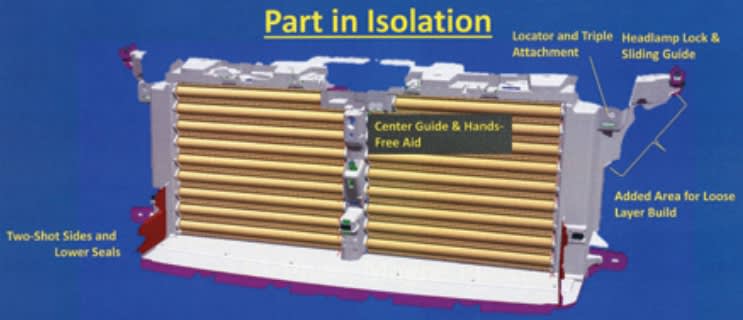
Possibly the largest two-shot active grille shutter unit in production, the Ford Expedition (U553 program) structure was designed with an integrated locating and attaching system for consistent fit between the grille and headlamps. This helped eliminate the need for front-end module (FEM) assembly, dunnage and shipping. In addition to reducing variable and piece costs by an estimated $5 with an entirely thermoplastic solution, the enhanced design achieved $16 internal assembly cost reduction per vehicle and eliminated around $45 auxiliary costs by negating the need for a FEM.
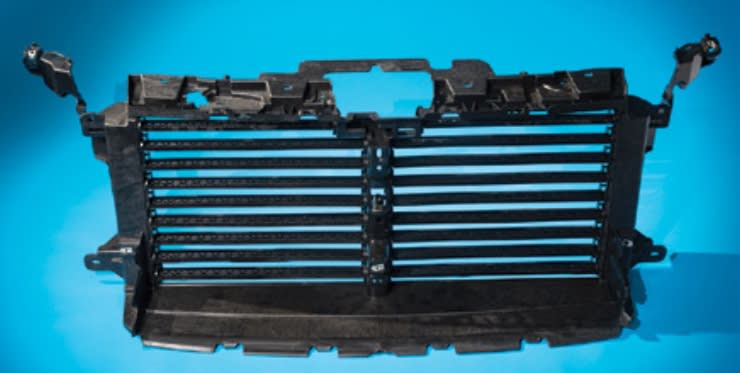
As a result, Ford avoided an estimated $2 million in dunnage, assembly plant line and handling costs. Improved parts consolidation also phased out the need for four separate fasteners and associated labor.
Using LFRT technology to develop a structure with polypropylene (PP) offset an estimated 3 lb/1.37 kg mass gain over alternative metal and nylon hybrid designs considered. An equivalent steel structure would weigh 18 lb/8 kg more than the long-fiber reinforced thermo-plastic (LFRT) design to deliver the required durability. According to Ford engineer Dave Glickman, the LFRT structure “looks to replace all FEMs at Ford Truck.”
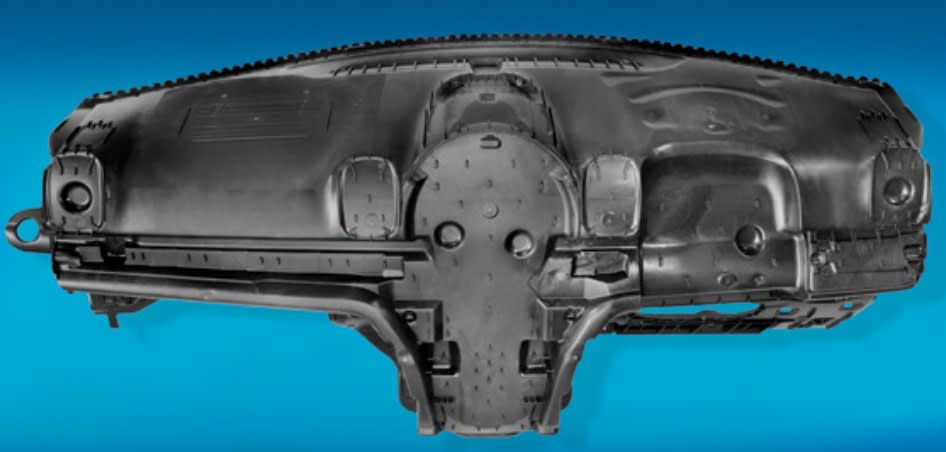
Body Interior Award — 2017 BMW Countryman instrument panel carrier
Tier Supplier / Processor: International Automotive Components (IAC)
Material Supplier / Toolmaker: Sabic / Siebenwurst
Material / Process: Stamax PP LGF/ injection molding Long-glass-fiber polypropylene (PP) injection molding via structural chemical foaming with core-back process enabled the production of this part with very low VOC emissions, meeting VDA 278 specification. Extensive CAE work predicting warpage of the foamed part provided valuable insights, allowing for the modification of tooling in advance. Use of foaming means less material is required resulting in a claimed 15% weight savings, fewer emissions and less cost.
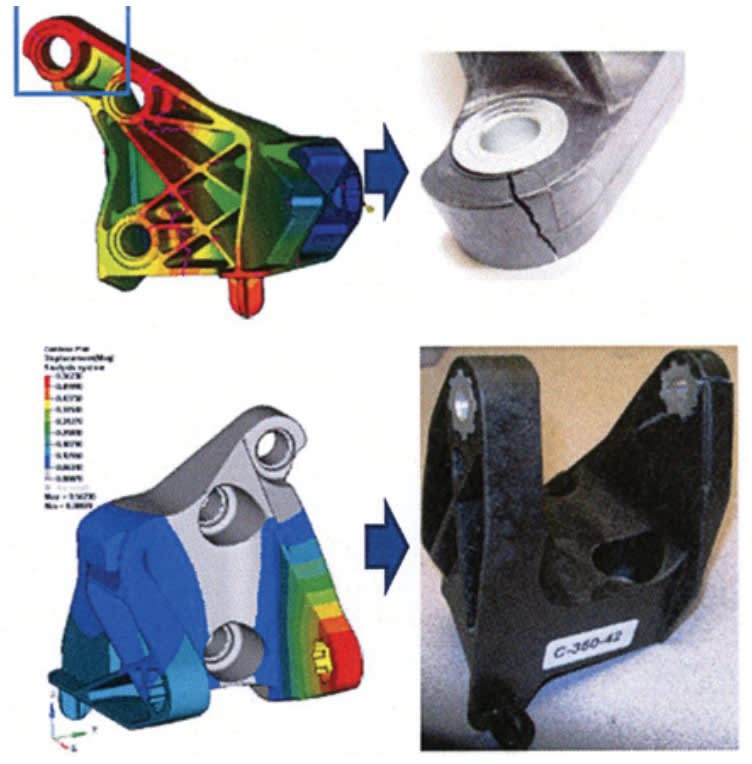
Chassis/Hardware Award — 2017 Cadillac XT5 V6 mounting clevis bracket
Tier Supplier / Processor: Hutchinson
Material Supplier / Toolmaker: BASF Corporation / not stated
Material / Process: Ultramid A3WG10 CR BK00564 PA66+50%GF / injection molding
This engine clevis bracket is the first composite mount designed for a V6 engine, passing peak loads of 25 Kilo-newtons of force. The injection molded part replaces metallic solutions (stamping, welding and diecasting) used previously resulting in a claimed 45% weight save. A reduction in cabin noise was also achieved due to the damping characteristics of the polyamide compared to aluminum.
Corrosion resistance is improved and the part can be recycled at end of life. Seven clevis brackets were developed for different powertrain combinations with no warranty claims after 1.5 years of production.
Environmental Award — 2018 Ford Fusion next-gen sustainable bio foam
Tier Supplier / Processor: International Automotive Components (IAC)
Material Supplier / Toolmaker: BASF Corporation / not stated
Material / Process: Elastoflex 3496/102 Resin, 113/4 Iso PU/ / foam in place
This application provides a sustainable alternative to conventional petroleum-based foams, at a lower weight and cost with more design flexibility, Ford engineers claim. Castor oil-based foam provides for lower molded density, the ability to be foamed in as little as 4-mm cross sections, and superior bond strength to mating materials. Foam in place tooling, where a cast PVC, TPE, or TPU skin is placed in the mold with a hard plastic retainer and the foam is injected between these two components, is used for processing. A claimed weight savings of 20-40% (depending on foam thickness) and a cost savings of $2 per average foamed-in-place instrument panel is achieved.
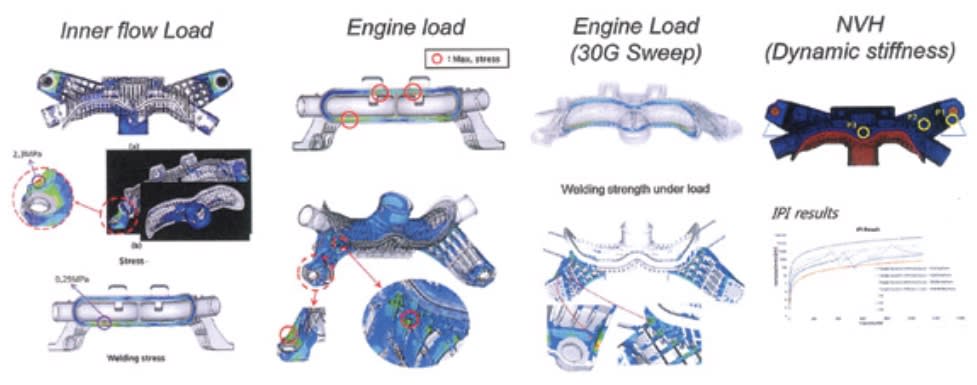
Powertrain Award — 2018 Hyundai G80/Kia Stinger turbocharger outlet T-joint
Tier Supplier / Processor: Hwaseung R&A Co., Ltd. / Songwoo Industrial & Seji Solotech, Inc.
Material Supplier / Toolmaker: DuPont Korea Inc. / not stated
Material / Process: PA66 / injection molding
A claimed 42% weight and 35% cost reduction, and improved airflow reducing the pressure drop (-8 kPa) to increase fuel economy and improve NVH performance, were achieved by designing and molding this part with plastic compared to the previous aluminum die casting. Airflow noise was also reduced and long-term durability increased via the rib pattern design.
Special three-gate positioning tooling was designed to minimize stress in weld-line area for strength and durability and for processing optimization. A new 35% glass fiber reinforced, heat stabilized polyamide-66 resin was developed for good retention of properties over time at temperatures up to 220°C (428°F).
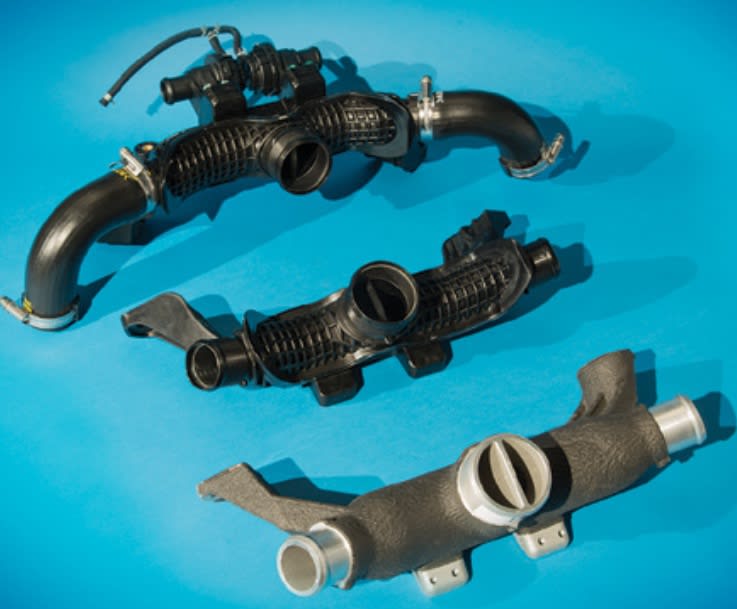
Materials Award — 2017 Ford F-150 and Mustang timing chain tensioner arms
Tier Supplier / Processor: BorgWarner
Material Supplier / Toolmaker: DSM / not stated
Material / Process: Stanyl HGR2 PA46(+PTFE) / injection molding This usage of a modified PA46 (nylon 46) resin to enhance stiffness, on vehicles powered by a 5.0-L V8 was a drop-in replacement for PA66, for enhanced wear and friction performance. The resultant fuel economy savings (0.4%), from rotational torque reduction in the camshaft (0.5 N·m) was equivalent to a 40-lb (18-kg) mass reduction, and at 1/10th the cost. Claimed annual environmental benefits include reduction in fuel consumption by 12,000 bbl and greenhouse gas emissions by 5000 t. This innovation will be utilized on more Ford vehicles beginning in 2018.
Safety Award — 2018 Ford F-150 Gen-3 four-way head restraint
Tier Supplier / Processor: Windsor Machine and Stamping
Material Supplier / Toolmaker: Ravago / Integrity Tool & Mold
Material / Process: Hylon N1000STHL PA / injection molding
This low-cost, low-mass head restraint provides exceptional rigidity for whiplash protection, Ford engineers claim. Its flexible design allows the front surface of the head restraint to be translated closer to or further from the occupant by 60 mm (2.3 in) without incurred costs, allowing for the precise balancing of comfort and safety. Using plastic, in place of steel, as the primary load bearing component is new to front-row head restraints.
The part design eliminates manufacturing complexity making use of intelligent geometries so that readily available materials could be used. A $10.73 million savings ($2.80/vehicle) is projected by the end of MY2020 as this technology is extended to new vehicle programs.
Process/Assembly/Enabling Technologies Award — 2018 Ford Fiesta two-shot interior bezel
Tier Supplier / Processor: Faurecia Interior Systems
Material Supplier / Toolmaker: Lotte Advanced Materials / JP Grosfilley SAS
Material / Process: INFINO LT1220 PC & Starex LX0760 ABS / 2-shot injection molding
This unique 3-D decorative effect was achieved with 2K “reverse” injection molding (1st shot tinted PC) with overmolding of grained surface with 2nd shot (self colored pigmented ABS). Ford and its suppliers claim this is the first time this process was used to achieve the 3-D visual effect (color and texture) for a part of this size and geometry. A 30% cost save was achieved vs. IMD/IML/high gloss painting and there was a 20% scrap reduction vs. conventional two-layer high gloss piano black appearance.
Aftermarket Award — 2017 Chevrolet Silverado integrated bedliner divider
Tier Supplier / Processor: Penda Corp. / Penda/Durakon
Material Supplier / Toolmaker: A. Schulman / Penda Corp.
Material / Process: Polytrope TPP1026EU TPO / twin sheet thermoforming This is claimed to be the first twin-sheet thermoformed divider that is integrated into the bedliner as one piece. A $275 cost avoidance resulted by not having to manufacture a separate floor divider part.
The divider incorporates a molded-in locking feature to secure the divider into the truck wall when it is raised. It eliminates the need for a cargo net or separate divider allowing the customer to put smaller items in the bed without having the items move and slide around while the vehicle is in motion. Dual textures are achieved on both sides of the part. The design can be applied to different vehicle models and brands via an insert for different logos.
Vehicle Engineering Team Award — 2018 Chevrolet Traverse
The 2018 Traverse team introduced a first-surface-appearance, thin-wall, structural, long-glass-fiber poly-propylene on the floor console carrier saving the program 30% mass (2.2 lb/1 kg). This eliminated the need for metal reinforcements to take $1.50/assembly out of the part as well.
The team also launched the first serial production polyamide clevis bracket, reducing the part weight by 45% relative to the previous aluminum design while increasing damping by a factor of 10. Other innovative applications included development of a new LED head-lamp system that includes nine tailored elements producing about 720 lumens; and extended the use of low density (0.96 g/cc) TPO on the front and rear fascias, wheel opening moldings, claddings and rocker moldings. The use of plastics and composites in Traverse contributed to enhanced performance (a claimed 8% power gain with the 3.6-L V6), weight savings (7% lower than the previous program), improved fuel economy (17% increase) with best-in-class cargo space.
For more on the annual SPE Automotive Awards program, see here .
More From SAE Media Group
Automotive Engineering
2019’s Best Automotive Plastics Innovations
Automotive Engineering
ZF's CEO Talks About Lightweight Vehicle Applications
Automotive Manufacturing and Machining
Aluminum’s Rising Star
Automotive Engineering
Top Mass-Cutting Innovations Receive Altair Enlighten Awards
Automotive Engineering
Wrecking Ball
Automotive Engineering
Steel Stands Tall
Automotive Engineering
Gearing Up Drive Axle Innovations
Automotive Engineering
Altair Honors Innovations in Sustainability and Lightweighting
Automotive Engineering
SPE Names 2023’s Best Automotive Plastics Innovations
Automotive Engineering
GT350 Mustang Features Novel Composite Structural Component
Automotive Engineering
Altair Honors Weight-Saving Innovations

Automotive Engineering
Rethinking Aluminum for NVH Abatement
Automotive Engineering
Aluminum: Toward 50% Body Content
Automotive Engineering
Toyota Tacoma’s Resin Seat Named SPE’s 2024 Best Automotive Plastic Innovation
Automotive Engineering
Steel Red-hot for Weight Reduction
Off-Highway Engineering
Yokohama Rolls out Latest Off-Highway Radial

Battery & Electrification Technology
Battle for the Box
Automotive Engineering
Steel Targets EV Structures, Battery Boxes
Medical Design Briefs
New Products and Services
Automotive Engineering
Cadillac's Future-Tech Flagship
Automotive Engineering
Mass-Reducing Innovations Honored by Altair
Automotive Engineering
Innovation More Than Skin Deep
Automotive Engineering
A Hundred Innovations for Renault’s Eolab Concept
Automotive Engineering
Weaving a New Future for Composites
Automotive Engineering
2019 Ford Ranger XL STX
Automotive Engineering
2019 Vehicle Technology Review
Automotive Engineering
Martinrea's New Tech Center Focuses on Subframe Innovation
Automotive Engineering
Steeling for Reduced Mass and Higher Strength
Top Stories
INSIDERManufacturing & Prototyping
 How Airbus is Using w-DED to 3D Print Larger Titanium Airplane Parts
INSIDERManned Systems
 FAA to Replace Aging Network of Ground-Based Radars
NewsTransportation
 CES 2026: Bosch is Ready to Bring AI to Your (Likely ICE-powered) Vehicle
NewsSoftware
 Accelerating Down the Road to Autonomy
EditorialDesign
 DarkSky One Wants to Make the World a Darker Place
INSIDERMaterials
 Can This Self-Healing Composite Make Airplane and Spacecraft Components Last...
Webcasts
Defense
 How Sift's Unified Observability Platform Accelerates Drone Innovation
Automotive
 E/E Architecture Redefined: Building Smarter, Safer, and Scalable...
Power
 Hydrogen Engines Are Heating Up for Heavy Duty
Electronics & Computers
 Advantages of Smart Power Distribution Unit Design for Automotive...
Unmanned Systems
 Quiet, Please: NVH Improvement Opportunities in the Early Design...
