




A Hundred Innovations for Renault’s Eolab Concept

When Renault prepares a motor show concept, it invariably does so comprehensively. But for Paris this year it has excelled itself, claiming that its ultra-lightweight Eolab environmental hybrid (actually, two versions: a pure concept to emphasize visual aspects and an engineering working prototype) contains almost 100 “realistic” production-destined technological innovations including “active wheels.” It has been designed and engineered to achieve a fuel consumption of 1.0 L/100 km. On the official NEDC (New European Driving Cycle) cycle, that would equate to 22 g/ km of CO2.
It also claims that Eolab conforms to established B-segment levels of performance, practicality, and affordability, providing a vision of what a Renault in this class could be like in 10 years’ time.

By taking an aggressive and imaginative approach to weight saving, not only via an aluminum architecture but by radical solutions including the use of a magnesium roof, Renault estimates a saving in six specific areas of some 400 kg (900 lb) against a similar-size conventional production car. Renault explains that Eolab forms part of the French government’s “New Industrial Plan,” which includes a fuel consumption target of 2.0 L/100 km by 2020; but Eolab apparently has the ability to eventually halve even that aggressive figure.
Often, OEMs claim all the glory for concepts or prototypes like Eolab, but Renault has been open about many of its weight-saving collaborators. They include Saint Gobain (glass), Faurecia (seats), Michelin (tires), Continental (brake systems) and Posco (magnesium components).

Aerodynamic efficiency of the Eolab has been honed to a Cd of 0.235 with a CdA of 0.470 m2, some 30% less than the figures for a Renault Clio hatchback that compares as a B-segment design. To help achieve this in a small car, aerodynamicists took possible solutions to an extreme.
Totally flush wheel covers were tempting but rejected as both practically and aesthetically unacceptable. Instead, engineers opted for active vane-like covered wheels that would be in a closed position when brakes are unlikely to be in continual use. They are controlled via a rim-mounted sensor. Specially designed 145/70 R17 “tall and narrow” Michelin tires are fitted to the Eolab for improved aerodynamics and low rolling resistance. Active spoilers are common when rear-mounted, but Eolab has one fitted to the front bumper that lowers by 10 cm (3.9 in) beyond 70 km/h (43 mph) to restrict underfloor airflow.
Renault’s determination to achieve meaningful weight reduction for a hybrid is wide ranging.
While weight saving applications reached 400 kg, 145 kg (320 lb) had to be added for the car’s powertrain, including a lithium-ion battery, to achieve the “total” vehicle weight of 955 kg (2105 lb), but it is still around 20% less than a similar-size conventional-powered car.
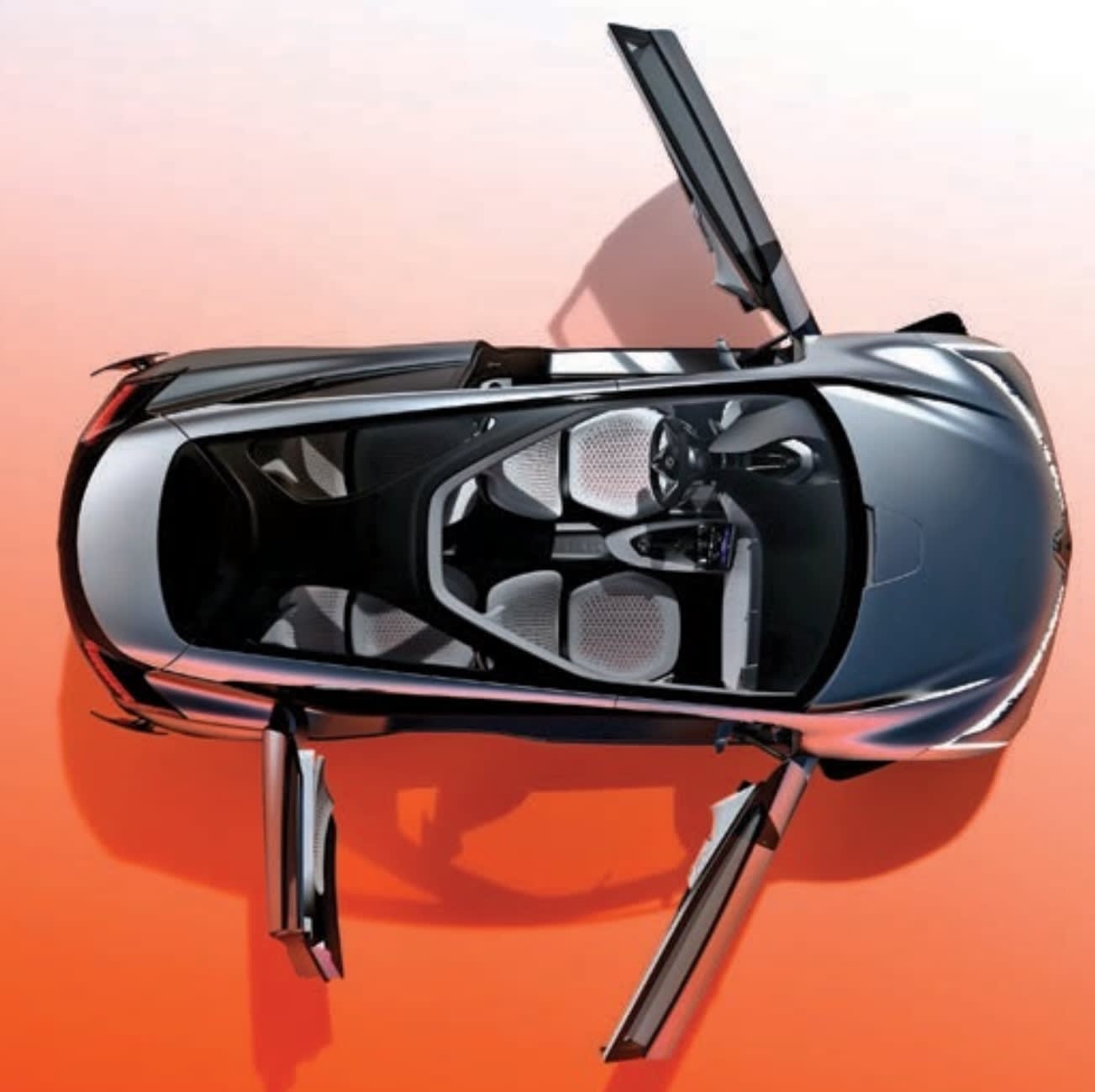
Specific savings were for the body, 130 kg (290 lb); equipment and trim, 90 kg (200 lb); suspension, 70 kg (150 lb); engine “peripherals”, 30 kg (70 lb); powertrain, 60 kg (130 lb); and electrical equipment, 20 kg (40 lb).
Eolab Project Leader, Laurent Taupin, explained that various material solutions were used: “But the only way to lighten steel components is to use thinner metal. However, since detracting from a given part’s functional properties was out of the question, it was necessary to upgrade the mechanical properties of steels employed.”
That’s where Very Very High Elastic Limit (VVHEL) steels entered the equation, with yield strength of between 1200 and 1500 MPa (174 and 218 ksi), an improvement of between 200 and 500 MPa (29 and 73 ksi) over the VHEL used for current Renault models. With a tensile strength of up to 150 kg/mm2, hot-stamped VVHEL was used “wherever it served a real purpose, notably for the front part of the cabin,” stated the company.
The use of magnesium for the roof outer of the Eolab is a very interesting choice, as the material is usually confined to areas unlikely to experience conditions susceptible to corrosion such as dashboard cross-beams. Renault opted to use magnesium sheeting supplied by Posco of South Korea. The material is also used for the lower part of the dashboard.
A roof section in steel would have weighed about 10 kg (20 lb), stated Renault. The company also explained that as well as producing wide magnesium alloy sheets for the car, Posco also carried out process assessment including warm stamping formability evaluation and development of customized surface treatment.

Other alternative materials R&D work has seen Renault working with university research departments and specialist suppliers on a new family of thermoplastic resins more suitable for recycling than thermoset resins.
Eolab’s front and rear floorpans, B-pillars, and lower crossmember use hot-stamped composite thermoplastic, with the skins of the one-piece hood and front fender assembly plus the concept’s doors using injection-molded thermoplastic.
Running gear has also been subject to very close scrutiny by Renault’s weight saving teams, replacing steel for aluminum in areas including the subframe’s 5.3 kg (12 lb) saved compared to the production Renault Clio IV’s 14 kg (31 lb); suspension arms, 1.8 kg (4.0 lb) lighter; hub carriers 5 kg (11 lb) lighter; and rear suspension arms,9 kg (20 lb) lighter.
Further, more complex weight saving solutions were also examined, including the structure required to meet head-on crashworthiness legislation, particularly regarding the upper part of the chassis, side members, and lower part of the chassis. For Eolab, design changes included relocation and strengthening of the side members to achieve a weight saving of more than 7 kg (15 lb).
Taupin added: “We also looked at making the springs from a glass fiber/thermoset plastic composite, which would have produced a saving of 3 kg.”
Some 4.7 kg (10.4 lb) was also saved via changes to the braking system. This work, with Continental, includes combining steel with aluminum parts for the front brake components and, because the Ecolab has a low curb weight, disc diameter was reduced.
Glass is heavy, so together with Saint Gobain Sekurit, Renault reduced its thickness for the Eolab to 3mm (0.1 in), which it describes as being 1.5 mm (0.06 in) less than the industry norm; it believes the prototype’s thin glass windshield is an industry first. Side windows are of laminated glass and fixed windows utilize polymers. The rear window uses “polymères vernis” (literally: polymer glazing) in place of tempered glass; it incorporates the taillights.

The result of the work with Saint Gobain has seen vehicle glass weight cut to 21 kg (46 lb) against the Clio IV’s 28 kg (62 lb).
Thickness and weight reduction were also part of the Eolab’s seat design, carried out in conjunction with Faurecia. Frames use steel, aluminum, magnesium, and carbon-fiber composites, combining to save about a third of the weight compared to a typical B-segment car. The cushion structure was optimized via a semi-rigid shaped trim and compliant seatback.
The seat is said to be 30% more compact than a regular production type for no comfort loss with kneeroom gain. Faurecia’s technology was applied to enable the cover to closely match the seatback’s form. Seat shell weight is reduced by about 40%.
As for the hybrid powertrain, it combines a 57-kW (76-hp) three-cylinder 999cm3 ICE and a 50-kW, 200-N·m (148-lb·ft) electric motor, which is housed within the clutch casing. A three-speed gearbox is used, the first two ratios mated to the electric motor, the third to the ICE. A 6.7-kW·h battery is installed—relatively small in keeping with the car’s lighter weight.
Eolab range in pure electric mode is 60 km (40 mi) and top speed 120 km/h (75 mph). Renault was not only working to save weight and reduce packaging with its hybrid system but also to cut costs. It sees the technology as apposite for a small production car by 2020. Jean-Pierre Fouquet, ZE Hybrid Innovation Project Leader, says the aim is to produce a car with two power sources for the price of one.

This would be a major contribution to Renault’s stated aim of manufacturing a car with ultra-low fuel consumption that offers performance and ownership costs similar to those of a Clio.
The Eolab was designed in close collaboration with Renault’s production-car development and manufacturing teams as a lead towards volume production.
“This project’s process of innovation is therefore already in place for future vehicles in the Renault range,” said Project Leader Taupin.
More From SAE Media Group
Off-Highway Engineering
Forward-Looking Lidar Can Revolutionize Driver-Assistance Systems
ADAS & Autonomous Vehicle Engineering
AV Life After Argo AI
Aerospace & Defense Tech Briefs
SAE International Extends Call for Abstracts, Seeks Submissions for AeroTech Conference
Automotive Engineering
MOIA’s L4 ID. Buzz AVs Starting Service Next Year
Autonomous Vehicle Engineering
Velodyne Preps for Volume Lidar
Automotive Engineering
Valeo Debuts New Lidars, EV Tech at CES 2022
ADAS & Autonomous Vehicle Engineering
Automated Driving in Italy’s 1,000 Miglia Rally
Aerospace & Defense Tech Briefs
Industry Invited to Participate in AeroTech Aerospace and Defense Technical Program
Tech Briefs
Compact 3D LiDAR Imaging System
ADAS & Autonomous Vehicle Engineering
Making Sense of Next-Gen ADAS Sensing
Automotive Engineering
Mercedes Kicks off Dedicated EV Lineup with Flagship EQS
Automotive Engineering
New Lidar Tech Illuminates CES 2022

Autonomous Vehicle Engineering
Ford Gets in the ‘Hands-Free’ Game with BlueCruise
Off-Highway Engineering
Uhnder and Spartan to Partner on Hi-rez Radar
Automotive Engineering
Sensitive Subjects

Automotive Engineering
Honda to Reveal Autonomous Work Vehicle at CONEXPO
Autonomous Vehicle Engineering
New Roles for Lidar in Autonomy’s Lower Levels

Autonomous Vehicle Engineering
The ‘Buzz’ in Driverless Shuttling
Automotive Engineering
Q&A: Three’s Not a Crowd When It Comes to ADAS Sensors
Automotive Engineering
2019’s Best Automotive Plastics Innovations
Off-Highway Engineering
WCX 2019: IAMTS Association Will Establish Standardization and Testing for Connected Vehicles
Off-Highway Engineering
ZM Trucks Starts Production in Fontana, California
Automotive Engineering
A Divergent Approach to Vehicle Development and Production
Off-Highway Engineering
Peloton Develops a Level 4 Automated Platooning System, but Keeps the Driver in Charge
Autonomous Vehicle Engineering
GM Announces Door-To-Door Ultra Cruise ADAS
Automotive Engineering
Inside Tesla's Cybercab Future
Top Stories
INSIDERManufacturing & Prototyping
 How Airbus is Using w-DED to 3D Print Larger Titanium Airplane Parts
INSIDERManned Systems
 FAA to Replace Aging Network of Ground-Based Radars
NewsTransportation
 CES 2026: Bosch is Ready to Bring AI to Your (Likely ICE-powered) Vehicle
NewsSoftware
 Accelerating Down the Road to Autonomy
EditorialDesign
 DarkSky One Wants to Make the World a Darker Place
INSIDERMaterials
 Can This Self-Healing Composite Make Airplane and Spacecraft Components Last...
Webcasts
Defense
 How Sift's Unified Observability Platform Accelerates Drone Innovation
Automotive
 E/E Architecture Redefined: Building Smarter, Safer, and Scalable...
Power
 Hydrogen Engines Are Heating Up for Heavy Duty
Electronics & Computers
 Advantages of Smart Power Distribution Unit Design for Automotive...
Unmanned Systems
 Quiet, Please: NVH Improvement Opportunities in the Early Design...
