




Steeling for Reduced Mass and Higher Strength
New 3rd-generation AHSS and steel-polymer laminates are sparking significant mass reduction — and taking a bite out of aluminum’s business.

The auto industry’s increasing use of mixed-material body structures, and the wide array of joining technologies accompanying them, are paving the way for a new value construct for the steel industry. OEMs are now willing to pay over three times the cost of conventional carbon steel, experts say, for new material solutions that reduce vehicle mass while retaining crash integrity and overall durability.

“The trend to using dissimilar metals has ripped the lid off of technology constraints and opened up an entirely new universe for vehicle designers,” noted Eric Petersen, VP of Research and Innovation at AK Steel.
Petersen and others credit Ford’s bold switch, beginning in 2015, to aluminum-intensive structures for its F-Series pickups and large SUVs, for spurring a new round of incorporating steel innovations into vehicle designs. It’s akin to the 1980s when steel rose to new challenges presented by engineered plastics for body panels.
“Since the year 2000 the steel industry has doubled its number of automotive-spec steel alloys, to 200 grades,” said Petersen. “And there’s so much more coming as we look at medium- and high-manganese alloys and the opportunities that extend beyond them.”
The new high-strength and advanced high-strength (HSS and AHSS) alloys now in use, and those so-called Generation 3 products in the pipeline for 2020-2022, enable engineers to downgauge components and consolidate parts in an assembly. These and other new developments, including the ‘Smart Steel’ product from Material Sciences Corp. (see below), are giving body engineers the opportunity to reduce structure mass by 30 percent compared with conventional mild steels.
Even with their price premium and, for some applications, more costly processes such as hot stamping, the new automotive-grade steels are still expected to beat aluminum in cost.
“That cost barrier [vs. aluminum] tends to be whether an OEM is looking at a 2G design change or a 3G,” Petersen explained — 2G being a simple step-change in material gauge, versus the bigger leap into a new part geometry, or 3G change. The Generation 3 steels feature higher tensile strengths, improved formability, and more opportunities for downgauging and part consolidation.
Constant innovation by steelmakers has kept steel the dominant material for automotive body construction. It accounts for over 55 percent of vehicle curb weight: 36 percent of that is mainly mild steel sheet; 13 percent is HSS/bake hardened; 6 percent is AHSS and 1 percent is UHSS, according to materials analysts Ducker Worldwide. By comparison, aluminum accounts for 11 percent of vehicle curb weight.
Some 63 new steel-intensive vehicles — ranging from the Honda Accord and Tesla Model 3 to the Ram 1500 and Chevrolet Silverado — were unveiled at major North American auto shows during the past 12 months, according to industry executives at the 2018 Great Designs in Steel conference in Michigan.
“The steel industry never rests on advancing its game,” an SPE-awarded plastics engineer told Automotive Engineering during GDIS. “That’s why you see plastics guys like me at this event.”
New 3rd generation AHSS
An example of lightweighting steels are the two ‘families’ of AK Steel’s NexmetTM. One is a low-carbon, bake-hardenable alloy called Nexmet 440EX designed for closures and other Class-A surface applications. It offers high strength and increased formability with improved dent resistance, according to the company.

“With 440EX, we were able to take ‘the battle’ on closures directly to aluminum,” Petersen explained. “Typically for Class-A applications you’re limited on the level of strength you can bring from an alloying perspective. The 440EX enables customers to down-gauge — to potentially as low as 0.50 mm. With this we’ve seen over 20 percent weight reductions over existing bake-hardened Class-A type products.”
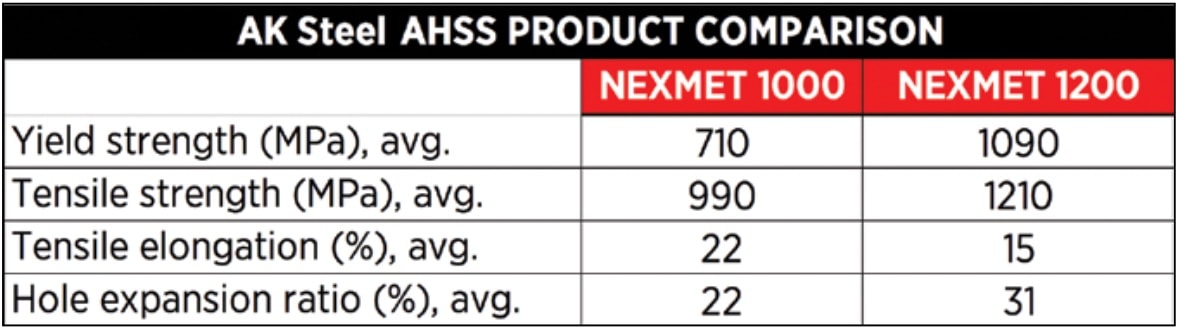
The second Nexmet family, 1000 and 1200, is a 3rd-generation AHSS aimed at body-in-white structural applications. Introduced in 2017, these alloys enable gauge reductions and opportunities for 3G part-geometry changes. Both are currently in customer trials. Last year AK Steel purchased a company called Precision Partners which allows the steel-maker to start stamping its new products before its OEM customers finish their qualifications or run stamping tests.
“We did a front-end study on a pickup truck with Nexmet 440EX as well as the 1000 and 1200, and achieved about a 30 percent weight reduction in the vehicle’s front end — with global formability of the Nexmet 1200 nearly equivalent to a dual-phase 590 AHSS,” Peterson said. He explained that such capabilities create opportunities both in cold stamping and enable customers to take hot-stamped components and make them out of the cold-stamped Nexmet product.
“That provides cost savings and design opportunities,” he said.
Steel gets ‘Smart’
Along with new alloys are what some experts dub ‘hybrid steel’ solutions — steel/plastic laminates — that are also engineered for mass reduction. Material Sciences Corp.’s new Smart Steel will launch on three continents in MY2019 and employs technology similar to that of the company’s Quiet Steel acoustic-focused products that have helped reduce cabin noise by up to 5 dB in a variety of vehicles since 2003.
Quiet Steel features a viscoelastic, 0.02 mm (0.00078 in) polymer sheet sandwiched between two stamped-steel skins. The material is spot-welded into floor pan tunnels, dash panels and other areas of the body-in-white. Micro-level shearing, caused by the panels moving against each other when attenuated, dampen the noise. In addition to its acoustic properties, Quiet Steel also has enabled mass reduction by eliminating various add-on NVH mastics and blankets. MSC engineers leveraged the Quiet Steel laminate technology to create Smart Steel, explained Matt Murphy, VP Engineered Solutions at MSC’s Canton, MI tech center.
“Rather than using a thin, viscoelastic middle-layer as in Quiet Steel, the polymer in Smart Steel is an extruded product,” explained Murphy. “We take four to five polymer components, including one with embedded steel fibers, compound them into our formulation, and extrude rolls of sheet that is about the width of the [steel] coil,” he said. “Then we laminate that sheet between two monolithic metal skins.”
For the body-in-white components, the polymer core of Smart Steel is 0.38 mm (0.015 in), vs. the 0.02 mm core of Quiet Steel (and 0.025 mm in MSC’s Quiet Aluminum). The steel outer sheets are thin and “very formable — basically like a cold-rolled product,” Murphy said.
He explained that Smart Steel was developed for applications to replace monolithic steel “high in the body,” Murphy explained — “close-outs, roof panels, package trays, brackets. It’s not a replacement for the high-tensile martensite or 1180 dual-phase alloys used in cross-car beams, B-pillars or rockers.”
Body-in-white applications are attracting most OEM attention, including high interest in pickup-truck bumpers. “With this product we can take the weight of those big chrome pickup bumpers down from an average 35 pounds today, to 25 pounds.” CAE simulations for offset crash performance are “very favorable,” he said. MSC is also working with forming - simulation software suppliers to develop new techniques to model Smart Steel for springback and other characteristics, correlating the modeling with the first set of production tools.
MSC has been awarded several vehicle programs by the OEM that is launching Smart Steel for MY19. Dies have been built for upper-body parts and the Production Part Approval Process (P-PAPP) is under way, according to Murphy.
“The cool thing about Smart Steel is it will spot-weld into the body with existing welding equipment. That’s the key,” Murphy said. “While the engineering community often thinks of aluminum related to lightweighting, that requires a change in supply chain and joining processes in the body shop. With Smart Steel, you run it through the same dies as with monolithic steel, spot-weld it into the body, run it through e-coat and paint — and save up to 35 percent in mass.”
More From SAE Media Group
Automotive Engineering
Aluminum: Toward 50% Body Content
Automotive Engineering
Steel Stands Tall
Automotive Engineering
Tesla’s Cybertruck Is Audaciously Austenitic
Automotive Engineering
Rethinking Aluminum for NVH Abatement
Automotive Engineering
Lightweight Steel Is Stronger Than Titanium
Automotive Engineering
Lightweight Steel on a (Cold) Roll
Aerospace & Defense Tech Briefs
Evaluation of Additively Manufactured Ultrahard Steels
Automotive Engineering
The Economics of Materials Selection

Automotive Manufacturing and Machining
Aluminum’s Rising Star
Automotive Engineering
Blazer EV Is a Steel-Intensive Showcase

Automotive Engineering
A Step-change in the Cost of CFRP

Medical Design Briefs
What Medical Device OEMs Should Know About Outsourced MIM

Tech Briefs
Using 3D Printing to Strengthen Jet Engines
Medical Design Briefs
Product Focus: Manufacturing/Assembly Equipment

Automotive Engineering
Virtual and Physical Testing of Third-Generation High Strength Steel
Aerospace & Defense Tech Briefs
Testing Military-Grade Adhesive in Extreme Loading Conditions
Aerospace & Defense Tech Briefs
These Speedy Cold Spray Machines Can 3D Print Vehicle Parts in War Zones
Off-Highway Engineering
MELD Exploits Plastic Deformation of Metals with Non-Melt Additive Manufacturing
Tech Briefs
Manufacturing Process for Aluminum Alloys
Automotive Engineering
Aluminum Prepares for Its Next Big Leap

Automotive Engineering
Steel Targets EV Structures, Battery Boxes
NASA Spinoff
Rocket Manufacturing Meets Science Friction
Aerospace & Defense Tech Briefs
Plasma Electrolytic Oxidation: The Future of Lightweight Designs in Aerospace and Defense
Top Stories
INSIDERManufacturing & Prototyping
 How Airbus is Using w-DED to 3D Print Larger Titanium Airplane Parts
INSIDERManned Systems
 FAA to Replace Aging Network of Ground-Based Radars
NewsTransportation
 CES 2026: Bosch is Ready to Bring AI to Your (Likely ICE-powered) Vehicle
NewsSoftware
 Accelerating Down the Road to Autonomy
EditorialDesign
 DarkSky One Wants to Make the World a Darker Place
INSIDERMaterials
 Can This Self-Healing Composite Make Airplane and Spacecraft Components Last...
Webcasts
Defense
 How Sift's Unified Observability Platform Accelerates Drone Innovation
Automotive
 E/E Architecture Redefined: Building Smarter, Safer, and Scalable...
Power
 Hydrogen Engines Are Heating Up for Heavy Duty
Electronics & Computers
 Advantages of Smart Power Distribution Unit Design for Automotive...
Unmanned Systems
 Quiet, Please: NVH Improvement Opportunities in the Early Design...
