




Driving Good Dynamics
How the demands of safety, light weight, ride, and handling can be brought together to create cars of character.

Dave Rollett, Vehicle Dynamics Team Leader at motorsport and engineering consultancy Prodrive, is forthright in his views about car buyers: “Most do not know what good dynamics feel like, yet they form strong opinions about a vehicle based on how the dynamics feel to themselves.”
Because dynamics are a vital part of brand identity creation, getting them right from both engineering and customer standpoints is a must.
“Modern cars rarely suffer from poor chassis dynamics, but they may reach the market with inappropriate dynamics,” Rollett said. “The key for a dynamicist today is to understand how the driver uses dynamic feel to interpret the vehicle brand.”
Brand identity through dynamics is not new, but it is ever more important in a world that is seeing increasing use of multi-role modular chassis designs such as the Volkswagen Group’s MQB modular platform.
A member of that Group is Spanish company SeAT, which has worked to create a “sporting” image based on “character” for its products; it uses the MQB to good effect.
“Here at SEAT, we are Spanish and we are German,” said Executive Vice President for Research and Development, Dr. Matthias Rabe. “Thanks to the flexibility of the MQB, SEAT has developed the Leon family according to its own DNA, target customers, and marketing positioning.”
more modular solutions
Mercedes-Benz also applies modular chassis solutions. These include the MRA (rear-drive architecture), which it uses for the latest C-Class.

It has taken some five years to fully develop the new-generation architecture. The company’s most flexible, it can be tailored for use by many classes of car, said Dr. Michael Krämer, Vice President–Program Management: “We had a very important concept phase with everybody from engineering to marketing discussing the right strategic guidelines. Amg was at the table, too. So the suspension design was decided as a team effort, and our production colleagues were there to work out how we were going to build it.”
The result is a C-Class that provides a comprehensive ride-and-handling solution created to take the C-Class into a new dynamics and quality segment. Air suspension is an option, a claimed “first” in its class, and the driver has a wide selection of chassis response settings including an extra bespoke “Individual” mode.
Said Krämer: “The biggest design challenge was predicting the future; this architecture needs to keep going for many years, so it is flexible — like a tool kit. If drivers have tough days they may wish for light steering and a soft ride to soothe them, but for driving hard it’s a firmer ride and more direct steering that’s wanted. It’s all about choice.”
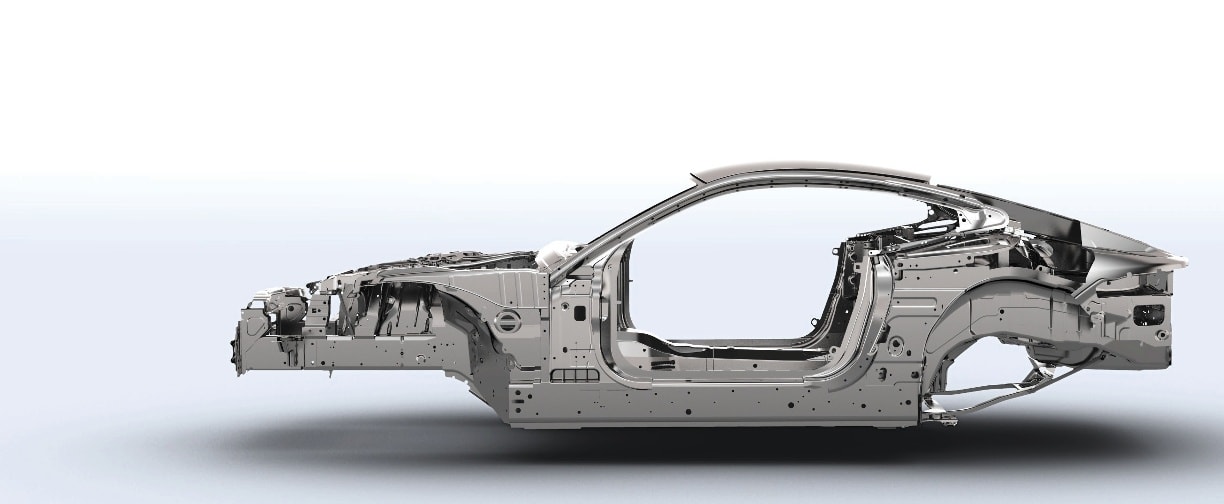
Complementing this is a switch to more intensive use of aluminum for the body structure. The new C-Class body-in-white is some 70 kg (154 lb) lighter than that of the previous generation, and total weight savings on the car reaches 100 kg (220 lb).
Saving 400 kg
The use of aluminum is a “very, very strong contributor” to the enhancement of dynamics, according to Jaguar land Rover (JLR) Engineering Director Dr. Wolfgang Ziebart: “We see that in the Range Rover and in Jaguar sports cars. In the case of the Range Rover we have saved 400 kg; just imagine how the vehicle would drive with close to half a ton onboard!”
But intensive use of aluminum is “to some extent” limited to vehicles occupying the upper end of the market, and he gave no precise indication of the extent of its use for Jaguar’s forth-coming XE midsize (in European terms) premium model. However, it will incorporate JLR’s flexible, D7A modular aluminum architecture, with some use of aluminum for the body. Like other OEMs, JLR is looking at flexible material mixes.
Choosing his words carefully, Ziebart said that with regard to more price-sensitive (high-volume) models, there may be a “soft transition” phase for the material’s use for the “foreseeable future,” particularly with regard to closures.

“The hard transition is when the decision is made to make the whole structure from aluminum,” he said. This brings challenges, especially concerning joining technology, which, like aluminum, does not come cheap: “But we think our riveting and bonding technology is suitable for higher volume, too. In general for bodies, there is more diversity of materials being considered. You can bond and rivet almost any material in terms of material mix within certain boundaries. It makes us much more flexible in terms of which material to use.”
However, he is very cautious about carbon fiber: “We have achieved so much from aluminum that in our opinion the added gain from carbon does not justify it.”
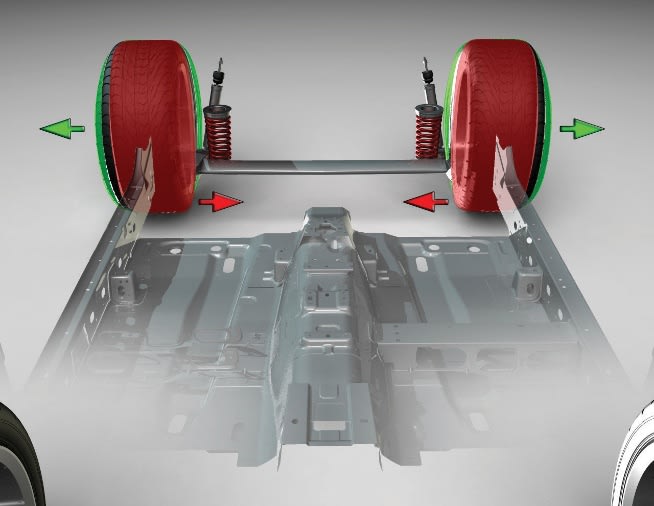
Enhancing dynamics is a subject that is also at the heart of the design and technology ethic of lotus, a brand that has always created cars of character via remarkable dynamics. Matthew Becker, Chief Engineer, Test and Development, cites attachment (or hard-point stiffness) as a key item in its design portfolio.
“To achieve our extremely high levels of vehicle dynamics performance, we require very stiff suspension bushes, although it is critical to keep a good ratio between radial stiffness (high) and torsional/axis stiffness (low),” Becker explained. “High hard point stiffness helps at two levels: firstly, to keep a sufficient level of isolation (function of the rubber stiffness and attachment point stiffness), and secondly, to keep the noise and vibration transfer function levels low: It means that for the same excitation force, we will get lower levels of noise and vibration inside the car.”
ANC aids dynamics
Lotus is also developing Active Noise Control (ANC), Becker said. It helps allow a setup for which the compromise is more oriented toward vehicle dynamics: “This generates higher input forces, but the active system cancels out some of the issues (up to a given frequency range), thus maintaining acceptable levels of refinement,” he explained.
Together with advances in CAE and vehicle simulation, Becker believes ANC is one of the most significant developments in body and chassis engineering in the past five years.
Prodrive’s Rollett agrees: “A customer looking for sports car dynamics may find an uncomfortably stiff setup pleasantly sporting, not knowing that such an extreme ride/handling compromise is not necessary.”
Engineers really cannot let vehicle purchasers have exactly what they think they want, Rollett insists.
“Matching a vehicle’s steering characteristics to buyers’ expectations means satisfying both subjective demands for good ‘feel’ and objective requirements such as linearity of response that could affect safety,” he said. “Many drivers, particularly in North America and China, may prefer low steering effort and interpret steering feedback as a lack of refinement. For safety reasons, good steering feel matters. Achieving this while delighting the driver means very careful management of the frequencies fed back through the steering wheel.”
This is the point where objective and subjective meld.
Strength of character

At JLR — particularly at Jaguar — delighting the driver is also a must, and a team that includes Chief Vehicle Engineer Mike Cross does exactly that, Ziebart shared.
“With a mathematical tool like a simulator you can only develop chassis systems, such as spring and damper settings, so far; eventual settings are always finalized in a subjective way,” Ziebart said. “Mike is an extremely valuable person in our company as he has the feeling for how our models need to respond, and it is not just about things that can be measured but even how the driver is positioned on a seat — he likes to sit as low as possible — that is so important.”
The JLR chassis team’s fundamental vehicle character forming — the “feel” of the car — is complemented by sophisticated body control that does not detract from driver delight, according to Ziebart.
“Many of the systems are switchable and are accepted by both experienced and less experienced driver. But the opportunity for specific preferences is there,” he said.

Increasing torsional body stiffness is a target for all OEMs; at JLR, the new F-type coupe is the ace at 33,000 N·m/° (24,340 lb·ft/°).
“I think we have reached such a level that further improvements will hardly be recognizable by even the most experienced driver,” Ziebart said.
The SEAT Leon was one of the first VW Group cars to be built on the MQB chassis (the others are the Golf and Audi A3), and Rabe also emphasizes the importance of torsional stiffness to help give a high-volume, practical hatchback model the character and sportiness that the brand is projecting.
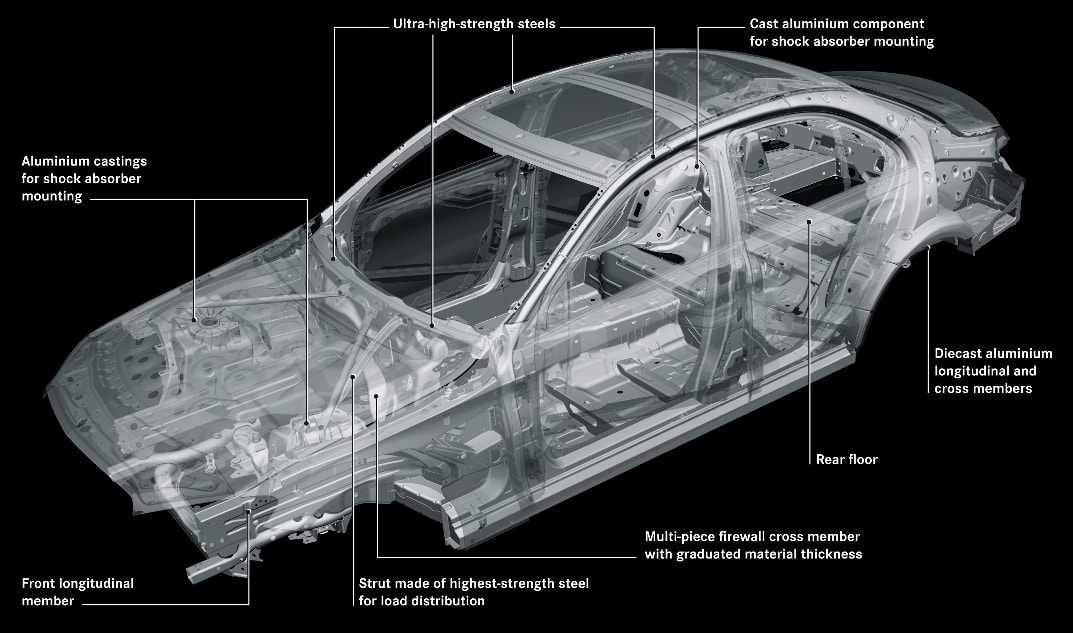
“Early identification of load paths via simulation in the concept phase led among other things to the definition of the torsion ring concept at the rear of the vehicle, improving torsional stiffness — both static and dynamic — while allowing a really good relationship between weight (the car is 90 kg lighter than the previous Leon) and stiffness,” Rabe said. “The driving dynamic is strongly influenced by the design of the body structure; in this area, energy input points are identified in order to improve local stiffness and therefore handling of the car.”
Hot-formed ultra-high-strength steels with a yield strength of more than 1000 MPa (145 ksi) are crucial in some areas of the Leon’s body (including A- and B-pillars and central tunnel) to save weight and also provide a good EuroNCAP safety rating for the car.
More power, more dynamic efficiency

Rabe aims to see future SEATs continuing to meet the essential criteria of greater efficiency in terms of fuel consumption and emissions: “But they still have to get more powerful and dynamic, and this can be achieved mainly through further light-weight construction.”
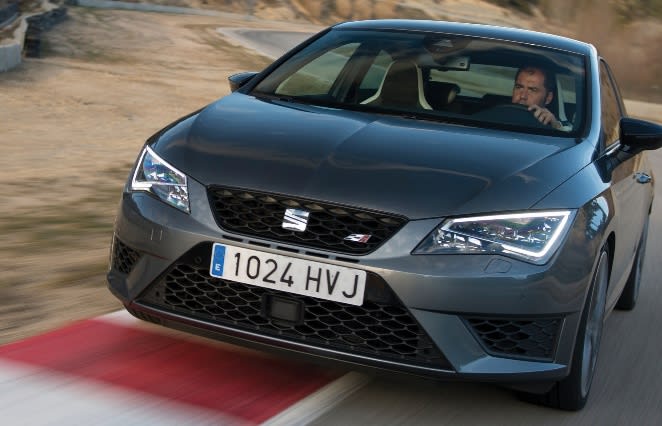
“Powerful” and “dynamic” are apposite adjectives applied to the new high-performance Leon Cupra, which uses torque vectoring to help get its 206 kW (276 hp) controllably and safely onto the road (or track) surface.
It is a technology that Prodrive’s Rollett sees as becoming an increasingly major asset for chassis capability.
“It helps us align the feel of the car with the expectations that the customer has of a brand,” he explained. “Because we can do so much in software, it allows lower-cost regional calibrations or brand-specific calibrations, on shared platforms. The same is true of Prodrive’s ATC (Active Toe Control) developed to allow a low-cost rear suspension to deliver the benefits of sophisticated multilink arrangements.”
By controlling rear-wheel alignment electrically, ATC permits different models derived from the same platform to be set up with individual handling characteristics simply by changing the control calibrations, allowing optimization for different markets without hardware changes.
individual wheel motors

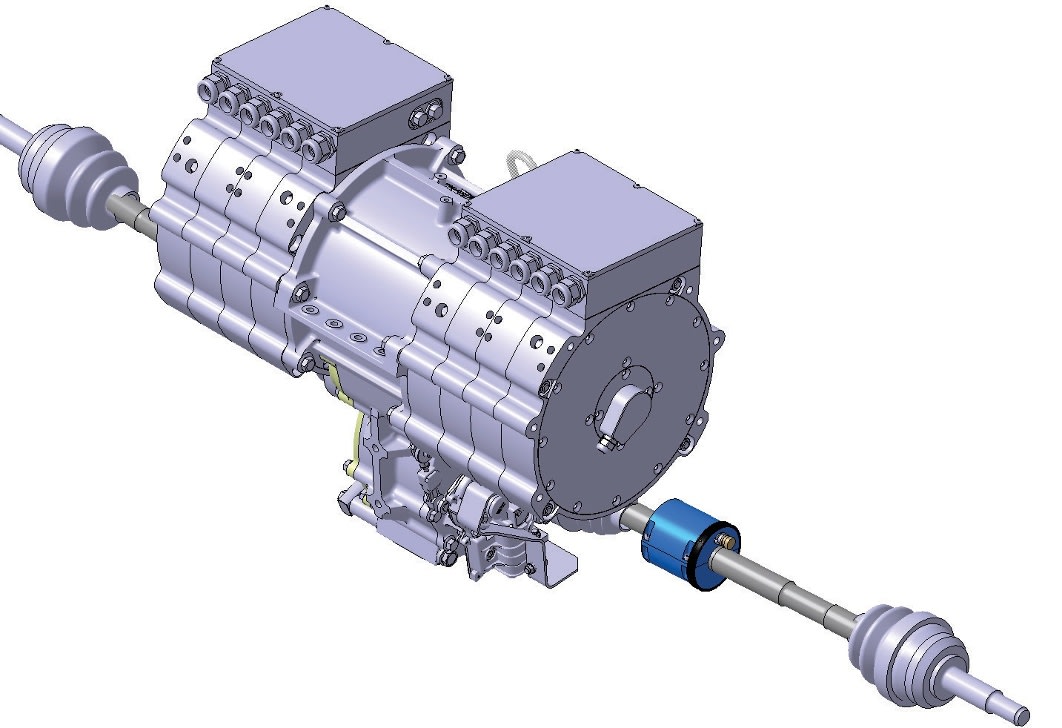
The advent of electric (and hybrid) vehicles that typically exhibit increased mass and inertia, which reduce agility and transient stability, open several possible avenues of body and chassis development to improve dynamics, including the use of individual wheel motors, which offer the opportunity to actively control torque distribution across an axle, producing a yaw moment that can in effect steer the vehicle independently to driver input.
Lotus has developed such a system for its 414E technology demonstrator, according to the company’s Steve Williams, Manager, Vehicle Dynamics CAE.
“With individual wheel drive motors, the torque vectoring authority is much higher than with an active differential or single wheel brake intervention,” Williams said.
The 414E provides up to 920 N·m (679 lb·ft) of drive or braking torque to each rear wheel independently: “This brings the benefits of increased agility combined with increased stability through damping of the oscillatory yaw behavior that would result from improving agility through passive means,” he explained.
It is a whole new ball game for a customer’s perception of dynamics.
More From SAE Media Group
Automotive Engineering
A Rebel’s Guide to Chassis Engineering
Automotive Engineering
2026 Nissan Sentra Review: Putting the Pieces Together
Automotive Engineering
Ford Approved for Hands-Off Driving on German Autobahn
Green Design & Manufacturing
MUTE: The Efficient City Car
Off-Highway Engineering
Electrification’s Impact on Commercial-Vehicle Chassis Design
Automotive Engineering
ZF's CEO Talks About Lightweight Vehicle Applications
Automotive Engineering
Gearing Up Drive Axle Innovations
Off-Highway Engineering
ZM Trucks Starts Production in Fontana, California
Automotive Engineering
Suppliers Struggling to Keep Pace with Faster Product Cycles, Says IHS
Off-Highway Engineering
REE’s P7 Brings Advanced Suspension Control to Medium-Duty Trucks
Automotive Engineering
LEAF Turns to the 2020s
Automotive Engineering
Next-gen Nsx: A Twin-turbo, Multi-material Ferrari-fighter
Automotive Engineering
Toyota Stretches SUV Line-Up with World Debut of Grand Highlander
Automotive Engineering
2026 Nissan Leaf First Drive: Fun and More Efficient
Off-Highway Engineering
First Drive: Drifting in the Electric 2027 Mercedes GLC 400
Automotive Engineering
Lotus Breaks out with New Eletre Electric SUV
Automotive Engineering
Lighter, More Powerful 3rd-Gen Pilot Debuts Honda’s NPD Process
Automotive Engineering
Volvo’s Polestar Powerhouse Plug-In Hybrid
Autonomous Vehicle Engineering
AV Powers Bring May Flowers
Autonomous Vehicle Engineering
Volvo Leads the Shift to ‘Driver Understanding’
Automotive Engineering
Stability Control Boosts Motorcycle Safety
Power Electronics INSIDER
World’s Strongest Battery Paves Way for Light, Energy-Efficient Vehicles
Automotive Engineering
First Drive: 2027 Mercedes-Benz CLA Hybrid
Automotive Engineering
Making over the World’s Leading Hybrid
Automotive Engineering
Balancing the Scales in Dakar

Automotive Engineering
Jaguar Reveals Long-Awaited Clean-Sheet Entry-Level XE
Automotive Engineering
See-Through A-Pillars, Ghost Navigation, and Discovery Sport Extreme Testing
Automotive Engineering
Mercedes-Benz Debuts 'Car of the Future' at CES
Top Stories
INSIDERManufacturing & Prototyping
 How Airbus is Using w-DED to 3D Print Larger Titanium Airplane Parts
INSIDERManned Systems
 FAA to Replace Aging Network of Ground-Based Radars
NewsTransportation
 CES 2026: Bosch is Ready to Bring AI to Your (Likely ICE-powered) Vehicle
NewsSoftware
 Accelerating Down the Road to Autonomy
EditorialDesign
 DarkSky One Wants to Make the World a Darker Place
INSIDERMaterials
 Can This Self-Healing Composite Make Airplane and Spacecraft Components Last...
Webcasts
Defense
 How Sift's Unified Observability Platform Accelerates Drone Innovation
Automotive
 E/E Architecture Redefined: Building Smarter, Safer, and Scalable...
Power
 Hydrogen Engines Are Heating Up for Heavy Duty
Electronics & Computers
 Advantages of Smart Power Distribution Unit Design for Automotive...
Unmanned Systems
 Quiet, Please: NVH Improvement Opportunities in the Early Design...
