




Next-gen Nsx: A Twin-turbo, Multi-material Ferrari-fighter
The 2016 production NSX made its much-awaited global debut at NAIAS in January. More technical details of Acura’s mid-engine AWD hybrid supercar will be shared by Honda R&D experts at the SAE 2015 World Congress.
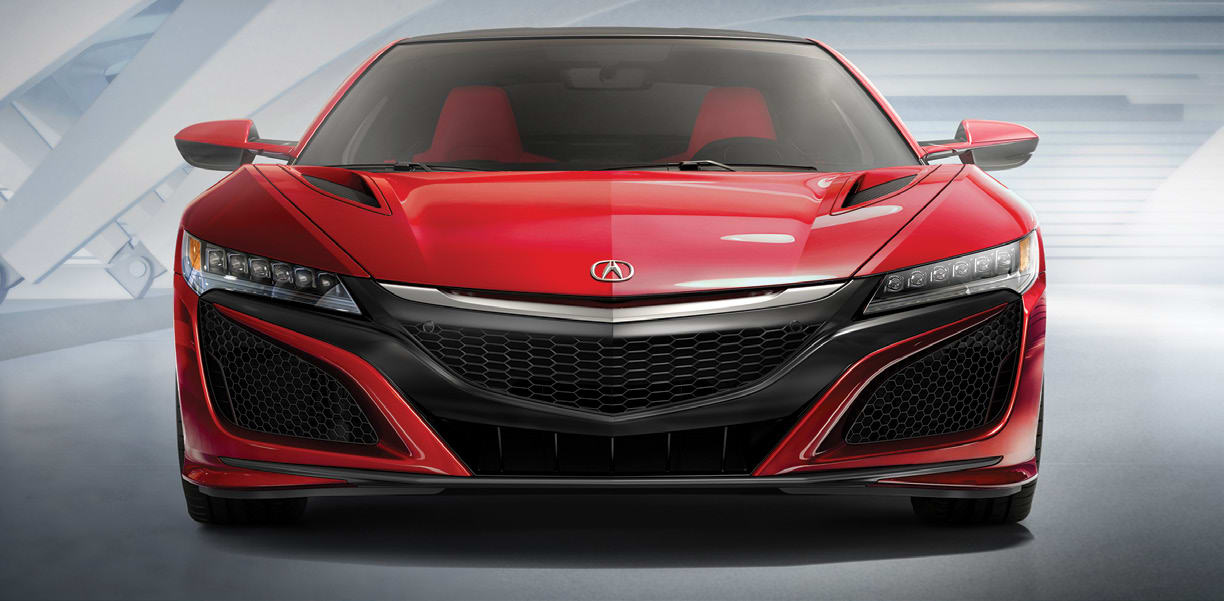
Three years removed from its concept-design debut, the Acura NSX supercar took to the 2015 North American International Auto Show (NAIAS) stage once more, this time in its production form. While recognizable as that concept’s progeny, the next-generation 2016 NSX revealed this January in Detroit has evolved over its 36-month development program.
The Ohio-based, American-led R&D team for the new NSX, with Ted Klaus, Chief Engineer and Global Development Leader, at the helm, has made design and engineering decisions both big and small — but none insignificant — every step of the way.
Perhaps the biggest of these decisions, inevitably making exterior design changes necessary as well, was to abandon the initially planned naturally aspirated V6 engine for a power plant with more “growl.” Which is something the new $150,000+ supercar will need plenty of to compete against what Klaus considers its key competitors: the Porsche 911 Turbo, Audi R8 V10, and “looking up toward” the Ferrari 458 Italia.

Revising the powertrain on the fly
“Some of you may recall [the] blue NSX Concept that lapped Mid-Ohio before the start of the Indy Car race in August of 2013. This prototype was powered by a transverse-mounted, normally aspirated V6. It was a good powertrain, but for NSX good is not good enough,” Klaus explained after the production NSX rolled onto the Detroit stage.
“So, in the middle of development, we made a bold decision to create an all-new longitudinally mounted, twin-turbocharged V6. Changing the powertrain design and layout was not an easy task — it was like undergoing a heart transplant while running a marathon. But 10 seconds behind the wheel, and you will understand how this new power unit is one of the keys to delivering a ‘new sports experience.’”

The mid-mounted, 75° DOHC V6 engine (Klaus would not reveal the displacement) employs a “race-inspired” compact valvetrain and dry-sump lubrication system to help lower the center of gravity. It is paired with a new nine-speed dual clutch transmission (DCT) “of our own design,” stated Klaus. The unit houses an electric motor that helps directly drive the rear wheels, to support acceleration, braking, and transmission shifting performance. Twin electric motors in front provide instantaneous torque delivery and dynamic torque vectoring. The Sport Hybrid system is said to generate “north of 550 hp.”
“It will run on electric alone for short periods of time,” said Klaus. “It is not a heavy plug-in hybrid...We have just the right amount of electric capacity to support the driver when they’re demanding it but also to quickly recover energy from the brakes. It’s a very lightweight, high-performance [system] — much closer to an F1 type.”

While vehicle development was led by Honda R&D Americas, engineering of the sport-hybrid power unit was executed in Japan, Klaus shared. “We were interdependent; we’re a global team,” he said. “The engine will be built in America at Anna [Ohio]. It’s all about leveraging our global capabilities — certainly in Japan, in Europe just refining the product, and in America, we’ve integrated everything. And also working with our global suppliers and bringing on new suppliers.” (Supplier information will be released at a later date, Klaus said.)
Key powertrain components including the Sport Hybrid battery pack and power control unit were optimally placed to concentrate vehicle mass low and toward the center of the vehicle.
“The combination of its lightweight chassis and low-mounted Sport Hybrid power unit, give the NSX the lowest center of gravity in its class,” Klaus claims.
The NSX features a fully independent, all-aluminum front and rear suspension, riding on Continental ContiSportContact high-performance tires — 245/35Z R19 front and 295/30Z R20 rear — with 19-x 8.5-in front and 20-x 11-in rear aluminum alloy wheels. Six-piston front and four-piston rear monoblock calipers and carbon-ceramic brake discs bring the supercar to a stop.
Sport Hybrid Super-Handling All Wheel Drive (Sport Hybrid SH-AWD) enhances stability, control, and launch performance while providing quicker response to driver inputs for steering, braking, and throttle. Agile Handling Assist (AHA) subtly applies brake torque to further enhance yaw response and dynamic stability.
The NSX’s dial-operated Integrated Dynamic System (IDS) features four modes — Quiet, Sport, Sport+, and Track — plus a “launch” function. The system adjusts engine, motor, transmission, and chassis response accordingly, as well as the engine sound level. Quiet mode enables electric-only driving at lower speeds. Dynamic vehicle responses become “increasingly sharp” moving from Sport to Sport+ to Track.
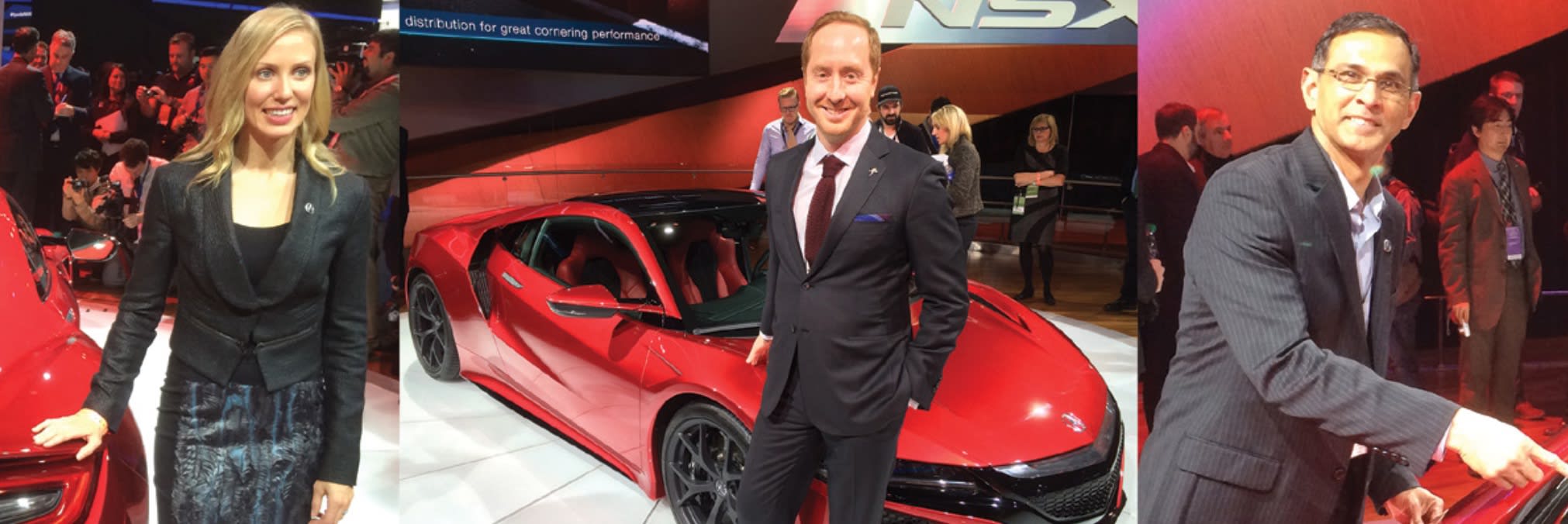
“These guys are real time developing the car,” Michelle Christensen, NSX Exterior Design Project Leader, said at NAIAS in January. “We’re still taking it on the track, but can get rid of that camo a little bit now.”
Aerodynamic sans active elements
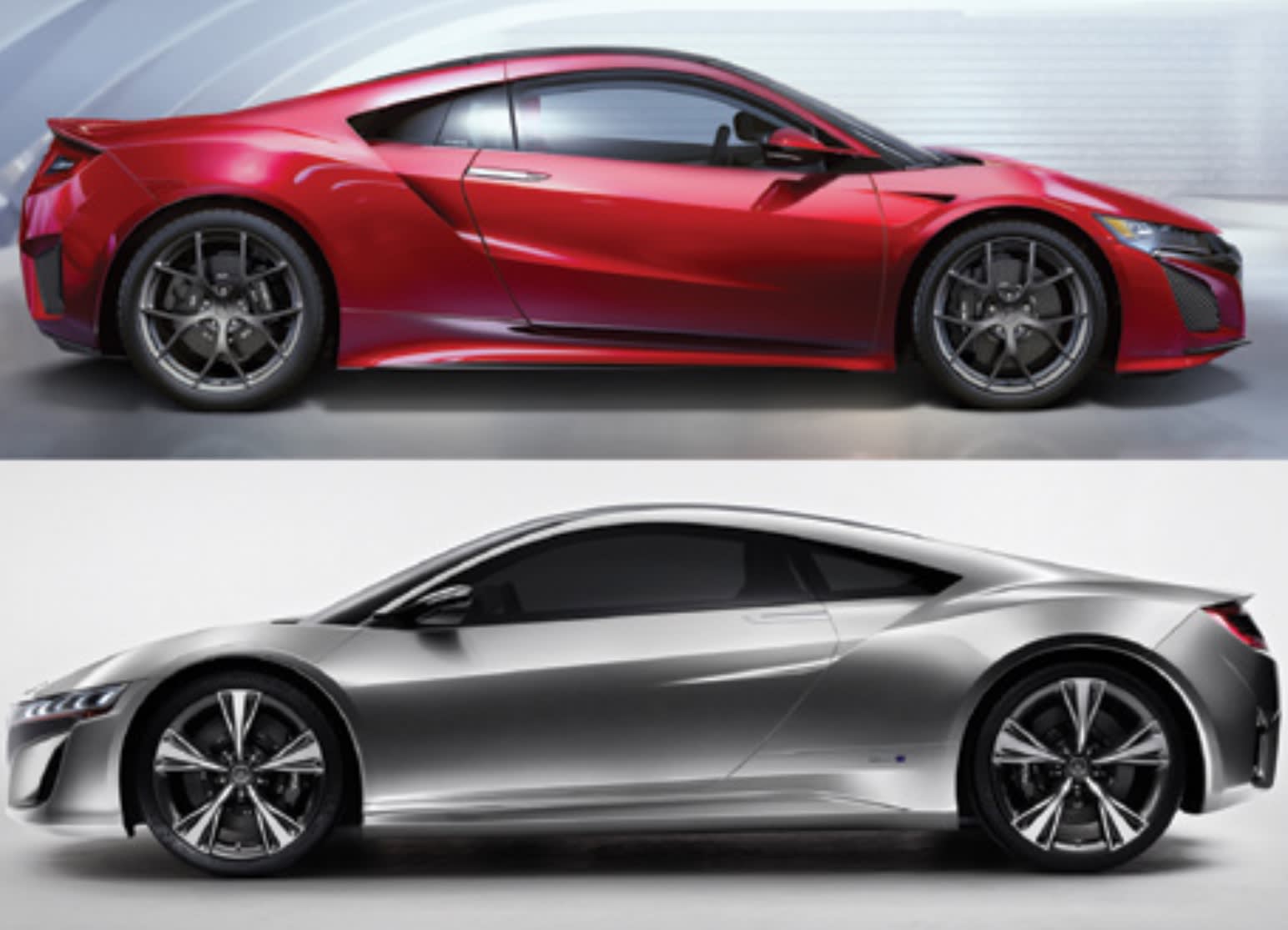
To accommodate the new longitudinally mounted twin-turbo V6 and nine-speed DCT, the production NSX is longer — by 3.2 in (80 mm) — and wider — by 1 in (25 mm) — than the NSX Concept shown in 2012. (See table for dimensions comparison between new NSX, the concept, and 2005 NSX.)
A slightly more cab-forward package also stems from the powertrain change, according to Christensen, who is based in the Torrance, CA, Acura design studio.

“Closely. Daily,” Christensen said when asked how closely she worked with engineering on the exterior design of the vehicle. “I’m in the Torrance office and our engineers are in Ohio, but [we had] daily communication and I would fly out to Ohio for a week at a time.”
The exterior body design was sculpted with “total airflow management” in mind, for optimum downforce and vehicle systems cooling — all with no active aerodynamic elements “because we wanted it to be pure and not add any extra gear and weight that we didn’t really need,” Christensen said. She gave Automotive Engineering a vehicle walk-around on the Detroit show floor, pointing out the many aero features and design changes.
“Compared to the 2012 show car, the biggest difference on the exterior is all the cooling and airflow elements. So that’s really the pivotal styling change for us,” she said. “When we changed from the transverse engine that we had earlier to the longitudinal twin-turbo, obviously now we need a lot more air intake. And as much air that’s going in we need that to go out, so we took it to the wind tunnel [in Raymond, OH] and started exploring.”
The NSX has three radiators in the front. Explaining the modifications made to the hood vents from concept to final body design, Christensen said, “They were further back on the original show car, and by doubling the size and pulling them forward, we were able to strategically get the air to land on the windshield and provide downforce; downforce is obviously critical for this car.”
Other significant changes to the production car include new front fender vents, modified side air intakes, and an optimized deck spoiler.
“In the wind tunnel, we have a string test — it’s kind of like the paint blot test, where you can see the direction of the airflow,” Christensen said, discussing the efficacy of the fender vents. “We stuck the string in the wheel well just to make sure it was in fact exiting out that side vent. As we put the string in there, it kind of wiggled its way out of that vent, stuck down the body side, and shot right into the side intake, which is awesome — that’s right where we need all the air to go at high velocity.”
The side intake and floating C-pillar collect air to feed the intercoolers and mid-mounted engine, and direct airflow over the rear deck to increase downforce.
“As the air comes out onto the decklid, it meets up with the air coming off the roof,” she continued at the rear of the car. “So we were getting a lot of lift back here. We extended the spoiler a great deal from the original show car, and we also adjusted all these surfaces on the decklid to help guide the air; we had slightly different surfacing before.” A small vent was also added to duct air out of the wheel well to reduce lift.

“This whole relationship is creating a lot of downforce, with the diffuser and the air coming out of the rear. It’s all a very delicate balance,” Christensen said. “All the updates that we did in the wind tunnel, I think it changed the styling for the better, made it a little more aggressive, more exotic.”
An interior that ‘disappears’
While the exterior surely will attract attention, the interior of the new NSX — with its “human support cockpit” design theme — is meant to not be noticed. “We didn’t want to create a glitzy, elaborate interior. We wanted to make sure that the interior almost disappeared when you drove,” John Norman, NSX Interior Design Project Leader, shared with Automotive Engineering.
“I had this excellent experience when we did the original ride-and-drive for the car during the development,” he continued. “We had all of our competitors; we had a Lamborghini there, a Ferrari, Porsche, the Nissan GT-R, a [Chevrolet] Corvette, we had all these fantastic cars. But we also had an original NSX to drive. Now while the performance benchmark had gotten much more modern and much faster, I read about driving the original NSX, how it was like the invisible car, and I actually experienced that. We were driving through the canyon roads of Malibu and I had this transcendent driving experience where everything just went away, the car went away, and it was just me and the road. And I said, ‘Wow! We really need to keep this [with the next-gen NSX].’”
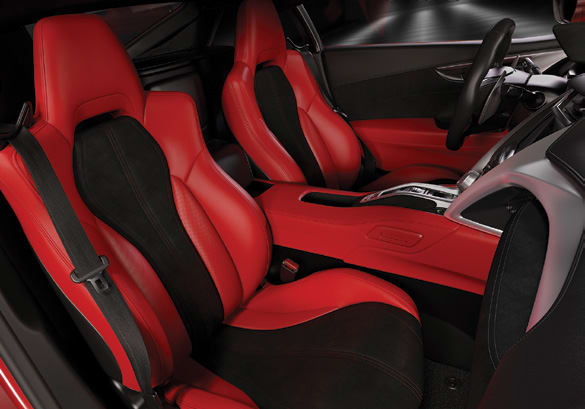
To that end, designers focused on providing great forward visibility; simple, intuitive controls; and “class-leading” ergonomics — most notably with the seats, which feature “top-class” holding performance thanks to suede inserts and offer easy ingress/egress.
“We really focused on pushing the IP [instrument panel] down as low as we could, making the pillars as thin as possible, prioritizing outward visibility. Even though it’s a very low, wide, very sexy car, when you sit in it, it doesn’t feel completely like you’re inside the space shuttle or some really compromised seating position.”
The NSX’s instrument cluster features a dynamic thin-film-transistor display that responds to changes in the driver-selectable IDS with pertinent graphics and information. The Power button resides in the center of the new IDS dial control.
“The interface is relatively straightforward,” Norman said. “In some of our other Acura cars we have the high screen, but from a package standpoint we wanted to really prioritize outward visibility, so we have a low-mounted touchscreen. Also on our current cars, the IDS control function is just a small button behind the shifter that you cycle through the modes; this one, we turned it into this large rotary knob and placed it kind of high in the center panel...We made it big enough that it can function at track speed — you can just grab it with a gloved hand and select your mode.”
Below the handcrafted leather dash panel is an exposed mid-frame — a functioning chassis structural member — made of a structural polymer with metal plating, according to Norman. “We didn’t want to put some giant metal casting in there; that’d just be ridiculous [in terms of weight],” he said, noting that parts consolidation and weight reduction were major goals of the interior development program.
Manufacturing — a materials technology-enabler
After stating that there “absolutely” will be a right-hand-drive version of the NSX since it’s a global project, Klaus gave a “shout-out” to the new Performance Manufacturing Center (PMC) in Marysville, OH, where the supercar will be exclusively manufactured, as well as to the man leading the creation of the plant, Clement DeSouza.
“We would not have been able to deliver this product without this new factory,” Klaus said. “To achieve that styling, to achieve our performance, the story of the factory enabling new technologies is a very exciting [one].”
The multi-material chassis comprises an aluminum-intensive space frame complemented by the “strategic use” of ultra-high-strength steel (UHSS) and carbon fiber. UHSS is used for the thin A-pillar, which is a continuous member, while carbon fiber is placed at the central floor, “close to the spine of the car,” Klaus said, to enhance torsional and bending stiffness.
“I know ultra-high-strength steel maybe isn’t as sexy as carbon fiber or aluminum, but if it’s the most effective way to meet your overall design concept, that’s what you should be doing,” said Klaus. “[Plus] it’s lighter than if we tried to use aluminum [for the A-pillar] and it’s not as strong but way more robust than using carbon fiber.”
Body panels are composed of aluminum and sheet molding composite.
The NSX features “world-first” casting technology that combines the design and manufacturing flexibility of a casting process with the strength and elongation properties of a forged material, enabling significant weight reduction, according to DeSouza.
“One of the big reasons we picked Ohio [for manufacturing] was because of proximity to R&D and our ability to work with them on a daily basis to realize this model,” he told Automotive Engineering. Development of the casting technology provides “one of our biggest material differences and also biggest challenges on this project.”
The casting is employed for aluminum frame parts, but the process will be carried out at the Anna engine plant. “We had to leverage our casting experience at Anna engine, so we decided to do it there,” DeSouza shared.
SAE technical paper 2015-01-0512, “Cast body nodes for 2016 NSX,” will be presented as part of the “Advances in Lightweight Materials” session on April 22 at the SAE World Congress in Detroit (see sidebar). The paper details ablation casting, described as “an emerging technology which combines traditional sand molding techniques with rapid cooling due to the use of a water soluble binder.” Six different body node castings have been manufactured for the aluminum space frame using ablation. These castings are integrated into the crash structure.
Full body construction, paint, and final assembly will be conducted at PMC, where about 100 associates will help support and perform those tasks. And DeSouza notes that it’s not your typical small-volume operation.
“It’s a blend of craftsmanship and technology,” he explained. “Usually when you go to a small-volume facility, you see a lot of hands-on work, but...keeping quality in mind and the demands of this vehicle, we realized we could use technology. Looking at each process and determining, ‘Do we have a robot do it or have a person do it?’ — that was our big driver in figuring out what we would devise.”
The body shop is one area that benefits from the deployment of technology. “If you look at most of the other supercars, a lot of them are hand-MIG welded, but we’re going to 100% robotic welding for the body,” DeSouza said. “That helps guarantee the quality, the heat distribution, the accuracy of the body, and torsional rigidity. [With] aluminum, the biggest challenge is heat distortion...It gives us so much more flexibility by using a robot.”
The company will begin accepting custom orders for the new NSX starting this summer. “There will be more than one spec because we know this customer wants to be able to configure, customize, and build their own vehicle,” said Mike Accavitti, Senior Vice President and General Manager, Acura Division.
Klaus acknowledges that the supply-and-demand equation may cause some disappointment. “We are conscious that allocating the products globally is going to be a challenge,” he said. “Especially if we choose to not satisfy demand...We have not given production figures and will not, but there is only so much we can do.”
Production is expected to commence at PMC in the fall, with first deliveries planned for later in the year. Klaus and his team are quite certain those customers driving away in the new NSX will not be disappointed.
More From SAE Media Group
Automotive Engineering
5 More HP for 2026 Kia Sportage: First Drive
Automotive Engineering
2016 Mazda MX-5 Stays True to Its Roots
Automotive Engineering
2026 Nissan Sentra Review: Putting the Pieces Together
Automotive Engineering
Audi TT Quattro Sport
Automotive Engineering
A Rebel’s Guide to Chassis Engineering
Automotive Engineering
Chevrolet Ups the Performance Ante with MY2015 Corvette Z06
Automotive Engineering
Sportier TLX All About Proportion and Performance
Automotive Engineering
Toyota Stretches SUV Line-Up with World Debut of Grand Highlander
Automotive Engineering
2021 Toyota Supra 2.0
Automotive Engineering
Porsche Ties Sportscar Label to Its New Macan SUV
Automotive Engineering
Audi Unveils New R8 and All-Electric E-Tron Version
Automotive Engineering
Mercedes-Benz Applies Full Sport to GLA
Automotive Engineering
Alfa Romeo Finally Returns to U.S. with 4C
Automotive Engineering
Lexus Previews 2018 LC 500 Luxury Coupe
Automotive Engineering
Designing for Downforce
Automotive Engineering
Volvo Concept Estate Shows Clues for New XC90
Automotive Engineering
Lighter, More Powerful 3rd-Gen Pilot Debuts Honda’s NPD Process
Automotive Engineering
Mercedes-Benz Debuts 'Car of the Future' at CES
Automotive Engineering
BMW Lightens 7 Series, but Bulks up on Tech
Automotive Engineering
Driving Good Dynamics
Automotive Engineering
EXP 10 Speed 6 Could Preview Sportier Two Seater
Automotive Engineering
2015 GT350 Mustang Aimed at Track-Day Dominance
Automotive Engineering
Dodge Charges Ahead with SRT Hellcat
Automotive Engineering
First Drive: 2027 Mercedes-Benz CLA Hybrid
Automotive Engineering
Supercar Concept Previews Lamborghini Plug-In Possibilities
Automotive Engineering
Lamborghini Huracan LP 610-4
Automotive Engineering
2023 Cadillac Lyriq Executive Chief Engineer: New EV Her ‘North Star’
Automotive Engineering
Mercedes Boosts Off-Road Prowess of 2019 G-Wagen
Automotive Engineering
Audi's New Compact Q2 Blends 3-Cylinder Efficiency, Agile Chassis
Automotive Engineering
Faster, Lighter: Lotus Reveals Its Quickest Road Car Yet
Top Stories
INSIDERManufacturing & Prototyping
 How Airbus is Using w-DED to 3D Print Larger Titanium Airplane Parts
INSIDERManned Systems
 FAA to Replace Aging Network of Ground-Based Radars
NewsTransportation
 CES 2026: Bosch is Ready to Bring AI to Your (Likely ICE-powered) Vehicle
NewsSoftware
 Accelerating Down the Road to Autonomy
EditorialDesign
 DarkSky One Wants to Make the World a Darker Place
INSIDERMaterials
 Can This Self-Healing Composite Make Airplane and Spacecraft Components Last...
Webcasts
Defense
 How Sift's Unified Observability Platform Accelerates Drone Innovation
Automotive
 E/E Architecture Redefined: Building Smarter, Safer, and Scalable...
Power
 Hydrogen Engines Are Heating Up for Heavy Duty
Electronics & Computers
 Advantages of Smart Power Distribution Unit Design for Automotive...
Unmanned Systems
 Quiet, Please: NVH Improvement Opportunities in the Early Design...
