




Other Expert Voices

Noted industry experts in Powertrain technologies shared their views on future propulsion trends during SAE’s 2019 WCX panel, “Still Not Dead: The ICE’s Continued Evolution,” moderated by Editor-in-Chief Lindsay Brooke. Some of those insights included:
Dr. Uwe Grebe, executive VP, AVL: “Fuels have a significant role to play. I think there’s potential to leverage greater efficiency in going to a higher octane number. Then there is discussion of the right utilization of renewables. I think going to synthetic fuels that are based on renewable energy is what we need to promote, because it takes the internal combustion engine out of the CO2 equation.”
Scott Bailey, president and CEO Tula Technology: “The march to an electrified future absolutely has to include clean, efficient, ideally low-cost internal combustion engines—simply because now we have to start combining technologies in order to get the maximum environmental benefit. There’s going to be roughly 2 billion more internal combustion engines produced between now and 2045. It’s an obligation to make them as efficient as we can. Whatever we can do in less complexity and less cost is going to favor some technologies over others. Who the winners will be is still TBD.”
Peter Davies, senior director powertrain, Honeywell Transportation Systems: “Collaboration between the internal combustion engine and the electrification side of the vehicle opens up a huge wealth of opportunities for us to optimize the ICE in new ways. Today with a modern gasoline engine, you can see a BSFC point of 225 grams per kilowatt hour. This is with a Miller cycle; the turbo-charger being the enabler for advanced combustion. It’s providing the boundary conditions and ultimately to provide the oxygen for the fuel. Our job has shifted from just make it a little bit better, to consider it at the system level—and get combustion at 225 grams—and maybe even to lean combustion down into the 190s and 180s. If we’re successful in providing the right boost and boundary conditions for this type of combustion, a vehicle becomes 5% more fuel economic — maybe even more than that.”
Fabien Redon, executive VP and CTO, Achates Power: “What’s important is to really consider the total equation — the life cycle of carbon emissions. So, when you optimize the engine in conjunction with the fuel, then you need to find a solution that ultimately has the highest efficiency and uses a fuel that has the lowest CO2 footprint. One of the challenges that I see happening in the industry is [spark-ignited] ICE engines, by definition, don’t have the same efficiency potential as compression-ignition engines. If the ICE engine, as it is today, requires a fuel that is a higher octane to re extract higher efficiency—but that fuel actually has a higher CO2 footprint — then is that truly the right equation for the whole equation, the full life cycle analysis? These are things we need to take into consideration.”
More From SAE Media Group
Automotive Engineering
Not dead yet: The resilient ICE looks to 2050
Off-Highway Engineering
Hydrogen Generates BUZZ in Power Generation
Off-Highway Engineering
Danfoss and Sany Extend Electrification of Off-Highway Machines
Off-Highway Engineering
The Future of Carbon-Neutral Fuels for Heavy-Duty Machines
Automotive Engineering
In Support of Diesel’s Future
Off-Highway Engineering
Hexagon Bullish on CNG for Long-Haul Trucks

Off-Highway Engineering
Solving Problems and Seeking Big Ideas for Commercial Vehicles
Tech Briefs
High-Power Direct Borohydride Fuel Cells
Off-Highway Engineering
Hyundai CE Debuts Hydrogen and Electric Excavators at Bauma 2022
Off-Highway Engineering
FEV Simplifies Off-Highway Electrification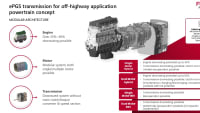
Off-Highway Engineering
Alternative Fuels Overshadowed in EV Era
Automotive Engineering
Propulsion Tech Tops SAE WCX 2021 Papers and Presentations
Automotive Engineering
The Inside Story on Thermal Management
Tech Briefs
When to Expect a Hydrogen Fuel Cell Truck
Automotive Engineering
The International Fight over EFuels, Internal Combustion’s Would-Be Savior
Automotive Engineering
Future ICEs: What Comes After 2025?
Off-Highway Engineering
Iveco Pursues Natural Gas in Stralis NP Models
Off-Highway Engineering
Hydrogen ICE Is Heating Up
Off-Highway Engineering
Off-Highway Emissions Set to Get Stricter
Off-Highway Engineering
Bosch Sees Two Paths Forward for On-Road Hydrogen Trucks
Tech Briefs
Making Diesel Engines Nearly Emission-Free
Automotive Engineering
New Aramco Research Center in Detroit to Advance Fuels and Engine Development
Battery & Electrification Technology
Hydropower Technology Swaps Dams with Electric Trucks
Off-Highway Engineering
Combustion Engines Carry on in Construction
Off-Highway Engineering
Many ICE Paths Lead to Reduced Emissions
Automotive Engineering
Flywheel Hybrids Offer New Efficiency Potential
Off-Highway Engineering
SuperTruck REDUX
Off-Highway Engineering
Developing Next-Gen Diesels to Last Decades
Off-Highway Engineering
Designs on a Diverse Powertrain Future
Top Stories
INSIDERManufacturing & Prototyping
 How Airbus is Using w-DED to 3D Print Larger Titanium Airplane Parts
INSIDERManned Systems
 FAA to Replace Aging Network of Ground-Based Radars
NewsTransportation
 CES 2026: Bosch is Ready to Bring AI to Your (Likely ICE-powered) Vehicle
NewsSoftware
 Accelerating Down the Road to Autonomy
EditorialDesign
 DarkSky One Wants to Make the World a Darker Place
INSIDERMaterials
 Can This Self-Healing Composite Make Airplane and Spacecraft Components Last...
Webcasts
Defense
 How Sift's Unified Observability Platform Accelerates Drone Innovation
Automotive
 E/E Architecture Redefined: Building Smarter, Safer, and Scalable...
Power
 Hydrogen Engines Are Heating Up for Heavy Duty
Electronics & Computers
 Advantages of Smart Power Distribution Unit Design for Automotive...
Unmanned Systems
 Quiet, Please: NVH Improvement Opportunities in the Early Design...
