




Watching for Ways to Stand ABOVE THE CROWD
Sensors monitor a broad range of parameters to help powertrain design teams add features and improve performance.

Whether design teams are responding to the demand for more features and functions or meeting regulatory requirements, they’re using sensors to link digital controls to the analog world. Sensor counts are growing, though engineers are also honing strategies that let them displace components by using virtual sensing.
The factors driving growth vary widely. The availability of inexpensive natural gas, EPA Tier requirements, and a need for more diagnostics are some of the major factors.
“The counts have been going up since the beginning of full-authority electronic diesel engines over 25 years ago,” said Matthew Schneider, Chief Engineer and Chief Architect for Sensors at Cummins. “As the greenhouse gas regulations and the OBD requirements continue to develop, there will be a need for more inputs for different parameters of the engine or aftertreatment system. The addition of electronic aftertreatment systems has nearly doubled the sensor count.”
Regulatory requirements have been a compelling force behind the transportation industry’s adoption of electronic controls that help reduce fuel consumption and emissions. As engineers learn more about how the sensors and digital controls work together, they’re always looking for ways to trim component costs.

“The sensor count curve trends upward over time largely as a result of new regulations,” said Travis Anderson, Chief Engineer, Diesel Control Systems, at IAV Automotive Engineering. “But the curve does not necessarily increase monotonically. As we find better ways of doing things, occasionally that means some sensors can be eliminated. One example is the removal of DPFs. That eliminates the need for a differential pressure sensor, exhaust temperature sensor, and hydrocarbon dosing system sensors.”
Though reducing component counts is always a goal, many developers feel that sensors often bring benefits that outweigh the costs. Electronic features are often solid differentiators in the marketplace.
“Adding additional sensors and incorporating control and monitoring functionalities within existing machine controls adds little cost or complexity to the system, while providing significant benefits that machine end users are now demanding for greater efficiency and lowered maintenance costs,” said Michael Olson, Danfoss Power Solutions Electronic Components Engineering Manager.
Adding features
Equipment makers continuously endeavor to give users more features and functions while also helping them reduce operating costs. As natural gas production has risen in the U.S., interest in this fuel alternative has risen. Letting an engine run on different types of fuels requires a lot of input from multiple sensors.
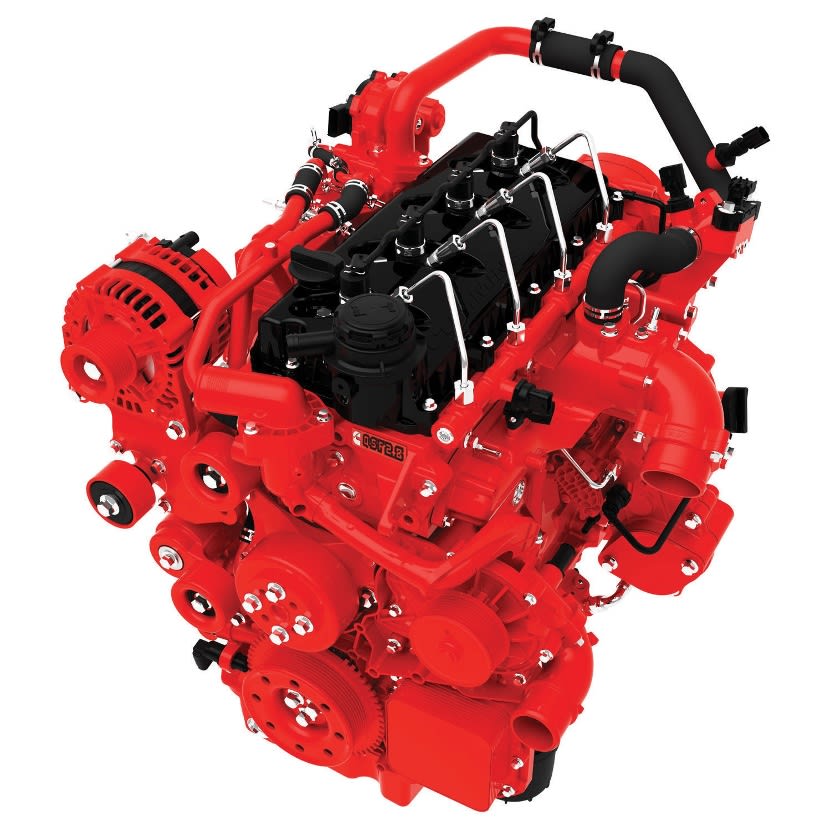
“Natural gas and diesel-natural gas dual-fuel engines must deal with a variety of issues not typically seen in diesel engines — knock being one of the more important,” said Ryan Roecker, Manager, Powertrain Control for the Southwest Research Institute’s Engine, Emissions and Vehicle Research Division. “Dual-fuel engines in particular are often running with higher compression ratios than would be considered normal for a spark-ignited natural gas engine, leading to a greater propensity for knock.”
He noted that new and retrofit natural gas and dual-fuel engines may require up to one knock sensor per cylinder. This could mean up to 16 knock sensors on some large engine applications, which would require more wiring, new control algorithms, and an increase in microprocessor performance.
Many sensors are critical in efforts to improve operating efficiency. Sensors can help adjust blades to smooth roads and other surfaces. They can monitor speed too.
“We have used MEMS technology, inclinometers, accelerometers, and gyroscopes to increase performance on slope sensors that are used for grade & slope control and other machine leveling applications,” Olson said. “These same sensors can also be used as inertial measurement units to sense machine motion to control propel or other work function.”
Sensors are helping make vehicles safer. Rollovers are a big concern in the uncertain environments confronted by off-highway equipment. Sensors can often perform double duty, helping operators improve efficiency while they watch for potential roll-over situations.
“Speed sensors on wheels can detect slipping, so the system can determine when it needs to divert power from one wheel to the next,”
said James Sterling, Manager of Integrated Sensors at Infineon. “If one wheel’s slipping and the controls know from the leveling sensor that you’re on a hill, the system can add power to the opposing wheel and help the driver get out of a dangerous situation.”
Virtually gone
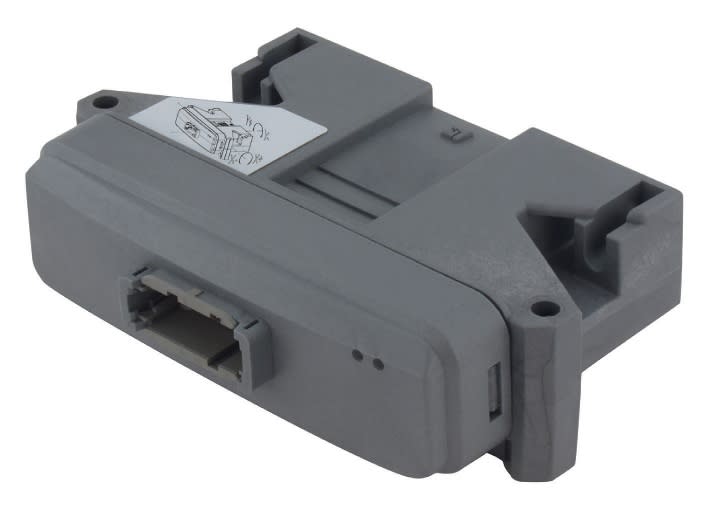
Engineers often use specific sensors to measure different parameters like temperature or pressure. But they have also devised ways to measure some parameters without using a dedicated sensor. They can gather data by examining information provided by multiple sensors and determine the operating conditions for a sensor that isn’t there.
“Virtual sensors will always be necessary to develop certain control functions,” Schneider said. “Depending on the accuracy of the system requirements, virtual sensors can be utilized in many ways from engine control to air handling, to exhaust gas recirculation control. As prognostics become more prevalent and desired, there will be an increased need for virtual sensors — especially if this will allow for a prognostic without adding an actual sensor.”
Eliminating sensors is often a way to reduce components and trim costs. But the concept can also be used to monitor parameters that aren’t easy to measure using conventional components.
“Virtual sensors are not always about reducing component counts,” Anderson said. “Perhaps more critical is the ability of virtual sensors to estimate system states that are difficult or even impossible to measure in the first place. One common example is the use of virtual NOx sensors to estimate engine-out NOx emissions after cold start when the physical NOx sensor is too cold to operate. Other common examples include virtual air mass flow sensors, EGR rate sensors, DPF soot load sensors, and SCR ammonia load sensors.”
Virtual sensors can sometimes provide better performance than physical components. Although engineers can list many benefits for virtual sensors, they note that these benefits don’t come for free.
“A virtual oxygen sensor can often be as accurate, and sometimes faster, than the physical sensor,” said Roecker. “While virtual sensors can be designed to be quite accurate, the cost is almost always in terms of increased ECU processor load.”
More From SAE Media Group
Off-Highway Engineering
Freightliner’s Medium-Duty Makeover
Battery & Electrification Technology
Ultracapacitor Solutions to Address Energy-Storage Needs of Vehicles
Off-Highway Engineering
DEF Delivery Modeling for SCR Systems
Off-Highway Engineering
Aftertreatment Comes With Challenging Diagnosis
Automotive Engineering
More Gears, More Challenges
Off-Highway Engineering
Gearshift Actuator Dynamics in a Dual Clutch Transmission
Off-Highway Engineering
Systems That Talk Together, Are Efficient Together
Automotive Engineering
Powering a Drive to Higher Voltages
Off-Highway Engineering
Reshaping the Mobile-hydraulic Ecosystem
Off-Highway Engineering
FEV Simplifies Off-Highway Electrification
Off-Highway Engineering
Cummins Unveils New B7.2 Diesel Engine
Off-Highway Engineering
ZM Trucks Starts Production in Fontana, California
Off-Highway Engineering
Komatsu Augments Intelligent Machine Control in New Excavator
Off-Highway Engineering
First Drive: Drifting in the Electric 2027 Mercedes GLC 400
Power Electronics INSIDER
An Electrifying Collaboration: From the Lab to the Marketplace
Off-Highway Engineering
Nikola Producing Battery-Electric Trucks, Fuel-Cell EVs Coming

Automotive Engineering
Toyota Stretches SUV Line-Up with World Debut of Grand Highlander
Off-Highway Engineering
Danfoss and Sany Extend Electrification of Off-Highway Machines
Off-Highway Engineering
Hyundai CE Debuts Hydrogen and Electric Excavators at Bauma 2022
Power Electronics INSIDER
Highly Conductive Aluminum Can Equal Copper
Aerospace & Defense Tech Briefs
SAE International Extends Call for Abstracts, Seeks Submissions for AeroTech Conference
Battery & Electrification Technology
Micro-Supercapacitors Enable Fast Charging
Tech Briefs
High-Power Direct Borohydride Fuel Cells

Battery & Electrification Technology
The Rechargeable Renaissance
Battery & Electrification Technology
Developing a Better Way to Recycle Lithium-Ion Batteries
Battery & Electrification Technology
Manufacturing Advances in Solid-State Batteries
Battery & Electrification Technology
Hydropower Technology Swaps Dams with Electric Trucks
Top Stories
INSIDERManufacturing & Prototyping
 How Airbus is Using w-DED to 3D Print Larger Titanium Airplane Parts
INSIDERManned Systems
 FAA to Replace Aging Network of Ground-Based Radars
NewsTransportation
 CES 2026: Bosch is Ready to Bring AI to Your (Likely ICE-powered) Vehicle
NewsSoftware
 Accelerating Down the Road to Autonomy
EditorialDesign
 DarkSky One Wants to Make the World a Darker Place
INSIDERMaterials
 Can This Self-Healing Composite Make Airplane and Spacecraft Components Last...
Webcasts
Defense
 How Sift's Unified Observability Platform Accelerates Drone Innovation
Automotive
 E/E Architecture Redefined: Building Smarter, Safer, and Scalable...
Power
 Hydrogen Engines Are Heating Up for Heavy Duty
Electronics & Computers
 Advantages of Smart Power Distribution Unit Design for Automotive...
Unmanned Systems
 Quiet, Please: NVH Improvement Opportunities in the Early Design...
