




Systems That Talk Together, Are Efficient Together
Design teams take a holistic view, linking engines, transmissions, hydraulics, and aftertreatment systems to boost efficiency and performance.

The need to trim fuel consumption and emissions is forcing design teams to take a broader look at equipment operations, linking various systems so they work together closely. Engines, transmission, hydraulics, and even aftertreatment systems share data so that demands and power output are coordinated for optimal performance.
Advanced electronics are being used to analyze ambient temperature and many other parameters making it possible to make the most of every drop of fuel. The benefits extend beyond fuel consumption, even extending component lifetimes by reducing friction.
“When the engine and transmission know more about the operating conditions of the other systems, the operation of the entire powertrain can be set to the most efficient point using data-based criteria rather than a generic set of rules,” said Chris Mays, Senior Technical Specialist at BorgWarner’s Advance Engineering Group. “For example, the system can warm up faster for friction reduction as well as for aftertreatment conversion efficiency.”
More powerful controllers also let OEMs customize installations. Typically, machine developers target specific characteristics related to transient response, smooth and stable equipment operation, or efficient use of equipment. ECUs ensure that engines stay near their sweet spot for longer periods so engines don’t have to be oversized to meet peak requirements.
“The benefits are significant, as it is possible to automatically control the engine and transmission to operate in the most efficient points without compromising machine performance,” said Mike Cullen, Perkins’ Product Marketing Specialist. “It is also possible to monitor and anticipate machine load, which allows us to work with our customers when considering engine downsizing.”
Smart shifting
This right-sizing extends to transmissions. With integrated controls, the transmission can reduce the worst-case condition to its mechanical limits. That lets the transmission maximize the engine’s output.
“Active torque limiting allows lower cost transmissions without sacrificing reliability or durability,” an engineering spokesman from Cummins said. “A transmission can sometimes be limited by having to avoid torque capacity in lower gears or by component stress during gear shifts. By using advanced electronics, the transmission has the ability to limit engine torque or power output when needed, but allow full or higher torque when possible.”
The benefits extend to operations in the field. Engines can adapt to the varied conditions seen by equipment, providing optimal performance in a range of environments.
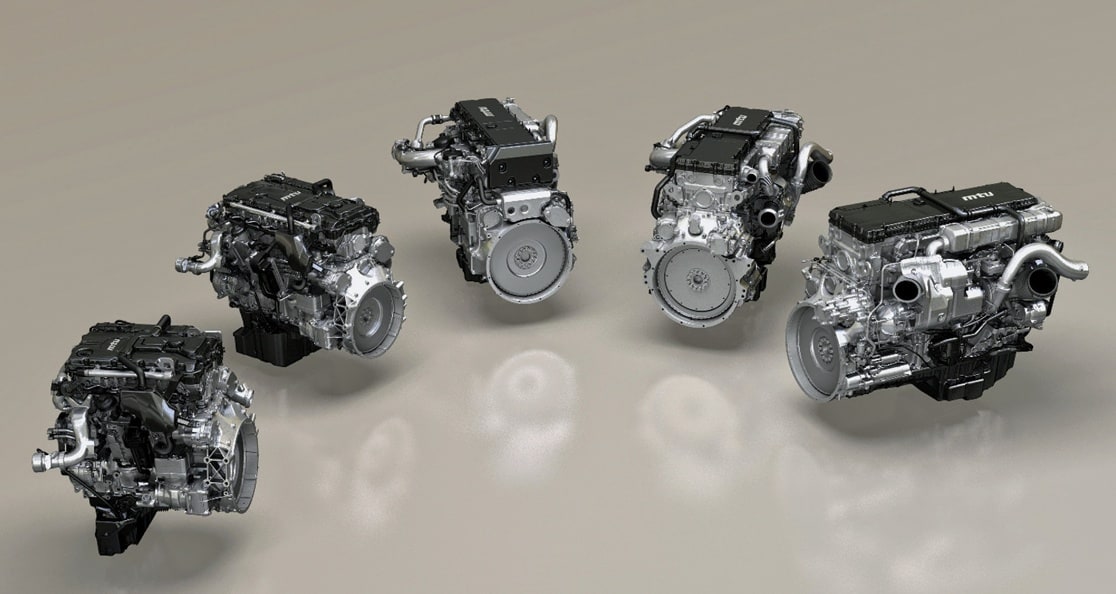
“Advanced electronics allow engine power curves to be optimized along with transmission capability to achieve the best efficiencies from each, particularly with changing environmental conditions, such as altitude, machine load, and ambient temperature,” said James Krueger, Senior Sales Engineer at MTU. “Transmission life and engine life can both be extended in certain situations, for instance, where electronics allow engine torque-limiting or the transmission can ‘teach’ an operator to operate the engine/machine more efficiently.”
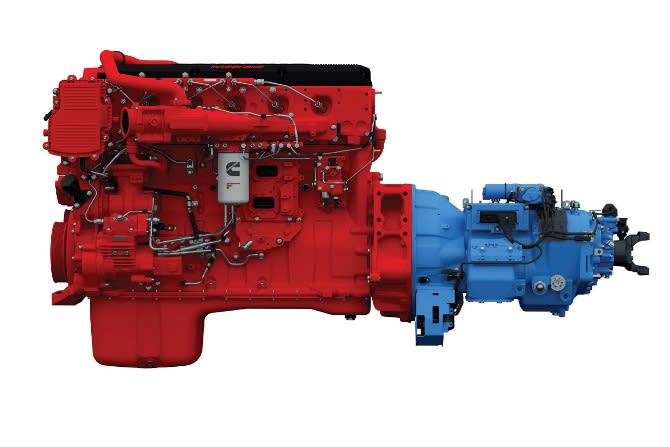
The results can be significant for equipment makers striving to meet demanding expectations for fuel conservation. For example, matching a Cummins ISX15 engine with an Eaton Fuller Advantage Series 10-speed automated transmission improves efficiency and trims fuel consumption for on-highway vehicles.
“Sharing data allows the engine to determine the torque curve and power level to match real-time demand, providing additional torque when necessary and better fuel economy as a total unit,” the Cummins spokesman said. “As a tangible example of benefits, the SmartAdvantage Powertrain offers customers a 3-6% improvement in fuel economy.”
Sharing data, sharing power

Maximizing efficiency extends beyond the basic powertrain. Engines must also interact well with hydraulic systems. In many existing equipment designs, hydraulic systems sometimes apply loads faster than the engine can accept them. When electrohydraulic controllers and engine controllers communicate, performance and fuel consumption can be improved by managing how loads are applied to the engine.
“Typically, the load is applied and the engine reacts to changes in speed by lugging,” the Cummins spokesman said. “The auxiliary device must be designed so it cannot lug the engine too low in speed or the engine speed must be increased to provide sufficient lugging capability to react. In a more integrated system, the engine can operate at low speed to save fuel when no load is applied, but then receive advanced communication prior to application of a load.”
Engineers try to keep the engine running at its optimal rate when the engine isn’t idling. When loads are added, it’s not always optimal to have the engine or the hydraulic system work at a level that’s very efficient for either system alone. The end goal for many design teams is to get the most overall efficiency.
“Instead of asking for an engine speed set-point to make the hydraulics most efficient, at the possible expense of engine efficiency, the machine could choose a point that means neither engine nor hydraulics are at optimal efficiency, but the net efficiency or productivity is maximized,” Mays said.
Clean communications
For many design teams, tighter emissions regulations have expanded the definition of a powertrain. Aftertreatment systems are now a critical factor that impacts engine operations. Design teams must include treatment technologies as they optimize powertrain parameters.

“The aftertreatment system, engine, and transmission need to be optimized as a complete system instead of individual elements,” Mays said. “For example, getting the SCR aftertreatment to its operating temperature quickly means that the engine can move to more efficient operation sooner. The engine needs to interact with fuel injection, throttles, and variable valve train components as well as the transmission to enable a rapid warm-up. This is a system decision to sacrifice lower engine efficiency for a short time to achieve a net overall system benefit for the full operation cycle.”
When all these systems share information continuously, there is a lot of data traveling over networks. Getting the right data to each node at the right time is a challenging task. If the combined systems and networking links aren’t considered as elements of a larger system, problems can arise.
“Another challenge associated with communication between the engine and transmission is obtaining accurate load information at very light loads,” said Michael Pipho, technical lead at John Deere Power Systems. “Aftertreatment technologies also increase the amount of data on the network structure due to additional control requirements and the need to communicate aftertreatment information to operator interfaces. The increased sharing of data among systems can result in high network loading and cause some data latency issues.”
Most developers are using a number of networks linked together using gateways. That provides the necessary bandwidth without adding a lot of complexity.
“As the engine subsystems develop, particularly those related to aftertreatment, it is necessary to use multiple networks separating machine and application data from subsystem monitoring,” Cullen said. “One example is NOx sensors, which run on a different network to that of the machine. As the number of variables increase, the limitations of a network become apparent. To maintain a responsive system and avoid latency issues it is sometimes necessary to rethink the network architecture of a machine.”
More From SAE Media Group
NASA Spinoff
NASA ‘RAMPT’ Up 3D Printed Engine Size
Battery & Electrification Technology
Ultracapacitor Solutions to Address Energy-Storage Needs of Vehicles
Off-Highway Engineering
Caterpillar Equipment Gets Smarter for Productivity Results
NASA Spinoff
Innovation Comes Out of the Wool Work
Off-Highway Engineering
Freightliner’s Medium-Duty Makeover
Off-Highway Engineering
Autonomous Vehicle Challenges Span Many Fields
Automotive Engineering
SAE Eye on Engineering Quick Take: Selling Vehicle Data
Automotive Engineering
SAE Eye on Engineering: Driver Monitoring Is Coming
Automotive Engineering
WCX 2025: Intel’s Weast Says China Leaping Ahead Due to Focus on Innovation
Off-Highway Engineering
ZM Trucks Starts Production in Fontana, California
Autonomous Vehicle Engineering
We Finally Have Some Data on ADAS!
Autonomous Vehicle Engineering
Who’s Ahead in the Automated-Driving Race?
Automotive Engineering
Ford Approved for Hands-Off Driving on German Autobahn
Automotive Engineering
ICE and Hybrid-Electric Propulsion Show Staying Power
Automotive Engineering
Mobileye Ready to Meet FMVSS 127 with Vision-Only System
Automotive Engineering
GM’s CTO Driving New Paths to Technology Leadership
Automotive Engineering
LEAF Turns to the 2020s
Automotive Engineering
Time with the Teardown Titan
NASA Spinoff
View from the Sky Helps Predict Crop Yields
NASA Spinoff
Home-Grown Housing
Automotive Engineering
2026 Nissan Leaf First Drive: Fun and More Efficient
Automotive Engineering
Nissan's ProPILOT Assist Is More Than Lane-Keeping
Battery & Electrification Technology
Putting a New ‘Charge’ in EV Recharging
Automotive Engineering
Engineering ‘Electron Guzzlers’
Automotive Engineering
Integrated and Open Development Platform (IODP)
ADAS & Autonomous Vehicle Engineering
The Subscriptions Are Coming for Your Wallet

Off-Highway Engineering
First Drive: Drifting in the Electric 2027 Mercedes GLC 400
Automotive Engineering
SAE Convergence 2016: Automakers, Suppliers Firm That Autonomous Driving Not Decades Away
Automotive Engineering
OEMs Continue to Diversify MaaS, Expand UX
Top Stories
INSIDERManufacturing & Prototyping
 How Airbus is Using w-DED to 3D Print Larger Titanium Airplane Parts
INSIDERManned Systems
 FAA to Replace Aging Network of Ground-Based Radars
NewsTransportation
 CES 2026: Bosch is Ready to Bring AI to Your (Likely ICE-powered) Vehicle
NewsSoftware
 Accelerating Down the Road to Autonomy
EditorialDesign
 DarkSky One Wants to Make the World a Darker Place
INSIDERMaterials
 Can This Self-Healing Composite Make Airplane and Spacecraft Components Last...
Webcasts
Defense
 How Sift's Unified Observability Platform Accelerates Drone Innovation
Automotive
 E/E Architecture Redefined: Building Smarter, Safer, and Scalable...
Power
 Hydrogen Engines Are Heating Up for Heavy Duty
Electronics & Computers
 Advantages of Smart Power Distribution Unit Design for Automotive...
Unmanned Systems
 Quiet, Please: NVH Improvement Opportunities in the Early Design...
