




Caterpillar Equipment Gets Smarter for Productivity Results
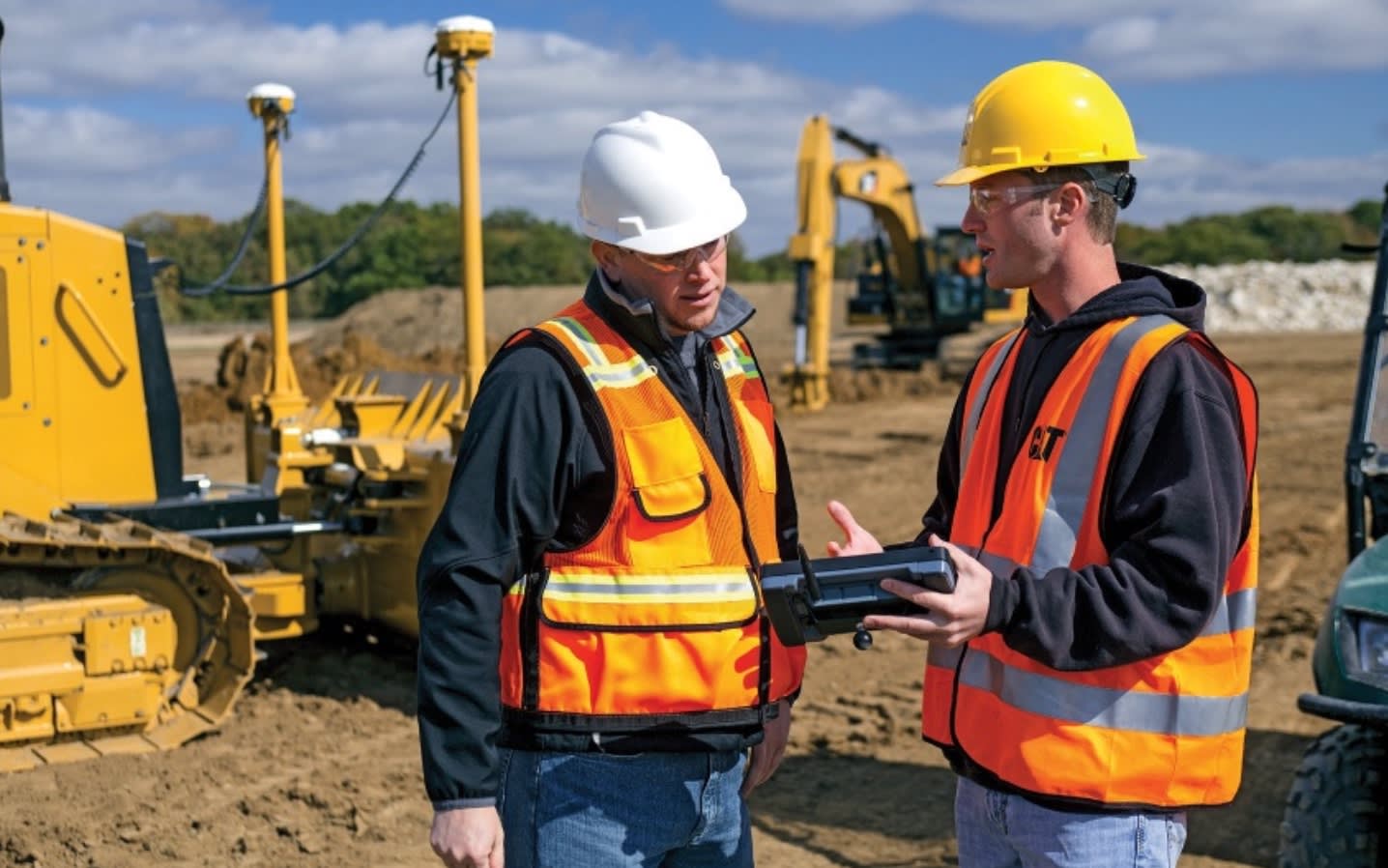
While “connectivity” has become an important part of the nomenclature as of late to both the automotive and on- and off-highway heavy-duty industries, it could be argued that Caterpillar was onboard with the forerunner of what connectivity means today long before the industry really knew what it could eventually evolve into.
In fact, it and Trimble, which came to life in 1978 in Silicon Valley as the brainchild of three former employees of Hewlett-Packard, one of whom was Charlie Trimble, to develop positioning and navigation solutions, have been working together since 1997 on making off-highway equipment smarter.
By 2002, the companies formed a joint venture called CTCT (Caterpillar Trimble Controls Technologies LLC) that focused on machine guidance and control products for a variety of Cat equipment. That JV led to Cat becoming the first OEM to offer factory-installed grade-control equipment options in 2005, and by 2011 Cat was offering 3-D systems on its blades that used GPS to compare the blade position to 3-D computerized site plans.
Those innovations were all in the name of increasing operator productivity.
Though even with all the technological innovations that have emerged throughout the off-highway industry over the last decade, John Thomas, Construction Technology Marketing & Strategy Manager at Caterpillar, recently told a gathered group of journalists in Peoria, IL, that “construction productivity has not improved in decades.”
And, in fact, Thomas showed a chart that seemed to prove that construction-site productivity has in fact “declined compared to dramatic [productivity] gains in other industries, with the construction industry getting less work done per hour than in 1964.”
Obviously, such productivity numbers are not due to a lack of technologies being introduced by off-highway engineers. Cat’s theory, which is quite believable, is that the technology is simply not being used correctly on the work site. Compounding the issue, according to Thomas, is that depending on the Cat equipment being sold, “as little as 5%, and only as high as 15% [of customers] have embraced technology solutions” with new equipment orders.
“Besides machine design, Cat can help with construction technologies,” said Thomas. That help is in the form of Cat Connect Solutions, which the company said will help customers monitor, manage, and enhance operations and gain more control of the job site via connectivity. That is, to use data from equipped machines to make technology and its benefits easier to understand and apply. In many cases, it says implementing Cat Connect Solutions will only require the addition of proprietary software, and in some instances, easily installed sensors or other electronic components.
A key commonality across most Cat Connect Solutions is the web-based user interface, VisionLink, which will provide visibility to items like equipment location, status, availability, and health. VisionLink essentially brings the office into the field virtually, and allows people in the office to analyze information quickly to respond accordingly to problems in the field.
Cat Connect Solutions consists of five “solution sets.” First, Equipment Management Solutions help customers increase uptime and reduce operating costs by monitoring fuel burn, location and utilization, and health and maintenance issues such as hours and fluid contamination. Using defined service levels, customers can choose the support they want to help manage their equipment and improve their bottom line.
Productivity Solutions monitor production and manage job-site efficiency. Using technology to measure payloads and cycle times can optimize production and reduce loading and hauling costs. By utilizing grade and compaction control technologies, operations get done faster with more accuracy and less rework.
Thirdly, Safety Solutions increase job site awareness with such elements as onboard camera systems and object-/proximity-detection systems to increase the operator’s situational awareness, contributing to a safer job site. Other features include tire monitoring and off-board safety.
Sustainability Solutions reduce environmental impact and simplify compliance reporting. By monitoring fuel burn and carefully managing resource consumption, customers can reduce operating costs and improve job-site efficiency while protecting the environment in which they operate.
Lastly, in the future, Command Solutions will help customers work safely and efficiently in harsh or challenging environments. Applying remote control, semiautonomous, and autonomous technologies can help make equipment more productive while also contributing to safety on the job site.
The intent, of course, is that new technology solutions for off-highway equipment be more transparent and helpful to operators, and profit more apparent to owners. Caterpillar will be talking more about Cat Connect Solutions at ConExpo this month.
More From SAE Media Group
Automotive Engineering
AVSC Develops Best Practices for Traceable AV Safety Inspection Protocols
Autonomous Vehicle Engineering
Platform-Agnostic Interface Aims to Accelerate Truck Autonomy
Automotive Engineering
Ford Approved for Hands-Off Driving on German Autobahn
Autonomous Vehicle Engineering
‘Software, Start Your Engines’
Automotive Engineering
Nissan's ProPILOT Assist Is More Than Lane-Keeping
Autonomous Vehicle Engineering
Purpose, Perceptions for Driver-Assist Tech Solidify
Autonomous Vehicle Engineering
Predicting the Road to Efficiency
Off-Highway Engineering
Kodiak Adapts Autonomous Tech for Military Vehicles
Automotive Engineering
Lighter Volvo XC90 Is Engineered for "Premium Cool"
Off-Highway Engineering
Forward-Looking Lidar Can Revolutionize Driver-Assistance Systems

Autonomous Vehicle Engineering
Hopeful but Closer Scrutiny for SAE Level 4 Automation
ADAS & Autonomous Vehicle Engineering
Volkswagen Plants Autonomous-Testing Flag in Austin
Automotive Engineering
Seeking a Common Language for Vehicle Automation
Autonomous Vehicle Engineering
'Level 2+': Making Automated Driving Profitable, Mainstream
Automotive Engineering
MOIA’s L4 ID. Buzz AVs Starting Service Next Year
Automotive Engineering
ACM President and Michigan DOT Director Steudle Keynote Kicks off SAE ADAS Event
Automotive Engineering
TRW Steering-Wheel Concept Supports Automated Driving
Automotive Engineering
SAE Publishes Terminology Standard for Automated Driving Systems
ADAS & Autonomous Vehicle Engineering
Automated Driving’s Journey: One Step Forward…
Automotive Engineering
GM Announces SAE Level 3 Autonomy and SDV Technology
Automotive Engineering
J3016 Automated-Driving Graphic Update
Off-Highway Engineering
Systems That Talk Together, Are Efficient Together
Sensor Technology
The Sensing Systems That Make ADAS Work
Automotive Engineering
Sensor Fusion Expanding in Step with Advancing Vehicle Sophistication
Automotive Engineering
CES 2025 Preview: All the Tech That’s Fit to Print
Automotive Engineering
Department of Transportation Asks for Public Input Regarding Relaxing AV Regulations
Off-Highway Engineering
Blue Arc Amps up for EV Production
ADAS & Autonomous Vehicle Engineering
Tesla’s FSD Recall Impacts AV Industry
ADAS & Autonomous Vehicle Engineering
AV Life After Argo AI
Top Stories
INSIDERManufacturing & Prototyping
 How Airbus is Using w-DED to 3D Print Larger Titanium Airplane Parts
INSIDERManned Systems
 FAA to Replace Aging Network of Ground-Based Radars
NewsTransportation
 CES 2026: Bosch is Ready to Bring AI to Your (Likely ICE-powered) Vehicle
NewsSoftware
 Accelerating Down the Road to Autonomy
EditorialDesign
 DarkSky One Wants to Make the World a Darker Place
INSIDERMaterials
 Can This Self-Healing Composite Make Airplane and Spacecraft Components Last...
Webcasts
Defense
 How Sift's Unified Observability Platform Accelerates Drone Innovation
Automotive
 E/E Architecture Redefined: Building Smarter, Safer, and Scalable...
Power
 Hydrogen Engines Are Heating Up for Heavy Duty
Electronics & Computers
 Advantages of Smart Power Distribution Unit Design for Automotive...
Unmanned Systems
 Quiet, Please: NVH Improvement Opportunities in the Early Design...
