




Defense Tech Briefs - April 2012
Inside this issue
Supplements
Overview
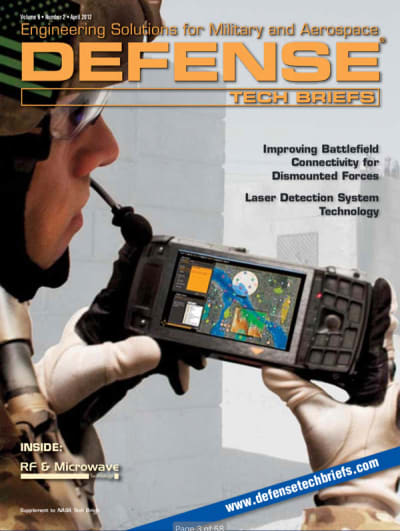
The April 2012 issue of Defense Tech Briefs presents a comprehensive overview of advancements in defense technology, focusing on innovations that enhance battlefield operations and improve military capabilities. This edition is particularly relevant for design engineers and professionals in the defense sector, as it highlights new product ideas and technologies that can generate jobs, improve health, increase sustainability, boost security, and enhance transportation safety.
Key Features
-
Improving Battlefield Connectivity for Dismounted Forces: One of the central articles discusses the critical need for enhanced communication systems for dismounted soldiers. As frontline soldiers increasingly rely on smartphones and ruggedized handheld computers for real-time information, the challenge lies in ensuring these devices can deliver critical data in various environments. The article explores the technologies being developed to improve connectivity and the implications for operational effectiveness.
-
Laser Detection System Technology: Another significant feature covers advancements in laser detection systems. These systems are vital for military applications, providing capabilities for threat detection and situational awareness. The article delves into the technical aspects of these systems, their operational benefits, and how they integrate with existing military technologies.
-
Application Briefs: The issue includes several application briefs that showcase innovative technologies and their potential military applications. These briefs cover a range of topics, from materials and coatings to advanced electronics, highlighting how new developments can enhance military operations.
Technology Focus
The magazine also features a section dedicated to Field Programmable Gate Arrays (FPGAs), which are crucial for modern military applications. The articles discuss:
-
Using High-Level Language to Implement Floating-Point Calculations on FPGAs: This piece explains how high-level programming languages can simplify the implementation of complex calculations on FPGAs, making them more accessible for military applications.
-
Managing Security in FPGA-Based Embedded Systems: This article addresses the security challenges associated with FPGA technology, emphasizing the importance of safeguarding military systems against potential vulnerabilities.
Innovations in Nanoelectronics
The issue explores the integration of CMOS-Memristor hybrid nanoelectronics, which represent a significant leap in electronic component technology. These innovations promise to enhance the performance and efficiency of military devices, contributing to more robust and reliable systems.
Software-Defined Radio for GNSS Applications
A feature on dynamically reconfigurable software-defined radios highlights their potential for Global Navigation Satellite System (GNSS) applications. These radios can adapt to changing conditions and requirements, providing military users with flexible and reliable communication options.
Materials and Coatings
The magazine discusses the investigation of basalt woven fabrics for military applications, showcasing how new materials can improve the durability and effectiveness of military gear. Additionally, the issue covers size scale and defect-engineered nanostructures, which can optimize strength and toughness in military materials.
Physical Sciences and Imaging Technologies
In the realm of physical sciences, the magazine presents advancements in computational cameras and miniature snapshot multispectral imagers. These technologies are crucial for enhancing surveillance and reconnaissance capabilities, allowing for better data collection and analysis in military operations.
Information Technology Innovations
The issue also highlights two-way, freeform, speech-to-speech translation systems designed for tactical use. This technology aims to bridge communication gaps in multilingual environments, enhancing collaboration among international forces.
RF & Microwave Technology
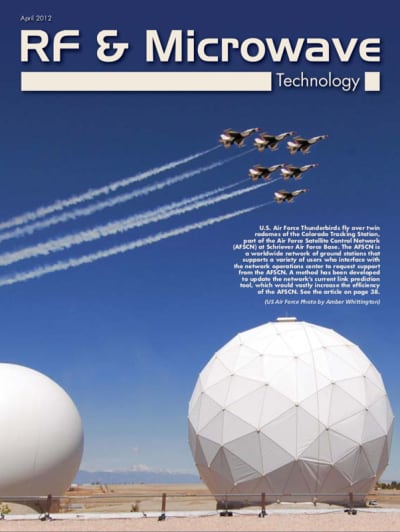
A special section dedicated to RF and microwave technology discusses the architecture of the Air Force Satellite Control Network (AFSCN). The AFSCN is a global network of ground stations that supports various military operations. The article details a new method developed to update the network’s link prediction tool, which significantly increases the efficiency of satellite communications.
Conclusion
The April 2012 issue of Defense Tech Briefs serves as a vital resource for professionals in the defense sector, offering insights into the latest technological advancements that can enhance military operations. From improved battlefield connectivity to innovative materials and communication systems, this edition underscores the importance of continuous innovation in defense technology. The articles not only highlight current trends but also encourage design engineers to contribute their ideas, fostering a collaborative environment for future advancements in military technology.
Overall, this issue encapsulates the dynamic nature of defense technology and its critical role in ensuring the effectiveness and safety of military operations in an ever-evolving landscape.
Features
-
Application Briefs
Silicone Cables: Silicone Encased Cables Make Military Robots More Reliable
Tech Briefs
-
Electronics & Computers
Using High-Level Language to Implement Floating-Point Calculations on FPGAs
Managing Security in FPGA-Based Embedded Systems
CMOS-Memristor Hybrid Nanoelectronics
Dynamically Reconfigurable Software-Defined Radio for GNSS Applications
-
Information Sciences
Two-Way, Freeform, Speech-to-Speech Translation Systems for Tactical Use
Web Service and Interface for Remote Electronic Device Characterization
Comparison of Subpixel Phase Correlation Methods for Image Registration
-
Materials
Investigation of Basalt Woven Fabrics for Military Applications
Size Scale and Defect Engineered Nanostructures for Optimal Strength and Toughness
-
Physical Sciences
Products
Top Stories
NewsSensors/Data Acquisition
 Microvision Aquires Luminar, Plans Relationship Restoration, Multi-industry Push
INSIDERRF & Microwave Electronics
 A Next Generation Helmet System for Navy Pilots
INSIDERWeapons Systems
 New Raytheon and Lockheed Martin Agreements Expand Missile Defense Production
NewsAutomotive
 Ford Announces 48-Volt Architecture for Future Electric Truck
INSIDERAerospace
 Active Strake System Cuts Cruise Drag, Boosts Flight Efficiency
ArticlesTransportation

Webcasts
Aerospace
 Cooling a New Generation of Aerospace and Defense Embedded...
Energy
 Battery Abuse Testing: Pushing to Failure
Power
 A FREE Two-Day Event Dedicated to Connected Mobility
Automotive
 Quiet, Please: NVH Improvement Opportunities in the Early Design Cycle
Electronics & Computers
 Advantages of Smart Power Distribution Unit Design for Automotive &...
Unmanned Systems
 Sesame Solar's Nanogrid Tech Promises Major Gains in Drone Endurance