




Comparison of Subpixel Phase Correlation Methods for Image Registration
This algorithm for subpixel-accuracy frame registration accurately processes multispectral imagery.
When working sequences of images, registration of the frames to a common point of reference is an essential prerequisite for many types of image analysis. The phase correlation method (PCM) is a popular Fourier domain method to register two images. It computes a phase difference map that (ideally) contains a single peak. The location of the peak is proportional to the relative translation [dx, dy] between the two images. The PCM is resilient to noise and image defects and is readily automated.
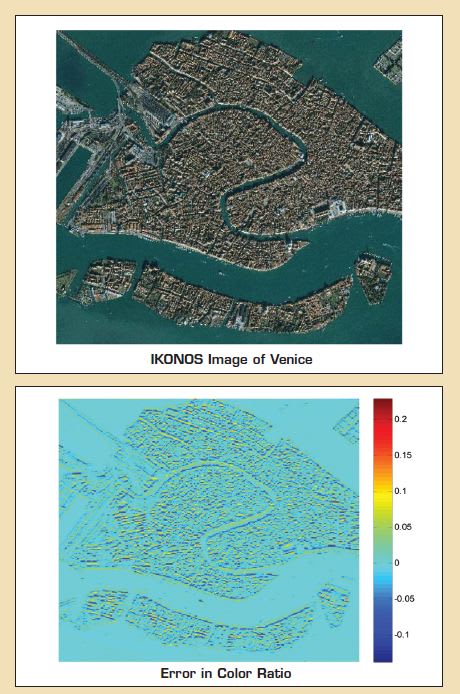
The PCM is strictly applicable to images that obey periodic boundary conditions. However, images of this kind are unphysical. An essential feature of the present work is that it uses realistic images that do not obey periodic boundary conditions. In addition to nonperiodic boundary conditions, real images are subject to noise and frequency aliasing. In addition, some focal plane arrays have dead space between the pixels. If one is concerned with registering images to within only ±1 pixel, these real-world effects are generally inconsequential. However, they become significant as one attempts to push the PCM to subpixel accuracy.
A reliable algorithm for subpixel accuracy frame registration is needed to accurately process multispectral imagery. Three different extensions of the popular PCM to subpixel frame registration were evaluated using a common set of satellite images. The test images derived from the satellite images include real-world effects such as nonperiodic boundary conditions, dead space between pixels, and additive noise.
The GTF (Guizar-Sicairos, Thurman, and Fienup) method and its two minor variants performed best, with registration errors consistently on the order of 0.05 pixels or less. This registration accuracy pertains to 256 × 256 images with rms noise levels as high as 10%. The RVJ (Ren, Vlachos, and Jiang) method performed inconsistently. It worked as well as GTF for most images, but poorly for others. The Hoge method is not recommended in its present form. However, the mathematical basis is sound, and with minor changes, it might be made to perform as well as the other methods.
Attempts to further increase the accuracy of registration by preprocessing the images (e.g., by taking gradients or by performing histogram equalization of the intensities) led to only minor gains in accuracy.
This work was done by Robert A. Reed of the Aerospace Testing Alliance. AFRL-0163
This Brief includes a Technical Support Package (TSP).
Comparison of Subpixel Phase Correlation Methods for Image Registration
(reference AFRL-0163) is currently available for download from the TSP library.
Don't have an account?
More From SAE Media Group

Tech Briefs
Maximum-Likelihood Template Matching
Tech Briefs
A Metric for Visual Quality of Digital Video
Tech Briefs
Hybrid Image-Plane/Stereo Manipulation
Tech Briefs
Simple Safe Site Selection (S4) Algorithm


Tech Briefs
The Spatial Standard Observer
Tech Briefs
Image Compression for High-Performance Computing
Aerospace & Defense Tech Briefs
Shape-Based Recognition of 3D Objects in 2D Images
Photonics & Imaging Technology
Analysis and Simulation of Low-Light INL in CMOS Image Sensors
Tech Briefs
Algorithm for Compressing Time-Series Data

Software Tech Briefs
Memory-Efficient Onboard Rock Segmentation
Overview
The document titled "Comparison of Subpixel Phase Correlation Methods for Image Registration" by Robert A. Reed presents a thorough investigation into the effectiveness of various subpixel phase correlation methods used for image registration. The report, finalized in April 2010, covers the period from October 1, 2008, to September 30, 2009, and is aimed at enhancing the accuracy of image alignment in real-world applications.
The introduction outlines the significance of image registration in various fields, including aerospace testing, where precise alignment of images is crucial for analysis and interpretation. The report emphasizes the need for robust methods that can handle variations in image quality and content.
The core of the document is dedicated to the Phase Correlation Method (PCM), which is explored in detail. The author discusses the mathematical foundations of PCM and its application in achieving subpixel accuracy in image registration. The report highlights the advantages of PCM, such as its ability to work with noisy images and its computational efficiency.
A significant portion of the report is devoted to analyzing accuracy trade-offs associated with different registration methods. The author notes that the accuracy of PCM registration is influenced by factors such as image content, quality, and noise levels. Various figures and tables illustrate the performance of different methods, showcasing registration accuracy under varying conditions.
The document also addresses the challenges posed by periodic boundary conditions, which can affect the performance of image registration techniques. The author provides insights into how these conditions can be mitigated to improve registration outcomes.
In the summary section, the report consolidates the findings, emphasizing that the performance estimates derived from the study are representative of real-world scenarios. The author concludes that while PCM offers significant advantages, careful consideration of image characteristics is essential for optimal results.
Overall, this report serves as a valuable resource for researchers and practitioners in the field of image processing, providing a comprehensive comparison of subpixel phase correlation methods and their implications for accurate image registration. The findings contribute to the ongoing development of more effective image analysis techniques, particularly in the context of aerospace applications.
Top Stories
NewsSensors/Data Acquisition
 Microvision Aquires Luminar, Plans Relationship Restoration, Multi-industry Push
INSIDERRF & Microwave Electronics
 A Next Generation Helmet System for Navy Pilots
INSIDERWeapons Systems
 New Raytheon and Lockheed Martin Agreements Expand Missile Defense Production
NewsAutomotive
 Ford Announces 48-Volt Architecture for Future Electric Truck
INSIDERAerospace
 Active Strake System Cuts Cruise Drag, Boosts Flight Efficiency
ArticlesTransportation

Webcasts
Aerospace
 Cooling a New Generation of Aerospace and Defense Embedded...
Energy
 Battery Abuse Testing: Pushing to Failure
Power
 A FREE Two-Day Event Dedicated to Connected Mobility
Automotive
 Quiet, Please: NVH Improvement Opportunities in the Early Design Cycle
Electronics & Computers
 Advantages of Smart Power Distribution Unit Design for Automotive &...
Unmanned Systems
 Sesame Solar's Nanogrid Tech Promises Major Gains in Drone Endurance