




Miniature Snapshot Multispectral Imager
Compact multispectral imaging sensors are used in defense, medical, and environmental monitoring.
Multispectral imagers use an optical device that can separate the colors to obtain the spectral content in the scene. Such an optical device could be a grating or prism, a filter wheel, a diffractive optic lens, a Fabry-Perot (F-P) etalon, or a tunable filter. All of these optical devices are used with a focal plane array (FPA) and suitable optics for a given spectral region. All such imagers collect images in a time-sequential manner. Recently, some multispectral imagers have been developed that collect images of the scene at all the spectral bands simultaneously.
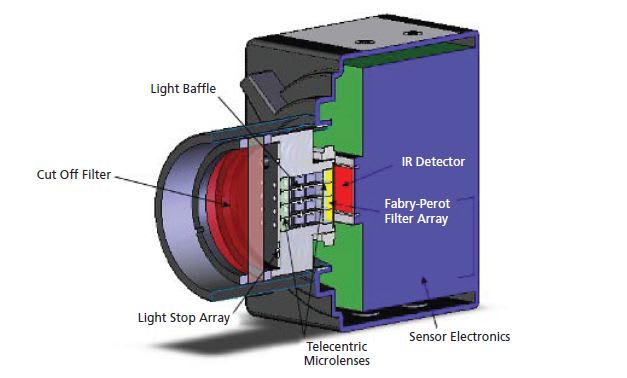
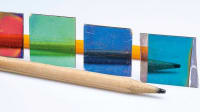
This snapshot miniature multispectral imaging system operates in the shortwave infrared (SWIR) region. The two main components used in the design of the snapshot multispectral imager are the multichannel F-P filter array and the microlens assembly. The filter array uses 16 F-P etalons, each tuned to a different peak wavelength. The filter bank consists of a 4°--4 two-dimensional (2D) array of fixed wavelength filters, each with a narrow bandpass. Instead of using two high-reflectivity metal mirrors with a cavity in between to fabricate each of the 16 F-P filters, a multilayer dielectric stack mirror design was chosen to obtain optimal filter performance. Each of the mirrors on either side of the cavity in the FP etalon was fabricated using 11 alternating layers of two different dielectric materials: titanium dioxide (TiO2) and silicon dioxide (SiO2) with different refractive index values.
In the mirror design, the layer thickness for each material was chosen equal to one-quarter of the selected center wavelength of the filter to obtain the desired spectral full width at half maximum (FWHM) with high filter finesse. An SIO2 cavity between the two dielectric mirrors was chosen with a corresponding thickness for each of the peak wavelengths. Each of the 16 F-P filters had the same top and bottom multilayer dielectric mirror, but the cavity thickness for each filter was different, equal to around one-half of the corresponding center wavelength of the filter. The F-P filters were fabricated by deposition of evaporated thin material films. Different cavity layer thicknesses for the 16 spectral filters were achieved by using only four 2-shadow masks for deposition of the evaporated SiO2 films.
The other main component that is required to obtain simultaneous multispectral images of a scene is a microlens assembly that can image the scene into 16 different spectral channels, coming through each filter on a subsection of the FPA of the SWIR camera independently, i.e., the out-of-band leakage from the surrounding filters has to be made as small as possible. This was achieved by using two arrays of 4°—4 microlenses with field stops and baffles. Commercial off-theshelf lenses were used with some machining to match the size of the individual filter. The f-number of microlenses, baffle thickness, and field stop distances were chosen after radiometric considerations to optimize the light transmission to the FPA. The filter bank operates from 1487 to 1769 nm with a spectral bandpass ~10 nm. The design of the filter array can be customized for any spectral region from the ultraviolet (UV) to the longwave infrared (LWIR). Also, filter and custom optics sizes can be matched to optimize performance using a variety of cameras with different size focal planes.
The fabricated filter was installed in front of a commercial camera with an indium gallium arsenide (InGaAs) FPA, and the camera imaging lens was replaced by the microlens assembly. The microlens assembly was carefully tested with the commercial camera for its 4°—4 independent image formation capability. A number of filter arrays was fabricated and characterized for their spectral characteristics. The snapshot multispectral imager with 16 independent channels was calibrated to evaluate its imaging performance. A number of indoor and outdoor scenes were imaged and the images were analyzed. It was clear from these images that each spectral channel operated independently without noticeable out-of-band leakage.
This work was done by Neelam Gupta of the Army Research Laboratory, Philip R. Ashe of SpectralSight, and Songsheng Tan of Infotonics Technology Center. ARL-0115
This Brief includes a Technical Support Package (TSP).
Miniature Snapshot Multispectral Imager
(reference ARL-0115) is currently available for download from the TSP library.
Don't have an account?
More From SAE Media Group
Aerospace & Defense Tech Briefs
Uncooled Tunable LWIR Microbolometers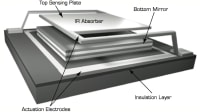
Aerospace & Defense Tech Briefs
Cleaning and Protecting Large Mirrors Using a Polymer Solution
Tech Briefs
A Broad-Band Phase-Contrast Wave-Front Sensor
Photonics Tech Briefs
Efficient Coupling of Lasers to Telescopes With Obscuration
Photonics & Imaging Technology
New “Metalens” Shifts Focus Without Tilting or Moving
Photonics & Imaging Technology
Visualizing Value at the Speed of Light

Photonics & Imaging Technology
The Latest Advancements in Optics

Photonics Tech Briefs
All-Reflective Computed-Tomography Imaging Spectrometers
Aerospace & Defense Tech Briefs
Designing COTS Optics Into Defense Projects
Aerospace & Defense Tech Briefs
3D Meta-Optics for High-Energy Lasers
Photonics & Imaging Technology
Ultra-Narrowband Optical Filters Pushing Boundaries from the UV to the LWIR
Photonics & Imaging Technology
Bird-Eye-Inspired Camera Developed for Enhanced Object Detection
Aerospace & Defense Tech Briefs
Stand-Off Scanning and Pointing with Risley Prisms

Medical Design Briefs
Optical Design Considerations for Additive Manufacturing
Photonics & Imaging Technology
How to Innovate and Overcome the Challenges of Blue Laser Beam Shaping
Photonics Tech Briefs
Dynamic Pupil Masking for Phasing Telescope Mirror Segments
Photonics & Imaging Technology
SPIE Photonics West 2023 Preview
Photonics & Imaging Technology
SPIE Photonics West 2022 Preview

Photonics & Imaging Technology
Photonics West 2021 Preview
Photonics & Imaging Technology
New Products
Photonics & Imaging Technology
Researchers Use Inkjet Printing to Make a Portable Multispectral 3D Camera
Aerospace & Defense Tech Briefs
CAT Scanner Provides 3D View Inside Nuclear Weapon Components
Overview
The document titled "Development of a Miniature Snapshot Multispectral Imager" presents a comprehensive overview of a novel imaging system designed to operate in the short wavelength infrared (SWIR) region. Authored by Neelam Gupta, Philip R. Ashe, and Songsheng Tan, the report details the development of a compact, lightweight, and low-power multispectral imager that utilizes a 4×4 Fabry-Perot filter array. This filter array operates within a spectral range of 1487 to 1769 nm, with a bandpass of approximately 10 nm, making it suitable for various applications, including the detection of chemicals used in improvised explosive devices (IEDs).
The imager's design incorporates a microelectromechanical system (MEMS) shadow mask technique to fabricate the Fabry-Perot etalon, which features multilayer dielectric mirrors. The filter array is integrated into a commercial handheld indium gallium arsenide (InGaAs) camera, where the standard imaging lens is replaced with a custom-designed 4×4 microlens array. This configuration allows for telecentric imaging performance across 16 sub-imaging channels, enhancing the system's versatility.
The report outlines the design and characterization processes of the filter array and microlens optical package, providing insights into the optical performance, tolerance analysis, and radiometric analysis. It also discusses the fabrication process of the MEMS filter array and presents experimental results that demonstrate the imager's capabilities in capturing multispectral images of various indoor and outdoor scenes.
The flexibility of the microlens optics and filter design is highlighted, indicating that the system can be tailored for different wavelength regions, from ultraviolet (UV) to longwave infrared (LWIR), and that the spectral bandpass can be customized to meet specific requirements. This adaptability makes the imager a valuable tool for a range of applications beyond IED detection, potentially extending to environmental monitoring, agricultural assessment, and other fields requiring multispectral imaging.
In summary, the document provides a detailed account of the development, design, and potential applications of a miniature snapshot multispectral imager, emphasizing its innovative features and the significance of its capabilities in various domains.
Top Stories
NewsSensors/Data Acquisition
 Microvision Aquires Luminar, Plans Relationship Restoration, Multi-industry Push
INSIDERRF & Microwave Electronics
 A Next Generation Helmet System for Navy Pilots
INSIDERWeapons Systems
 New Raytheon and Lockheed Martin Agreements Expand Missile Defense Production
NewsAutomotive
 Ford Announces 48-Volt Architecture for Future Electric Truck
INSIDERAerospace
 Active Strake System Cuts Cruise Drag, Boosts Flight Efficiency
ArticlesTransportation

Webcasts
Aerospace
 Cooling a New Generation of Aerospace and Defense Embedded...
Energy
 Battery Abuse Testing: Pushing to Failure
Power
 A FREE Two-Day Event Dedicated to Connected Mobility
Automotive
 Quiet, Please: NVH Improvement Opportunities in the Early Design Cycle
Electronics & Computers
 Advantages of Smart Power Distribution Unit Design for Automotive &...
Unmanned Systems
 Sesame Solar's Nanogrid Tech Promises Major Gains in Drone Endurance