




Cleaning and Protecting Large Mirrors Using a Polymer Solution
Polymer cleaning solution eliminates residue on optical surfaces.
Cleaning and protecting optics is a challenge — contamination must be removed without damaging the surface. Preventing recontamination for extended periods of time after cleaning was unattainable prior to use of polymer strip coat films. The SLRSC Western Range Depot Optics Group, WRDOG, at Vandenberg Air Force Base, is a pioneer in the cleaning and protection of precision glass optics, lenses, and large mirrors using polymer solution technology.
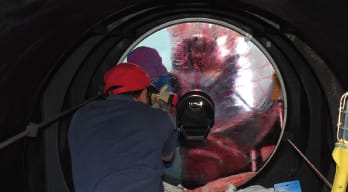
An ideal optics cleaning process allows treatment of all optics regardless of shape, size, or material composition. An effective cleaning process leaves no residue and removes particulates, oils, fingerprints, etc. from the optic surface. In a more perfect world, a cleaned optic will stay clean up to time of use, regardless of when the cleaning process was performed.
A new polymer solution effectively and safely cleans all glass optics, coated optics, silicon surfaces, sensors, crystals, and first surface mirrors, provided the substrate/coating interface is strong and intact. Cleaning is not recommended for poorly adhered coatings since if the coating/substrate interface is weak or in poor condition, the coating may be removed by any cleaning activity. This caution applies to traditional cleaning methods as well as strip coat cleaning.
The polymer solution has about one-tenth the adhesion to surfaces as standard Scotch tape. A practical application of the polymer in quality control would be its use as an effective optical component Acceptance Test since poor quality coatings or coating imperfections would be revealed when the polymer is removed from a brand new optic.
Just as importantly, the polymer film serves as a protective coating on clean optical surfaces. The polymer film is tough, flexible, and easily removed prior to using the optic. Many studies have shown the polymer film leaves no residue.
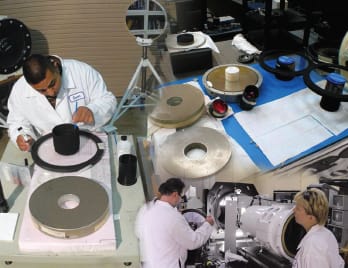
The ability to stage and work with optical components without fear of recontamination allows the WRDOG to work on many telescopes and assemblies concurrently. Work proceeds more quickly because the protective polymer film eliminates the possibility of cleaning the same component several times. The polymer allows cleaning to occur at any time in the refurbishment process, almost without regard for the final assembly timeline. The use of the polymer eliminates the need to construct expensive cleanrooms and allows coated lenses to be left in the open indefinitely.
This work was done by Philip Jackson and Dr. James Hamilton of Photonic Cleaning Technologies; and Steven Elieson of SpaceLift Systems Western Range, Vandenberg Air Force Base. For more information, click here .
More From SAE Media Group
Photonics & Imaging Technology
New “Metalens” Shifts Focus Without Tilting or Moving
Photonics & Imaging Technology
Controlling the Grind for Precision Photonics
Photonics & Imaging Technology
ZERODUR: The Highly Technical Glass-Ceramic
Tech Briefs
New Family of Glass for Lens Applications
Photonics & Imaging Technology
Lunar Lens: First Compact Flat Metalens Images Moon Surface
Photonics & Imaging Technology
Micro Molding and Micro-Optics
Photonics & Imaging Technology
Manufacturing Large Mirrors
Aerospace & Defense Tech Briefs
Miniature Snapshot Multispectral Imager


Photonics & Imaging Technology
Need for Larger Space Telescope Inspires Lightweight Flexible Holographic Lens
Photonics & Imaging Technology
SPIE Photonics West 2023 Preview
Photonics & Imaging Technology
SPIE Photonics West 2022 Preview
Photonics & Imaging Technology
Meta Optical Elements
Photonics & Imaging Technology
Silicon Carbide Optics for High-Energy Applications
Photonics & Imaging Technology
Photonics West 2021 Preview
Tech Briefs
Completely Flat Fisheye Lens
Photonics & Imaging Technology
How to Innovate and Overcome the Challenges of Blue Laser Beam Shaping
Photonics & Imaging Technology
Spider Silk Can Create Lenses Useful for Biological Imaging
Photonics & Imaging Technology
High Quality Optical Surfaces
Power Electronics INSIDER
Stable Optical Wireless Power Transmission for the IoT
Photonics & Imaging Technology
Researchers Develop Flexible, Stretchable Photonic Devices
Photonics & Imaging Technology
Hydrophobic & Oleophobic Coating Technologies for Polymer Optics
Photonics & Imaging Technology
Fabricating Optical Mirrors for Use in Outer Space Measurements
Sensor Technology
Breakthrough Lightweight AR Eyeglasses
Photonics & Imaging Technology
Upside-Down Design Expands Wide-Spectrum Super-Camera Abilities
Top Stories
NewsRF & Microwave Electronics
 Microvision Aquires Luminar, Plans Relationship Restoration, Multi-industry Push
INSIDERAerospace
 A Next Generation Helmet System for Navy Pilots
INSIDERDesign
 New Raytheon and Lockheed Martin Agreements Expand Missile Defense Production
INSIDERMaterials
 How Airbus is Using w-DED to 3D Print Larger Titanium Airplane Parts
NewsPower
 Ford Announces 48-Volt Architecture for Future Electric Truck
ArticlesAR/AI

Webcasts
Electronics & Computers
 Cooling a New Generation of Aerospace and Defense Embedded...
Automotive
 Battery Abuse Testing: Pushing to Failure
Power
 A FREE Two-Day Event Dedicated to Connected Mobility
Unmanned Systems
 Quiet, Please: NVH Improvement Opportunities in the Early Design Cycle
Automotive
 Advantages of Smart Power Distribution Unit Design for Automotive &...
Energy
 Sesame Solar's Nanogrid Tech Promises Major Gains in Drone Endurance