




Uncooled Tunable LWIR Microbolometers
These devices can be placed in handheld units, modified cell-phone cameras, rifle sights, and other devices for real-time chemical sensing and target recognition.
Uncooled infrared detectors have significant potential capabilities that have been little explored. Micro-machined uncooled detectors with tunable spectral characteristics across the long-wave infrared (LWIR, λ~8-12 μm) have been developed. In the middle wavelength infrared (MWIR) and LWIR regions, the fabrication of Fabry-Perot filters is more complex because the optical materials must be infrared-compatible and the layer thicknesses must be larger. It is very difficult to build filters for uncooled LWIR thermal detectors, which has limited previous researchers to demonstrations of discretely tunable 2- or 3-color thermal detectors rather than continuously tunable ones.
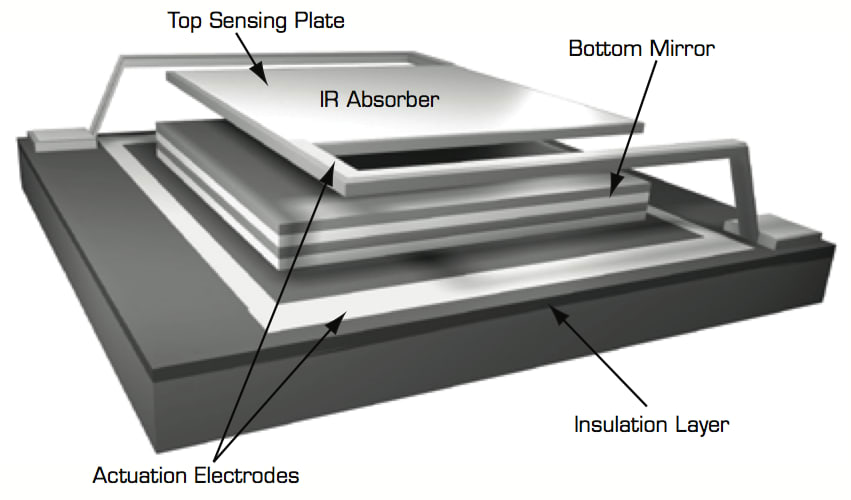
The devices can be continuously tuned, and a tuning range from 8.7 to 11.1 m with 0-42V of actuation voltage is demonstrated. Additionally, the devices can also be actuated to a broadband mode at 45V where the resonance width is increased to 2.83 μm. This mode is used to enhance its sensitivity in the presence of low-light signals with less spectral information. Experiments have shown that the devices have switching times of
about about 400-700 μsec, making them compatible with focal plane array frame rates.
The concepts apply to all thermal detectors, but in this work, they are demonstrated using a microbolometer. The IR absorbing material is deposited on the top of the upper plate of germanium (Ge). A thin layer of chromium (Cr) is chosen as the absorber because it is convenient for deposition and it has the most desirable optical constants of common metals. A key characteristic of Cr is that it produces a reasonably symmetric resonance with respect to wavelength. The bottom mirror is a modified quarter-wave distributed Bragg reflector (DBR), composed of Ge and zinc sulfide (ZnS) on top of an evaporated gold/chromium (Au/Cr) reflector with reflectivity centered around 10 μm.
The filter works in two modes. One is broadband IR reflection/absorption detection mode that is designed to maximize the thermal light absorbed. In this mode, a 45V actuation voltage pulls the top plate near the bottom mirror, creating a very small gap (<< λ/10). The top mirror itself does not touch the DBR mirror but instead the beam supports make contact so as not to thermally short the device. Although the contact area has not been measured in these devices yet, it is desirable to design the top movable structure such that the contact area is small enough to not affect the thermal performance.
The other mode is a reflection/absorption narrowband detection mode, achieved by using 0-42V actuation voltage to electronically control the air-gap over a distance of 4.3 to 6.4 μm. The position of the absorption resonance is continuously tuned, and a sharper resonance is obtained with the non-zero air gap. This mode can be used to recognize objects with subtle differences in emissivity spectrum, which are difficult to identify using standard bolometers.
This work was done by Joseph T. Talghader of the University of Minnesota-Minneapolis for the Army Research Office. For more information, download the Technical Support Package (free white paper) at www.defensetechbriefs.com/tsp under the Physical Sciences category. ARL-0107
This Brief includes a Technical Support Package (TSP).

Uncooled Tunable LWIR Microbolometers
(reference ARL-0107) is currently available for download from the TSP library.
Don't have an account?
More From SAE Media Group
Aerospace & Defense Tech Briefs
Miniature Snapshot Multispectral Imager
Photonics & Imaging Technology
Ultra-Narrowband Optical Filters Pushing Boundaries from the UV to the LWIR
Imaging Technology
Mid-Infrared Reflectance Imaging of Thermal-Barrier Coatings
Photonics Tech Briefs
Miniature, Tunable, Wide-Band-Pass Optical Filters
Tech Briefs
Niobium Titanium Nitride Thin Film Coating

Tech Briefs
System for Thermal Imaging of Hot Moving Objects

Photonics & Imaging Technology
SPIE Photonics West 2022 Preview

Photonics Tech Briefs
Sulfur Lamp With CaBr₂ Additive for Enhanced Plant Growth

Aerospace & Defense Tech Briefs
3D Meta-Optics for High-Energy Lasers

Photonics & Imaging Technology
OPO Lasers Put Optical Components to the Test
Tech Briefs
Rare-Earth Optical Temperature Sensors
Medical Design Briefs
Deep UV Lasers for Device Sterilization
Photonics & Imaging Technology
New Imaging Method Reveals Concealed Objects
Sensor Technology
Smart Windows Self-Illuminate on Rainy Days

Photonics & Imaging Technology
How Corning’s Hyperspectral Imaging in the Sky Sees the Unseen
Aerospace & Defense Tech Briefs
CAT Scanner Provides 3D View Inside Nuclear Weapon Components
Photonics & Imaging Technology
Rice ‘Metalens’ Could Disrupt Vacuum UV Market
Tech Briefs
Compact Infrared Spectrometer
Tech Briefs
Tunable, Narrow Linewidth, Chip-Scale Lasers
Overview
The document is a final report on the development of an uncooled tunable long-wave infrared (LWIR) microbolometer, highlighting significant advancements in infrared detection technology. This technology has provided the U.S. military with a critical advantage in recent decades, although its proliferation has raised concerns about maintaining superiority.
The report discusses two primary modes of operation for the microbolometer: a broadband detection mode and a reflection/absorption narrowband detection mode. The latter utilizes an actuation voltage of 0-42V to control an air gap between components, allowing for the continuous tuning of the absorption resonance. This capability enables the detection of objects with subtle differences in emissivity spectra, which standard bolometers may struggle to identify. The design is compatible with a read-out integrated circuit (ROIC), facilitating the control of individual pixels in an array.
The report also details the principle of "minimum energy" actuation, which minimizes the energy required to bring the microbolometer into contact with a substrate. By applying a short voltage pulse at the beginning of the actuation cycle, the device can touch down gently, reducing the risk of damage and stiction. The report explores the characteristics of hold voltages and their effects on device performance, noting that high hold voltages do not significantly impact device release as long as the initial pulse remains unchanged.
Experimental results and simulations are presented, demonstrating the effectiveness of the minimum energy actuation method. The report includes a detailed discussion of the microbeam fabrication procedure, the experimental setup, and the results obtained from various voltage levels and pulse lengths.
The document concludes with insights into the future applications of this technology, particularly in enhancing heat transfer across interfaces through variable electrostatic pressure. The findings from this research are expected to contribute to ongoing advancements in uncooled narrowband detectors, which are crucial for military and civilian applications alike.
Overall, the report encapsulates the innovative approaches taken in the development of the uncooled tunable LWIR microbolometer, emphasizing its potential to revolutionize infrared detection and recognition capabilities.
Top Stories
NewsSensors/Data Acquisition
 Microvision Aquires Luminar, Plans Relationship Restoration, Multi-industry Push
INSIDERRF & Microwave Electronics
 A Next Generation Helmet System for Navy Pilots
INSIDERWeapons Systems
 New Raytheon and Lockheed Martin Agreements Expand Missile Defense Production
NewsAutomotive
 Ford Announces 48-Volt Architecture for Future Electric Truck
INSIDERAerospace
 Active Strake System Cuts Cruise Drag, Boosts Flight Efficiency
ArticlesTransportation

Webcasts
Aerospace
 Cooling a New Generation of Aerospace and Defense Embedded...
Energy
 Battery Abuse Testing: Pushing to Failure
Power
 A FREE Two-Day Event Dedicated to Connected Mobility
Automotive
 Quiet, Please: NVH Improvement Opportunities in the Early Design Cycle
Electronics & Computers
 Advantages of Smart Power Distribution Unit Design for Automotive &...
Unmanned Systems
 Sesame Solar's Nanogrid Tech Promises Major Gains in Drone Endurance