




Defense Tech Briefs - August 2011
Inside this issue
Supplements
Overview
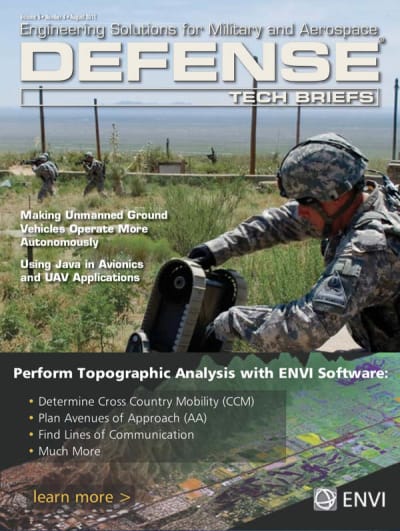
The August 2011 edition of Defense Tech Briefs presents a comprehensive overview of advancements in military and aerospace technology, focusing on unmanned systems, communication technologies, and innovative products. This issue highlights the evolution of various technologies and their applications in defense and related fields.
Key Features:
-
Unmanned Ground Vehicles (UGVs): The cover story discusses the increasing autonomy of UGVs, emphasizing their role in reducing operator workload and enhancing operational efficiency. The Army's focus on designing UGVs that can operate more independently is seen as a significant step towards achieving force multiplication on the battlefield. The article details how these vehicles are being tested in real-world scenarios, such as assault exercises, to assess their effectiveness and reliability.
-
Java in Avionics and UAV Applications: Another feature explores the integration of Java programming in avionics systems and unmanned aerial vehicles (UAVs). The use of Java is highlighted for its flexibility and ability to support complex applications, making it a suitable choice for modern avionics systems. The article discusses the benefits of using Java, including improved software development processes and enhanced system interoperability.
-
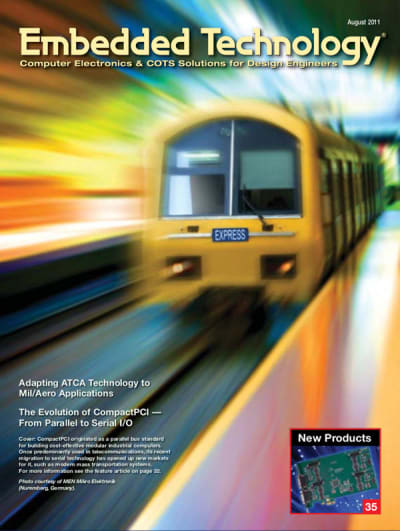
Adapting ATCA Technology to Military and Aerospace Applications: The issue also covers the adaptation of Advanced Telecommunications Computing Architecture (ATCA) technology for military and aerospace applications. Originally designed for telecommunications, ATCA's migration to military use is discussed, showcasing its potential for creating robust and scalable systems that meet the demanding requirements of defense applications.
The Evolution of CompactPCI: The magazine features an article on the evolution of CompactPCI technology, which has transitioned from a parallel bus standard to a serial I/O system. This shift has opened new markets, particularly in mass transportation systems, and has implications for the design and implementation of modular industrial computers.
-
New Products and Innovations: The issue includes a section dedicated to new products in the defense technology sector. Highlights include:
- Gallium Nitride High-Power Electronics: These components are noted for their efficiency and performance in high-power applications, making them suitable for various military uses.
- Photonics Innovations: The introduction of room-temperature sub-diffraction-limited plasmon lasers and rare-earth-doped soft glass optical fibers for coherent wavelength sources is discussed, showcasing advancements in photonics that could enhance communication and sensing capabilities.
- MEMS Switches for RF Applications: High-reliability Micro-Electro-Mechanical Systems (MEMS) switches are highlighted for their potential in radio frequency applications, offering improved performance and reliability.
-
Physical Sciences and Damage Detection: The magazine features an article on ultrasonic guided wave analysis for detecting damage in thin metallic plates. This technology is crucial for maintaining the integrity of military structures and equipment, providing a non-destructive method for assessing potential damage.
-
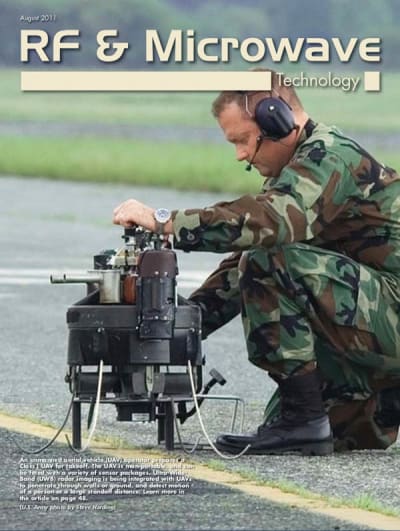
RF & Microwave Technology: A special section is dedicated to RF and microwave technology, including ultra-wide-band radar imaging for activity detection. This technology is particularly relevant for surveillance and reconnaissance missions, allowing for the detection of movement through walls or other obstacles.
-
Market Trends and Future Directions: The issue concludes with insights into market trends and future directions in defense technology. The ongoing integration of advanced technologies, such as artificial intelligence and machine learning, into military systems is discussed, highlighting the potential for enhanced decision-making and operational effectiveness.
Conclusion:
The August 2011 edition of Defense Tech Briefs serves as a valuable resource for professionals in the defense and aerospace sectors, providing insights into the latest technological advancements and their applications. The focus on unmanned systems, innovative communication technologies, and new product developments reflects the dynamic nature of the industry and the ongoing efforts to enhance military capabilities. As technology continues to evolve, the articles in this issue underscore the importance of adapting to new challenges and leveraging advancements to improve operational effectiveness in defense applications.
Features
-
Application Briefs
Hybrid Energy Storage System Designed for Tanks and Stryker Vehicles
-
Tech Transfer Reports
-
Articles
Making Unmanned Ground Vehicles Operate More Autonomously
Tech Briefs
-
Electronics & Computers
Microelectromechanical System (MEMS) Switch Test
-
Information Sciences
Data Fusion of Geographically Dispersed Information for Test and Evaluation
-
Photonics
Room-Temperature Sub-Diffraction-Limited Plasmon Laser
Rare-Earth-Doped Soft Glass Optical Fibers for Coherent Wavelength Sources Above 2 Microns
-
Physical Sciences
Process for Testing Aeromedical Equipment
Ultrasonic Guided Wave Analysis for Detecting and Classifying Damage in a Thin Metallic Plate
Top Stories
INSIDERRF & Microwave Electronics
 FAA to Replace Aging Network of Ground-Based Radars
PodcastsDefense
 A New Additive Manufacturing Accelerator for the U.S. Navy in Guam
NewsSoftware
 Rewriting the Engineer’s Playbook: What OEMs Must Do to Spin the AI Flywheel
Road ReadyPower
 2026 Toyota RAV4 Review: All Hybrid, All the Time
INSIDERDefense
 F-22 Pilot Controls Drone With Tablet
INSIDERRF & Microwave Electronics
 L3Harris Starts Low Rate Production Of New F-16 Viper Shield
Webcasts
Energy
 Hydrogen Engines Are Heating Up for Heavy Duty
Energy
 SAE Automotive Podcast: Solid-State Batteries
Power
 SAE Automotive Engineering Podcast: Additive Manufacturing
Aerospace
 A New Approach to Manufacturing Machine Connectivity for the Air Force
Software
 Optimizing Production Processes with the Virtual Twin
