




Deformable Mirrors Improve High-Energy Laser Accuracy
The Missile Defense Agency-funded Optical Physics Company (Calabasas, CA) has developed a new generation of deformable mirror systems that minimize unwanted surface distortion caused by the intense heat generated from high-energy laser radiation. Therefore, the mirror can direct highenergy lasers more precisely on target and for longer periods of time.
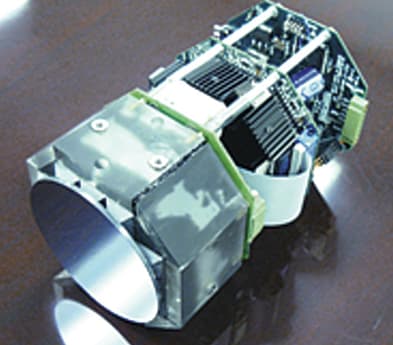 The Phase II funding helped OPC produce and test a 10-centimeter-diameter mirror. The company is expecting to receive add-on funding to build a 30-centimeter device, and is partnering with Lockheed Martin on a high-energy laser program.
How it Works
OPC’s adaptive optics system employs a Shack-Hartmann wavefront sensor and algorithms that account for and counteract the atmosphere’s scintillating effect. To direct the laser accurately, the sensor provides instructions to actuators that then make adjustments to the mirror’s shape. OPC’s actuators move over a range of up to 15 microns and can operate at 20 kilo-hertz.
The ability to whisk away the heat from the laser’s radiation is the reason why OPC’s thermal ripple is so small. The smaller the thermal ripple, the longer the laser beam can be employed. “You can continue to send out your laser beam for minutes, instead of seconds,” said Gail Erten, OPC’s director of marketing. “If you can hold it on target for a couple of minutes, you can punch a hole in even pretty thick metal. If all you had were seconds, then you’d just heat it up a little bit.”
Traditionally, electronics are placed on a rack several feet away from the mirror, connected by lengthy wiring. OPC’s configuration places the electronics on the back of the mirror itself, reducing latency.
Where it Stands
High-energy lasers may not be the only application of the mirror, according to OPC. Astronomers who want to eliminate distortion caused by the atmosphere’s light-refracting movement use deformable mirrors to counteract the effect.
Meanwhile, the company is expecting to receive an AS9100C certification — similar to an International Organization for Standardization certification for the aerospace industry — by mid-2011. Also, OPC is working on the Navy’s Free Electron Laser, which would protect ships from such surface and air threats as anti-ship cruise missiles or attacks from a swarm of small boats. Another potential customer for OPC’s mirror is the Defense Department’s High Energy Liquid Laser Area Defense System program, whose aim is to develop a high-energy laser weapon system that is lighter than existing laser systems so that it can be integrated onto tactical aircraft, significantly increasing engagement ranges compared with ground-based systems.
More Information
For more information on the OPC mirrors, visit http://info.hotims.com/34457-533 . (Source: Dale McGeehon/NTTC; MDA TechUpdate, Missile Defense Agency, National Technology Transfer Center Washington Operations)
Top Stories
INSIDERDesign
 How Airbus is Using w-DED to 3D Print Larger Titanium Airplane Parts
NewsSensors/Data Acquisition
 Microvision Aquires Luminar, Plans Relationship Restoration, Multi-industry Push
INSIDERManned Systems
 A Next Generation Helmet System for Navy Pilots
NewsAR/AI
 Accelerating Down the Road to Autonomy
INSIDERDefense
 New Raytheon and Lockheed Martin Agreements Expand Missile Defense Production
ArticlesAR/AI
 CES 2026: Bosch is Ready to Bring AI to Your (Likely ICE-powered) Vehicle
Webcasts
Transportation
 Advantages of Smart Power Distribution Unit Design for Automotive...
Automotive
 Quiet, Please: NVH Improvement Opportunities in the Early Design...
Electronics & Computers
 Cooling a New Generation of Aerospace and Defense Embedded...
Power
 Battery Abuse Testing: Pushing to Failure
AR/AI
 A FREE Two-Day Event Dedicated to Connected Mobility
