




Process for Testing Aeromedical Equipment
Proper test methods are required to ensure that medical devices do not adversely affect aircraft operation.
Medical devices are designed to function in environmentally controlled locations, such as stationary hospitals, and not within the harsh, dynamic aircraft environment. Yet, the same medical devices used to care for patients in a hospital environment are often the most capable devices for patient care during transport from one facility to another. These missions are called aeromedical evacuation (AE) missions, and they provide life-sustaining care for a vast array of patients. However, because the devices are designed for a controlled environment, concerns they may adversely affect the operation of aircraft systems must be addressed. Conversely, the aircraft may adversely affect the proper operation and efficacy of the medical equipment. Failure of medical devices during in-flight medical care may result in exposing patients and aircrew to hazardous situations.
- Baseline Assessment — The purpose of the baseline assessment is to verify that the equipment under test (EUT) operates in accordance with the manufacturer’s specifications and the operator’s manual. The EUT is evaluated for adherence to optimum human factors and basic electrical safety requirements.
- Laboratory Tests — The purpose of the laboratory testing phase is to simulate the operational in-flight environment through testing, which is modeled after a series of worst-case event scenarios such as a rapid decompression event or other aircraft incidences or mishaps. Typical laboratory tests include vibration, electromagnetic interference (EMI), hot and cold temperature extremes for operationaluse and storage, humidity, explosive atmosphere, altitude, rapid decompression, and acceleration.
- In-Flight Assessment (IFA) — The purpose of conducting an IFA for AE equipment is to perform functional checks onboard the aircraft during an aeromedical readiness mission. The controls, visual and audible alarms, and display screen of the AE equipment are observed and evaluated during the flight. Test personnel interact with and solicit feedback from AE crewmembers regarding the device’s form, fit, and function. These data are used to identify any remaining issue with the use of the device that may not arise during the simulated laboratory test scenarios.
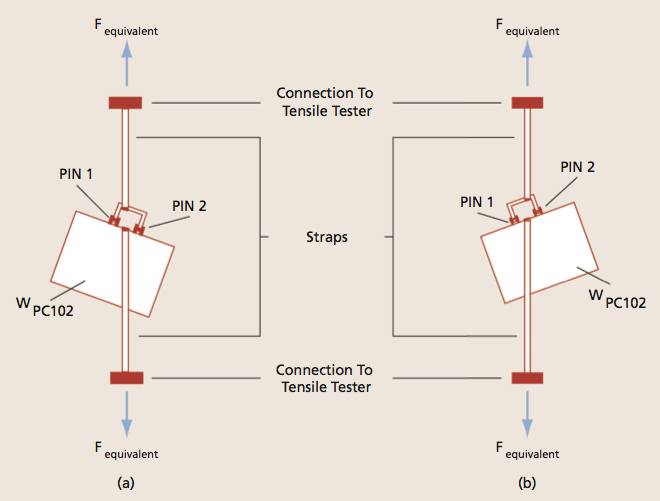
The various types of analysis and test methods raise questions as to what the correct decision process is for selecting the most appropriate method for STF testing of AE equipment. The process used in this work has proven to be well suited for identifying the most appropriate test method — one that not only represents the most appropriate and effective test method, but also minimizes the use of available resources. This process includes testing both structurally simple and complex equipment, and successfully introducing the use of the Equivalent Load Testing (ELT) method, which permits the use of alternative testing approaches, such as pull testing and tensile testing.
The initial task is to evaluate the test article for any inherent safety concerns. For example, the team identified that AE devices weighing less than five pounds are usually perceived to pose no substantial risks due to acceleration; therefore, a quick assessment and description of the equipment tie-down were found satisfactory. When the test team finds product-level tests are required, the article is tested in a physical environment, namely sled tracks or centrifuges, or a model representing the product can be developed and analyzed using finite element analysis (FEA) simulation.
The component-level tests refer to the tests specific to a sub-component or a structural member of the equipment, i.e., mounting brackets, screws, beams, straps, etc. When the decision is a component-level test type, the team applies the ELT method by conducting an in-depth evaluation of the test article, identifying the critical areas within the item, and noting any potential safety concerns within the environment. The outcome of this evaluation is a list of tasks that includes a series of tests, analyses, inspections, and evaluations.
The ELT terminology refers to the constant, or approximately constant loading that is applied to the test item for a finite duration. The magnitude, point of application, and the direction of the load are equivalent to the properties of inertial loads and moments generated in an acceleration event under g-levels. The magnitude of the equivalent load is determined using the magnitude of the sustained acceleration load that would be exerted on a tie-down component, a critical part, or a joint of the equipment in a physical test. For example, 9g of acceleration introduces 90 pounds inertial load on a device with 10 pounds of weight; and the critical areas, such as tie-downs and restraints, must be tested to verify they are capable of restraining the inertial loads and moments.
This work was done by Ismail Cicek and Gary S. Beisner of the U.S. Air Force for the Defense Acquisition University. DAU-0001
This Brief includes a Technical Support Package (TSP).
Process for Testing Aeromedical Equipment
(reference DAU-0001) is currently available for download from the TSP library.
Don't have an account?
More From SAE Media Group


Medical Design Briefs
Medical Device Package Testing: Developing a Test Plan that Avoids Product Launch Delays
Aerospace & Defense Tech Briefs
Laboratory Test Requirements for Marine Shock Isolation Seats

Medical Design Briefs
Addressing Challenges in Primary Packaging Testing for Medical Devices
Medical Design Briefs
Preparing for MDR? Don’t Overlook the Analytical Evaluation Threshold
Medical Design Briefs
Creating Robust Reprocessing Instructions for Reusable Device IFUs

Aerospace & Defense Tech Briefs
Sensuron Enables Real-Time Structural Health Monitoring Onboard NASA’s X-56 UAV
Aerospace & Defense Tech Briefs
Understanding Fiber Optic Transceiver Design and Test Rules
Medical Design Briefs
Peeling Back the Layers: Adhesives Testing for Wearables
Medical Design Briefs
On the Rise: Wearable Injector Systems
Medical Design Briefs
Impact-Modified Acrylic Copolymers: Evaluating Chemical Resistance
Aerospace & Defense Tech Briefs
Uncrewed Solar Aircraft Passes Key Ground Tests
Aerospace & Defense Tech Briefs
New AFRL Chamber Enhances Equipment Performance in Extreme Environments
Medical Design Briefs
The Three Challenges in Biomedical QC Testing
Aerospace & Defense Tech Briefs
Preliminary Development of an Integrated Mobility, Lethality, and Survivability Soldier Performance Testing Platform
Medical Design Briefs
Linear Motion Design Considerations for Medical Device OEMs
Medical Design Briefs
Simplifying Device Design with PCB Connectors
Medical Design Briefs
Four-Step Plastic Testing Protocol: Making Informed Design and Material Decisions
Tech Briefs
Measuring Aggressive Launch Loads on Spacecraft
Aerospace & Defense Tech Briefs
Formal Process Modeling to Improve Human-Decision-Making During Test and Evaluation Range Control
Aerospace & Defense Tech Briefs
New Method to Measure Wind Speed Could Unlock Drones’ Potential
Medical Manufacturing and Machining
Integrating Vision and Force Measurement into Medical Quality Control
Aerospace INSIDER
Air Force Conducts Aircrew Chemical Weapon Protection Test
Medical Design Briefs
Medical Design Briefs: 2022 Technology Leaders
Medical Design Briefs
Power Supplies: Speeding Time to Market for Medical Equipment
Medical Design Briefs
Six Tips for Ensuring Precise Compact Distance Measurements
Aerospace & Defense Tech Briefs
Industry Invited to Participate in AeroTech Aerospace and Defense Technical Program
Overview
The document titled "A New Process for the Acceleration Test and Evaluation of Aeromedical Equipment for U.S. Air Force Safe-To-Fly Certification," published by the Defense Acquisition University in October 2010, outlines a systematic approach to ensure the safety and reliability of aeromedical equipment used in military aviation. The primary focus is on the certification process that guarantees such equipment is safe for flight operations, particularly in the dynamic and often harsh environment of aircraft.
The report emphasizes the need for rigorous testing and evaluation methods to meet the U.S. Air Force's safety standards. It details a comprehensive methodology that combines analysis, inspection, and supporting tests to fulfill the acceleration test requirements. This approach is crucial for assessing the structural integrity and functionality of aeromedical equipment, which is designed to operate effectively under challenging conditions, unlike typical medical devices that function in controlled environments like hospitals.
The document describes a case study involving the acceleration test and evaluation team, which conducted an in-depth structural analysis of a specific aeromedical equipment unit (SUT No. 1). During this analysis, 23 tasks were identified, focusing on the testing, inspection, and evaluation of structural members, restraint mechanisms, and tie-downs. This thorough examination is essential to ensure that the equipment can withstand the stresses encountered during flight.
Additionally, the report references relevant regulations and standards, including the Special Federal Aviation Regulation and the Department of Defense's human engineering design criteria for military systems. These references underscore the importance of adhering to established guidelines to maintain safety and effectiveness in aeromedical operations.
Overall, the document serves as a critical resource for understanding the processes involved in certifying aeromedical equipment for flight. It highlights the collaborative efforts of various teams and the importance of a structured testing approach to enhance the safety of personnel during aeromedical evacuations. By implementing these rigorous testing protocols, the U.S. Air Force aims to ensure that all aeromedical equipment meets the highest safety standards, ultimately protecting the lives of those who rely on these systems during emergencies.
Top Stories
NewsRF & Microwave Electronics
 Microvision Aquires Luminar, Plans Relationship Restoration, Multi-industry Push
INSIDERAerospace
 A Next Generation Helmet System for Navy Pilots
INSIDERDesign
 New Raytheon and Lockheed Martin Agreements Expand Missile Defense Production
INSIDERMaterials
 How Airbus is Using w-DED to 3D Print Larger Titanium Airplane Parts
NewsPower
 Ford Announces 48-Volt Architecture for Future Electric Truck
ArticlesAR/AI

Webcasts
Electronics & Computers
 Cooling a New Generation of Aerospace and Defense Embedded...
Automotive
 Battery Abuse Testing: Pushing to Failure
Power
 A FREE Two-Day Event Dedicated to Connected Mobility
Unmanned Systems
 Quiet, Please: NVH Improvement Opportunities in the Early Design Cycle
Automotive
 Advantages of Smart Power Distribution Unit Design for Automotive &...
Energy
 Sesame Solar's Nanogrid Tech Promises Major Gains in Drone Endurance