




Uncrewed Solar Aircraft Passes Key Ground Tests
The German Aerospace Center’s (DLR) solar-powered high altitude platform (HAP) has completed ground vibration testing, in preparation for low altitude flight testing planned for 2026.

High-altitude uncrewed aircraft can remain in the lower stratosphere for extended periods, performing a wide range of Earth observation and communications tasks – from monitoring shipping lanes and supporting disaster response to providing internet access. The German Aerospace Center (Deutsches Zentrum für Luft- und Raumfahrt; DLR) has now taken an important step in the development of its own high-flying solar aircraft by successfully completing a Ground Vibration Test (GVT) on its innovative HAP-alpha high-altitude platform. Extensive ground trials took place at DLR’s National Experimental Test Center for Unmanned Aircraft Systems in Cochstedt, Germany. Further tests will follow and the first low-altitude flight trial is planned for 2026, subject to ideal weather conditions.
“With HAP-alpha, DLR is demonstrating its comprehensive systems expertise in the complete design, development and operation of a new and innovative aircraft, incorporating all disciplines,” explains DLR Executive Board Member for Aeronautics, Markus Fischer. “This illustrates our engagement in an important field of innovation, to strengthen Germany as a location for technology and business and to open up new perspectives for our public stakeholders in collaboration and knowledge exchange.”
HAP-alpha is a highly elastic, solar-powered flight platform with an extremely lightweight design, manufactured at DLR’s site in Braunschweig with a total mass of just 138 kilograms and a wingspan of 27 meters. The goal of this DLR project is to develop, build and operate a high-flying uncrewed solar aircraft. It will serve as a test platform, flying into the lower stratosphere at an altitude of approximately 20 kilometers. There, sensor systems and technologies for long-term use on a high-flying platform will be tested.
Key Milestone in Flight Readiness Achieved

The now completed GVT is an important milestone for investigating the vibration behavior of an aircraft. The goal is to identify critical vibrations that can occur during flight, takeoff and landing. This determines whether an aircraft is safe and thus airworthy. For HAP-alpha, the successful GVT marks a key step on the way to the first flight tests next year, which will involve basic flight maneuvers at low altitude.
“The successful Ground Vibration Test is a significant step in the development of our high-altitude platform,” said Julian Sinske of the DLR Institute of Aeroelasticity, which conducted the GVT. “It shows that we are on the right track to overcoming complex aeroelastic challenges and preparing the platform for flight.”
During the GVT, numerous sensors were used to record the dynamic properties of the platform, which was fitted with electromechanical vibrators so that its vibration characteristics could be identified. A particular challenge of the GVT on HAP-alpha was its very lightweight and therefore very flexible design.

The acquired data will now be used to update simulation models and predict flight behavior even more precisely – especially during maneuvers, turbulence and gusts of wind. “This allows the project team to focus on the upcoming complete system tests, which will mark the completion of ground testing and enable subsequent flight testing,” adds HAP project leader Florian Nikodem from the DLR Institute of Flight Systems.
Testing Sensor Systems and Technologies
With HAP-alpha, DLR aims to build comprehensive expertise for the development of high-performance, high-altitude solar-powered aircraft. HAP-alpha will also serve as a carrier platform for testing sensor systems and system technologies under realistic operating conditions in the lower stratosphere. In addition to the platform itself, DLR is developing two sensor systems for use on HAP-alpha, as well as optimized evaluation methods.
The sensor systems are a high-resolution camera system (MACS-HAP – Modular Aerial Camera System High Altitude Platform) and a synthetic aperture radar (HAPSAR – High Altitude Platform Synthetic Aperture Radar). Through this work, DLR is developing sustainable, long-life high-altitude platforms that will enable a wide range of future applications in Earth observation, environmental monitoring and communications.
This article was written by the German Aerospace Center (DLR). For more information, contact Falk Dambowsky, at
More From SAE Media Group
Aerospace & Defense Tech Briefs
Assessment of Noncommercial Icing Prediction Capabilities for Army Applications
Tech Briefs
Algorithms Improve Quadrotor Drone Performance
Aerospace & Defense Tech Briefs
Rising Star Awards: Women in Engineering Aerospace Winner - Heather Cummings

Aerospace INSIDER
NASA System Would Enable Unmanned Aircraft to Fly in US Airspace
Aerospace & Defense Tech Briefs
Sensuron Enables Real-Time Structural Health Monitoring Onboard NASA’s X-56 UAV
Aerospace & Defense Tech Briefs
New Method to Measure Wind Speed Could Unlock Drones’ Potential
Motion Design INSIDER
Tailless Jet Flies Free with Novel Control Technique
Aerospace INSIDER
Army’s “Robo-Raven” UAV Flies with Flapping Wings
Aerospace Manufacturing and Machining INSIDER
Heavy Ground Testing Puts Airbus’ BelugaXL On Track for First Flight
Aerospace INSIDER
Commercial UAS Observes Earth for Days or Weeks at a Time
Aerospace & Defense Tech Briefs
MUSHER Demonstrates Manned-Unmanned Aircraft Teaming Applications
Aerospace INSIDER
NASA Brings Air Mobility Vision to Stratospheric Heights
Tech Briefs
Novel Control Method in Tailless Aircraft
Motion Design INSIDER
AI-Powered Vision System Helps Drones Navigate Safely
NASA Spinoff
From Shark Searches to Space Tours
Tech Briefs
AIRVUE: Prelude to Self-Flying Aircraft
Aerospace & Defense Tech Briefs
VISTA X-62

NASA Spinoff
Eagle Eyes in Treacherous Skies
Aerospace & Defense Tech Briefs
AI Algorithms Fly Valkyrie XQ-58A
Aerospace & Defense Tech Briefs
Airbus to Fly Prototype eVTOL This Year
Aerospace INSIDER
Joby Aviation Announces Acoustic Data from NASA Testing
Aerospace & Defense Tech Briefs
High-Altitude Pseudo Satellites: New Battle for Inner Space, Part II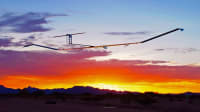

NASA Spinoff
NASA Helps Drones Take Flight

Top Stories
INSIDERManufacturing & Prototyping
 How Airbus is Using w-DED to 3D Print Larger Titanium Airplane Parts
INSIDERManned Systems
 FAA to Replace Aging Network of Ground-Based Radars
NewsTransportation
 CES 2026: Bosch is Ready to Bring AI to Your (Likely ICE-powered) Vehicle
NewsSoftware
 Accelerating Down the Road to Autonomy
EditorialDesign
 DarkSky One Wants to Make the World a Darker Place
INSIDERMaterials
 Can This Self-Healing Composite Make Airplane and Spacecraft Components Last...
Webcasts
Defense
 How Sift's Unified Observability Platform Accelerates Drone Innovation
Automotive
 E/E Architecture Redefined: Building Smarter, Safer, and Scalable...
Power
 Hydrogen Engines Are Heating Up for Heavy Duty
Electronics & Computers
 Advantages of Smart Power Distribution Unit Design for Automotive...
Unmanned Systems
 Quiet, Please: NVH Improvement Opportunities in the Early Design...
