




Heavy Ground Testing Puts Airbus’ BelugaXL On Track for First Flight
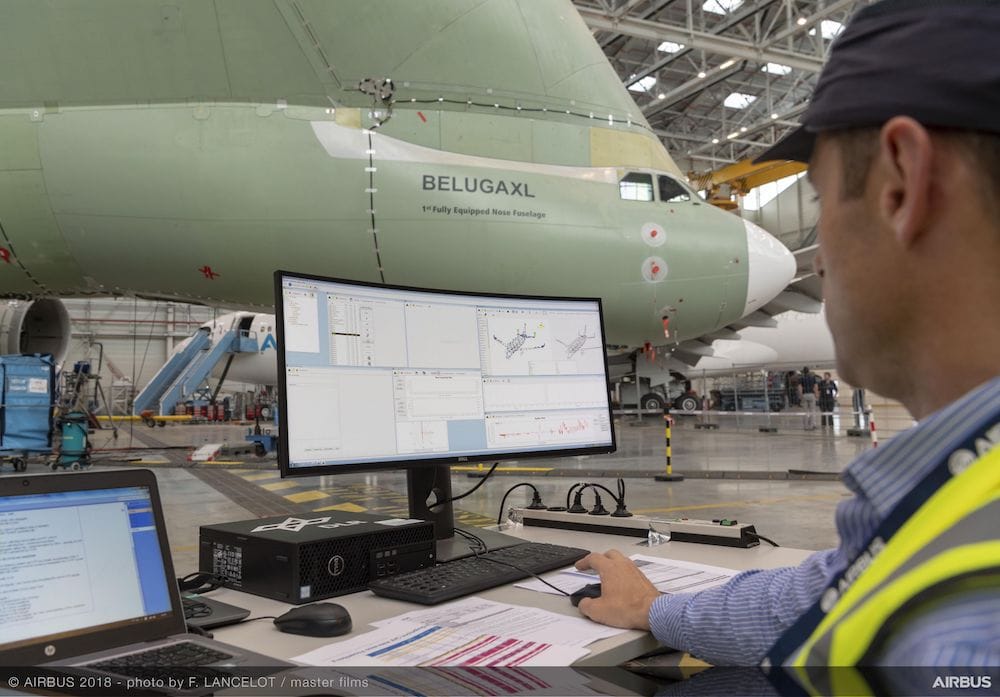
In preparation for its upcoming maiden flight, Airbus’ first BelugaXL is now in its heavy ground test phase – which focuses on the highly modified airframe for this next-generation oversize cargo airlifter.
According to ground test project leader Mathieu Laemle, a total of 72 development and certification ground tests must be performed before the BelugaXL’s high-profile first flight. “With more than 48 tests already completed, we are on time,” he added. “The big challenge was to be able to anticipate or modify the test scheduling so as not to impact final assembly.”
Airbus has succeeded in keeping things on track thanks to early analysis of the requirements and excellent multidisciplinary collaboration between the design office, laboratories, tests and program teams.
Heavy ground tests started with the team weighing the no. 1 BelugaXL at “pitch zero” and then at “pitch nine,” lifting the aircraft’s nose by 3.5 meters to determine the empty weight center of gravity. Next, they performed the standard loads and horizontal tailplane tests, which were followed by separate evaluations involving the dorsal fin and vertical tailplane.
The heavy ground test phase involves carrying out tests on the aircraft that would usually be conducted on a static cell. “It is unusual for us to perform tests like load calibration using the generalized finite element method of analysis on an aircraft which will fly, as we usually use a dedicated clean aircraft without any systems inside,” explained BelugaXL aircraft configuration leader Arnaud Puyo.
With the loads calibration test campaign completed, the team then began ground vibration testing performed in conjunction with the French ONERA aerospace research center and DLR, the German aerospace research center. The eight-day ground vibration campaign, which began 28 May, saw the BelugaXL tested while both empty and fully loaded. The activity required one week of intensive preparation during which the aircraft was put on pneumatic suspension and special shakers were installed to make it move.
The team identified 30 different locations for the 80-kg. shakers and during tests lasting two-to-three hours, sensors inside and outside the aircraft measured the structure’s response. Vibration data from the test are used in validating and improving structural dynamic models for the aircraft.
With the ground vibration tests now complete, subsequent steps ahead of the aircraft’s maiden flight include validating the flight test instrumentation and applying the BelugaXL’s special “smiling” livery.
Starting in mid-2019, the BelugaXL will gradually replace the existing five-member Beluga ST fleet – which is used for carrying complete sections of Airbus aircraft from different production sites around Europe to the final assembly lines in Toulouse, France and Hamburg, Germany.
More From SAE Media Group
Aerospace & Defense Tech Briefs
ONERA and DLR Shake up the Airbus BelugaXL Cargo Aircraft
Aerospace & Defense Tech Briefs
First Airbus A330-800 Airliner Goes Airborne in Maiden Flight, Enters Flight Test Phase
Aerospace & Defense Tech Briefs
First Airbus BelugaXL Oversize Cargo Airlifter Emerges from Paint Shop with Employee-Selected, Whale-Inspired Livery
Aerospace INSIDER
Pilot Assistance System Enables Low-Noise Landings
Aerospace INSIDER
Turkey's KAAN Combat Aircraft Completes First Flight
Aerospace Manufacturing and Machining INSIDER
Airbus Announces Expansion of Aircraft Manufacturing in the U.S.
Aerospace Manufacturing and Machining INSIDER
GA-ASI Installs First V-Tail from GKN Aerospace onto MQ-9B RPA
Aerospace INSIDER
Archer Achieves First Untethered Flight with Midnight eVTOL
Motion Design INSIDER
Tailless Jet Flies Free with Novel Control Technique
Aerospace & Defense Tech Briefs
Uncrewed Solar Aircraft Passes Key Ground Tests
Aerospace & Defense Tech Briefs
BelugaXL Successfully Completes Maiden Flight
Aerospace INSIDER
Archer Delivers First Midnight eVTOL to US Air Force
Aerospace INSIDER
Airbus Reveals Blended Wing Aircraft Demonstrator
Tech Briefs
Novel Control Method in Tailless Aircraft
Aerospace & Defense Tech Briefs
Hybrid Electric Aircraft Demonstrator
Aerospace & Defense Tech Briefs
Rear Fuselage Packer

Aerospace INSIDER
Airbus Starts Flight Testing Upgraded French Army Helicopter
Aerospace & Defense Tech Briefs
Airbus to Fly Prototype eVTOL This Year
Aerospace INSIDER
Quarterhorse Hypersonic Test Aircraft Completes First Flight
Aerospace INSIDER
NASA’s Quiet Supersonic Demonstrator Jet Completes First Flight
Tech Briefs
The Future of Supersonic Travel
Aerospace & Defense Tech Briefs
Boeing Completes Assembly of the First 777X
Aerospace INSIDER
Embraer Completes First Flight of E-Freighter Jet
Aerospace INSIDER
Hermeus Rolls Out First Quarterhorse Hypersonic Test Aircraft
Top Stories
NewsRF & Microwave Electronics
 Microvision Aquires Luminar, Plans Relationship Restoration, Multi-industry Push
INSIDERAerospace
 A Next Generation Helmet System for Navy Pilots
INSIDERDesign
 New Raytheon and Lockheed Martin Agreements Expand Missile Defense Production
INSIDERMaterials
 How Airbus is Using w-DED to 3D Print Larger Titanium Airplane Parts
NewsPower
 Ford Announces 48-Volt Architecture for Future Electric Truck
ArticlesAR/AI

Webcasts
Electronics & Computers
 Cooling a New Generation of Aerospace and Defense Embedded...
Automotive
 Battery Abuse Testing: Pushing to Failure
Power
 A FREE Two-Day Event Dedicated to Connected Mobility
Unmanned Systems
 Quiet, Please: NVH Improvement Opportunities in the Early Design Cycle
Automotive
 Advantages of Smart Power Distribution Unit Design for Automotive &...
Energy
 Sesame Solar's Nanogrid Tech Promises Major Gains in Drone Endurance