




NASA’s Quiet Supersonic Demonstrator Jet Completes First Flight

Lockheed Martin Skunk Works, and NASA recently completed the first flight of the X-59, a quiet supersonic aircraft that is being flight tested to help establish an acceptable noise standard for future commercial supersonic flights over land.
The X-59 took off from Skunk Works' facility at U.S. Air Force Plant 42 in Palmdale, California, before landing near NASA's Armstrong Flight Research Center in Edwards, California. The aircraft performed exactly as planned, verifying initial flying qualities and air data performance on the way to a safe landing at its new home.
"We are thrilled to achieve the first flight of the X-59," said OJ Sanchez, Vice President and General Manager of Lockheed Martin Skunk Works. "This aircraft is a testament to the innovation and expertise of our joint team, and we are proud to be at the forefront of quiet supersonic technology development."
At 99.7 feet long and 29.5 feet wide, the aircraft’s shape and the technological advancements it houses will make quiet supersonic flight possible. The X-59 is designed to fly at Mach 1.4 — 1.4 times the speed of sound — or 925 mph. Lockheed Martin has not publicly released official details about the top speed reached by the X-59 during its maiden flight.
RELATED: NASA's X-59 Supersonic Plane Takes Flight
The X-59 is designed to demonstrate the ability to fly at supersonic speeds while reducing the sonic boom generated to a gentle thump. In doing so, the aircraft aims to overcome one of the primary barriers to supersonic commercial flight, which is currently restricted over land due to noise concerns.
The X-59's successful development and flight testing will inform the establishment of new data-driven acceptable noise thresholds related to supersonic commercial flight over land, paving the way for a new generation of supersonic aircraft that can efficiently and sustainably transport passengers and cargo twice as fast as aircraft today.
Skunk Works will continue to lead the aircraft's initial flight test campaign, working closely with NASA to expand the X-59's flight envelope over the coming months. Part of this test journey will include the X-59's first supersonic flights, where the aircraft will achieve the optimal speed and altitude for a quiet boom. This will enable NASA to operate the X-59 to measure its sound signature and conduct community acceptance testing.
More From SAE Media Group


Tech Briefs
The Future of Supersonic Travel
Aerospace & Defense Tech Briefs
Lockheed Martin Skunk Works Begins Manufacturing X-59 Supersonic Aircraft Parts
Aerospace INSIDER
Quarterhorse Hypersonic Test Aircraft Completes First Flight

Aerospace Manufacturing and Machining INSIDER
NASA’s Supersonic X-59 QueSST Being Built at Famed Factory
Aerospace & Defense Tech Briefs
NASA to Test Quiet Thump Supersonic Propulsion Technique, Measure Sound Levels and Community Response
NASA Spinoff
Flying (Not Quite) Blind
Automotive Engineering
NASA Picks Lockheed to Build Low-Boom X-Plane

Aerospace INSIDER
X-59 Supersonic Aircraft Cleared for Final Assembly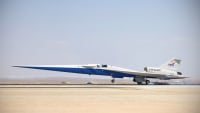
Tech Briefs
NASA's X-59 Supersonic Plane Takes Flight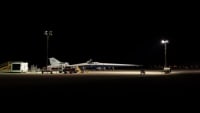
Aerospace & Defense Tech Briefs
Collins Aerospace Will Provide Avionics and Synthetic Vision for the Supersonic X-59 QueSST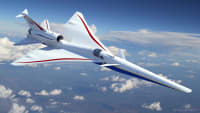
Aerospace INSIDER
New Probe Could Improve Sonic Boom Investigation
Aerospace INSIDER
Archer Achieves First Untethered Flight with Midnight eVTOL

Aerospace INSIDER
A Next Generation Helmet System for Navy Pilots
Aerospace & Defense Tech Briefs
NASA Partners with ONERA on Low-Boom Supersonic Flight
Tech Briefs
Using Aerial Towing to Study Sonic Booms
Aerospace INSIDER
Archer Delivers First Midnight eVTOL to US Air Force
Aerospace INSIDER
NASA Test Flights Will Study Improved Efficiency of Supersonic Aircraft
Tech Briefs
How Jet Engine Flow Can Be Controlled Optically
Autonomous Vehicle Engineering
Supersonic Spy Drone
Aerospace INSIDER
Turkey's KAAN Combat Aircraft Completes First Flight
Top Stories
NewsSensors/Data Acquisition
 Microvision Aquires Luminar, Plans Relationship Restoration, Multi-industry Push
INSIDERRF & Microwave Electronics
 A Next Generation Helmet System for Navy Pilots
INSIDERWeapons Systems
 New Raytheon and Lockheed Martin Agreements Expand Missile Defense Production
NewsAutomotive
 Ford Announces 48-Volt Architecture for Future Electric Truck
INSIDERAerospace
 Active Strake System Cuts Cruise Drag, Boosts Flight Efficiency
ArticlesTransportation

Webcasts
Aerospace
 Cooling a New Generation of Aerospace and Defense Embedded...
Energy
 Battery Abuse Testing: Pushing to Failure
Power
 A FREE Two-Day Event Dedicated to Connected Mobility
Automotive
 Quiet, Please: NVH Improvement Opportunities in the Early Design Cycle
Electronics & Computers
 Advantages of Smart Power Distribution Unit Design for Automotive &...
Unmanned Systems
 Sesame Solar's Nanogrid Tech Promises Major Gains in Drone Endurance