




NASA Partners with ONERA on Low-Boom Supersonic Flight
The French Aerospace Lab will work with NASA to develop method of determining where sonic booms hit the ground.

Last week, NASA and France’s Office National d'Etudes et de Recherches Aerospatiales (ONERA) signed a research agreement to collaborate on mitigating sonic boom noise produced by supersonic aircraft.
The research hinges on developing an accurate method of determining where the sound waves of sonic booms will impact the ground as supersonic aircraft fly overhead. This work could lead to reducing the harmful ground effects of sonic booms and give way to safe, supersonic passenger flights over land.
The agreement, signed during bilateral meetings held in conjunction with the 2018 Farnborough International Air Show in the United Kingdom, is the 12th agreement between the two organizations and the third that is still active.
“This partnership shows there is interest in supersonic travel all over the world,” says Jaiwon Shin, associate administrator for NASA aeronautics . “Solving the issue of annoying sonic booms could ultimately cut travel time to worldwide destinations in half.”
“This new partnership comes as a natural follow-up to a decade of successful cooperation between NASA and ONERA on the topic of aircraft noise mitigation, as well as an exciting perspective to revive the pioneering era of supersonic aviation,” said Bruno Sainjon, ONERA’s chief executive officer.
ONERA – internationally known as “The French Aerospace Lab” – is a public, application-based research establishment. The organization recently completed static ground vibration testing on the Airbus Beluga XL heavy lift cargo aircraft.
The cooperation under this agreement will create a forum through which NASA and ONERA can share technical knowledge and data in order to independently improve their own capabilities, with the overall objective of mitigating the effects of sonic booms produced by civil air transportation.
Both organizations will define common verification cases, use numerical tools to predict where sonic booms will reach the ground, and perform detailed analyses and comparisons of the results. NASA’s efforts toward this agreement complement work currently taking place at NASA’s Langley Research Center in Virginia.
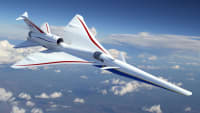
NASA has expressed commitments to conducting research that will enable a robust commercial supersonic market, including faster-than-sound air travel over land. The agency is currently vested in the development of the Lockheed Martin X-59 QueSST demonstrator aircraft through the Low-boom Flight Demonstration mission. The X-59’s airframe has been designed in such a way that the sound produced when transitioning to supersonic speeds will be as quiet as a “gentle thump.”
NASA intends to fly the X-59 over select U.S. communities to gather data on human responses to the low-boom flights and deliver that data set to U.S. and international regulators, with the end goal of overcoming public health and safety concerns related to supersonic flight over land.
William Kucinski is content editor at SAE International, Aerospace Products Group in Warrendale, Pa. Previously, he worked as a writer at the NASA Safety Center in Cleveland, Ohio and was responsible for writing the agency’s System Failure Case Studies. His interests include 'literally anything that has to do with space,' past and present military aircraft, and propulsion technology.
Contact him regarding any article or collaboration ideas by e-mail at
More From SAE Media Group
Aerospace & Defense Tech Briefs
NASA to Test Quiet Thump Supersonic Propulsion Technique, Measure Sound Levels and Community Response
Aerospace & Defense Tech Briefs
NASA’s Next X-Plane Passes Major Review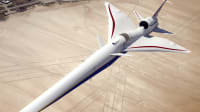

Automotive Engineering
NASA Picks Lockheed to Build Low-Boom X-Plane
Aerospace & Defense Tech Briefs
Lockheed Martin Skunk Works Begins Manufacturing X-59 Supersonic Aircraft Parts
Aerospace & Defense Tech Briefs
NASA Crash Landing Is a Complete Success
Aerospace & Defense Tech Briefs
Collins Aerospace Will Provide Avionics and Synthetic Vision for the Supersonic X-59 QueSST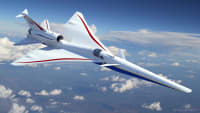
Aerospace & Defense Tech Briefs
USAF Take Rates Continue to Drop Despite Retainment Bonuses
Aerospace & Defense Tech Briefs
The F-35 Is Getting Life-Saving Automatic Ground Collision Avoidance Systems from the F-16
Aerospace & Defense Tech Briefs
How Has Automation Transformed Aviation?
Aerospace & Defense Tech Briefs
Industry Invited to Participate in AeroTech Aerospace and Defense Technical Program
Aerospace & Defense Tech Briefs
Maintainers Design a $400 Maintenance Fixture to save the U.S. Air Force $500k per Year
Aerospace & Defense Tech Briefs
Battery Technology Is Still the Key Barrier to Better Urban Air Mobility
Aerospace & Defense Tech Briefs
First Airbus A330-800 Airliner Goes Airborne in Maiden Flight, Enters Flight Test Phase
Aerospace & Defense Tech Briefs
Boeing Debuts First Hypersonic Passenger Aircraft Concept
Aerospace & Defense Tech Briefs
Russia to Develop Supersonic Passenger Jet
Aerospace & Defense Tech Briefs
New Research on Noise Reduction for Next Generation Aircraft Engines
Aerospace & Defense Tech Briefs
When It Comes to Fifth-Generation Assets, Air Force Values Virtual Training over Live Flying
Aerospace & Defense Tech Briefs
Air Mobility Innovations Take Center Stage at Aerospace Systems and Technology Conference
Aerospace & Defense Tech Briefs
Like a Good Neighbor, Impossible Aerospace Flew over to a Nearby Construction Fire to Help Locate Hotspots for First Responders
Aerospace & Defense Tech Briefs
Sensuron Enables Real-Time Structural Health Monitoring Onboard NASA’s X-56 UAV
Aerospace & Defense Tech Briefs
MTSI’s Latest Project Gives Fixed-Wing Aircraft Vertical Cargo Lift Capabilities
Aerospace & Defense Tech Briefs
Boeing and NASA Unveil Lightweight, Ultra-Thin, More Aerodynamic Transonic Truss-Braced Wing Concept
Aerospace & Defense Tech Briefs
L3 Makes Its C-130 Modernization Package Available to Global Operators
Aerospace & Defense Tech Briefs
ONERA and DLR Shake up the Airbus BelugaXL Cargo Aircraft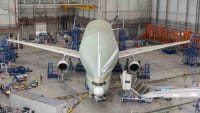
Automotive Engineering
Bye Aerospace’s Solar-Electric Prototype Completes First Flight
Aerospace & Defense Tech Briefs
General Atomics Moves Toward Global RPA Flight Certification for MQ-9B SkyGuardian
Aerospace & Defense Tech Briefs
AirMap and Skyguide Deploy Swiss National Flight Information Management System for Drones
Transcript
No transcript is available for this video.
Top Stories
NewsRF & Microwave Electronics
 Microvision Aquires Luminar, Plans Relationship Restoration, Multi-industry Push
INSIDERAerospace
 A Next Generation Helmet System for Navy Pilots
INSIDERDesign
 New Raytheon and Lockheed Martin Agreements Expand Missile Defense Production
INSIDERMaterials
 How Airbus is Using w-DED to 3D Print Larger Titanium Airplane Parts
NewsPower
 Ford Announces 48-Volt Architecture for Future Electric Truck
ArticlesAR/AI

Webcasts
Electronics & Computers
 Cooling a New Generation of Aerospace and Defense Embedded...
Automotive
 Battery Abuse Testing: Pushing to Failure
Power
 A FREE Two-Day Event Dedicated to Connected Mobility
Unmanned Systems
 Quiet, Please: NVH Improvement Opportunities in the Early Design Cycle
Automotive
 Advantages of Smart Power Distribution Unit Design for Automotive &...
Energy
 Sesame Solar's Nanogrid Tech Promises Major Gains in Drone Endurance