




NASA’s Next X-Plane Passes Major Review
The X-59 QueSST project is now committed to a three-year timeline.

NASA has officially committed to a three-year development timeline that will lead to the first flight of its X-59 Quiet Supersonic Technology (QueSST) aircraft.
This critical milestone comes after a rigorous review, called “Key Decision Point-C (KDP-C),” that confirmed NASA’s continued support of the X-59 in terms of funding. It establishes an achievable development timeline for NASA’s first piloted full-size X-plane in more than three decades.
“This aircraft has the potential to transform aviation in the United States and around the world by making faster-than-sound air travel over land possible for everyone,” said NASA Administrator Jim Bridenstine.
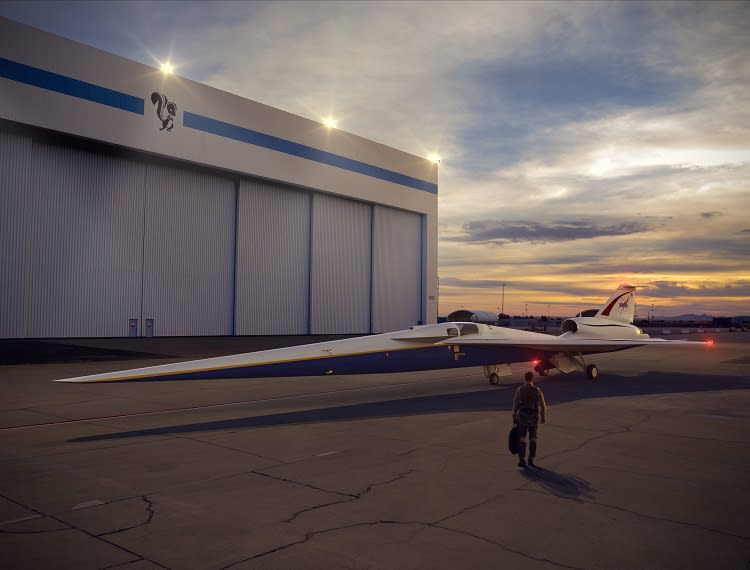
“We can’t wait to see this bird fly!” added Bridenstine.
KDP-C commits NASA to the full X-59 development effort through flight-testing in 2021. The cost and schedule commitments outlined in KDP-C align the project with program management best practices that account for potential technical risks and budgetary uncertainty beyond the project’s control.
“This is a monumental milestone for the project,” said Jaiwon Shin, NASA’s associate administrator for aeronautics. “I’m extremely proud of the team for its hard work getting to this point, and we all look forward to watching this aircraft take shape and then take flight.”
The X-59 QueSST is shaped to reduce the loudness of a sonic boom to that of a gentle thump, if it’s heard at all. The supersonic aircraft will be flown above select U.S. communities to measure public perception of the noise – data that will help regulators establish new rules for commercial supersonic air travel over land.
Earlier this month, NASA conducted test flights in Galveston, Texas, with a modified McDonnell Douglas F/A-18 supersonic research aircraft in a unique maneuver intended to produce a quieter “thump.” NASA surveyed volunteers from Galveston to determine how audible the supersonic thumps were in order to better understand successful data collection methods for the X-59.
Read more: NASA to test quiet thump supersonic propulsion technique, measure sound levels and community response
Furthermore, NASA will be working with France’s Office National d'Etudes et de Recherches Aerospatiales (ONERA) to develop an accurate method of determining where the sound waves of sonic booms will impact the ground as supersonic aircraft fly overhead.
Read more: NASA partners with ONERA on low-boom supersonic flight
Management of X-59 QueSST development falls under the Low Boom Flight Demonstrator project , part of the Integrated Aviation Systems Program in NASA’s Aeronautics Research Mission Directorate. Lockheed Martin’s Palmdale, California-based special projects branch, Skunk Works, will manufacture the X-59 for NASA.
Read more: Lockheed Martin Skunk Works begins manufacturing X-59 supersonic aircraft parts
William Kucinski is content editor at SAE International, Aerospace Products Group in Warrendale, Pa. Previously, he worked as a writer at the NASA Safety Center in Cleveland, Ohio and was responsible for writing the agency’s System Failure Case Studies. His interests include literally anything that has to do with space, past and present military aircraft, and propulsion technology.
Contact him regarding any article or collaboration ideas by e-mail at
More From SAE Media Group
Aerospace & Defense Tech Briefs
Collins Aerospace Will Provide Avionics and Synthetic Vision for the Supersonic X-59 QueSST
Aerospace & Defense Tech Briefs
NASA to Test Quiet Thump Supersonic Propulsion Technique, Measure Sound Levels and Community Response
Aerospace & Defense Tech Briefs
Pratt & Whitney Receives $437M for Continued Adaptive Engine Development
Aerospace & Defense Tech Briefs
Lockheed Martin Skunk Works Begins Manufacturing X-59 Supersonic Aircraft Parts
Aerospace & Defense Tech Briefs
NASA Partners with ONERA on Low-Boom Supersonic Flight
Aerospace & Defense Tech Briefs
Maintainers Design a $400 Maintenance Fixture to save the U.S. Air Force $500k per Year
Aerospace & Defense Tech Briefs
Boeing Completes Assembly of the First 777X
Aerospace & Defense Tech Briefs
Aerion AS2 Supersonic Bizjet on Track for Trans-Atlantic Crossing in 2023
Tech Briefs
How Jet Engine Flow Can Be Controlled Optically
Aerospace & Defense Tech Briefs
Connected Aircraft Technologies Benefit Manufacturers, Airlines, and Travelers
Aerospace & Defense Tech Briefs
Aircraft, Engine Orders Reach $98B, Focus on Flying Farther, Faster, Greener at Farnborough Airshow
Aerospace & Defense Tech Briefs
GE Aviation Debuts Affinity, First Civil Supersonic Engine in 55 Years
Aerospace & Defense Tech Briefs
Boeing and NASA Unveil Lightweight, Ultra-Thin, More Aerodynamic Transonic Truss-Braced Wing Concept
Automotive Engineering
NASA Picks Lockheed to Build Low-Boom X-Plane

Aerospace & Defense Tech Briefs
Mitsubishi Heavy Industries Aero Engines Completes Assembly of First Pratt & Whitney GTF PW1200G Engine
Aerospace & Defense Tech Briefs
Air Mobility Innovations Take Center Stage at Aerospace Systems and Technology Conference
Aerospace & Defense Tech Briefs
Boeing Debuts First Hypersonic Passenger Aircraft Concept
Aerospace & Defense Tech Briefs
SAE International Launches Aerospace Technology Symposium at Japan Aerospace 2018
Aerospace & Defense Tech Briefs
Stratos Aircraft Evolves Carbon-Fiber Very Light Jet, Offers Limited Number of Kit Aircraft
Aerospace & Defense Tech Briefs
J-10B Fighter Demonstrates Thrust-Vectoring Supermaneuverability at Airshow China
Aerospace & Defense Tech Briefs
Boeing’s 777X Finally Gets Its Engines
Aerospace & Defense Tech Briefs
Rolls-Royce’s Race to Develop the World’s Fastest All-Electric Aircraft
Aerospace & Defense Tech Briefs
Future of British Air Power: The Next-Gen Tempest
Aerospace & Defense Tech Briefs
AVIC Subsidiary Continental Aerospace Will Power the Upcoming Diamond DA50, Expands into Electric Propulsion
Aerospace & Defense Tech Briefs
The F-35 Is Getting Life-Saving Automatic Ground Collision Avoidance Systems from the F-16
Aerospace & Defense Tech Briefs
Airlines for America and SAE International Recognize Lufthansa Technik, 3D.aero for Nondestructive Testing Innovation
Aerospace & Defense Tech Briefs
Industry Invited to Participate in AeroTech Aerospace and Defense Technical Program
Aerospace & Defense Tech Briefs
FAA, SAE International Focus on Engine Fire Protection System Standards for Aerospace
Aerospace & Defense Tech Briefs
Jetoptera, GE Aviation Collaborate On, Demonstrate Hover with Fluidic Propulsion
Transcript
No transcript is available for this video.
Top Stories
NewsRF & Microwave Electronics
 Microvision Aquires Luminar, Plans Relationship Restoration, Multi-industry Push
INSIDERAerospace
 A Next Generation Helmet System for Navy Pilots
INSIDERDesign
 New Raytheon and Lockheed Martin Agreements Expand Missile Defense Production
INSIDERMaterials
 How Airbus is Using w-DED to 3D Print Larger Titanium Airplane Parts
NewsPower
 Ford Announces 48-Volt Architecture for Future Electric Truck
ArticlesAR/AI

Webcasts
Electronics & Computers
 Cooling a New Generation of Aerospace and Defense Embedded...
Automotive
 Battery Abuse Testing: Pushing to Failure
Power
 A FREE Two-Day Event Dedicated to Connected Mobility
Unmanned Systems
 Quiet, Please: NVH Improvement Opportunities in the Early Design Cycle
Automotive
 Advantages of Smart Power Distribution Unit Design for Automotive &...
Energy
 Sesame Solar's Nanogrid Tech Promises Major Gains in Drone Endurance