




Remotely Piloted Plane Bridges Gap Between Wind Tunnel and Crewed Testing
A new modular, subscale remotely piloted aircraft offers NASA researchers more affordable options for developing a wide range of cutting edge aviation and space technologies. The Prototype-Technology Evaluation and Research Aircraft (PTERA) flying laboratory bridges the gap between wind tunnels and crewed flight testing.
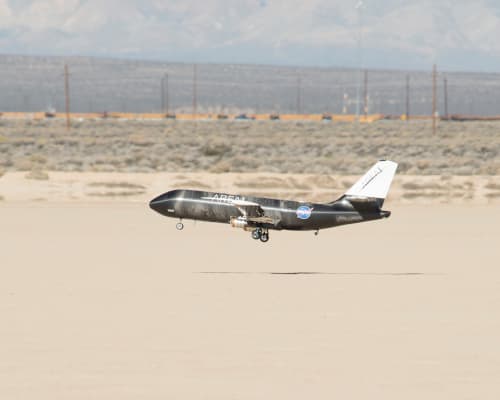
The ability to alter PTERA’s configuration allows cost-effective testing of unconventional designs that might otherwise be too dangerous or expensive to test with a full-scale, crewed aircraft. The PTERA aircraft are configured to resemble an 11%-scale Boeing 737 with a wingspan of 11.3-feet and 200-pound gross weight. Powered by two 50-pound-thrust JetCat P200 engines, each PTERA has a semi-modular airframe designed to accommodate a variety of configurations and technologies.
More From SAE Media Group
Aerospace INSIDER
NASA Tests Green Aviation Technology
Test & Measurement INSIDER
NASA Tests Shape-Changing Wing for Next-Generation Aviation
Aerospace INSIDER
NASA Flies Drones in Aircraft Noise Test
Aerospace INSIDER
NASA and Boeing Partner to Advance Aviation
Aerospace & Defense Tech Briefs
Unmanned Aerial Refueling Aircraft
Tech Briefs
Novel Control Method in Tailless Aircraft

Aerospace INSIDER
New DARPA X-Plane Will Have No Moving Control Surfaces

Aerospace INSIDER
New Probe Could Improve Sonic Boom Investigation
Motion Design INSIDER
Tailless Jet Flies Free with Novel Control Technique
Aerospace Manufacturing and Machining INSIDER
Heavy Ground Testing Puts Airbus’ BelugaXL On Track for First Flight
NASA Spinoff
From Shark Searches to Space Tours
Aerospace INSIDER
Archer Delivers First Midnight eVTOL to US Air Force

Aerospace INSIDER
NASA Tests Electric Aircraft Power Systems
Aerospace INSIDER
Turkey's KAAN Combat Aircraft Completes First Flight
Aerospace & Defense Tech Briefs
Designing a High-Speed Decoy Unmanned Aerial Vehicle (UAV)
Aerospace INSIDER
NASA Tests Technologies to Increase Drone Uses
Aerospace & Defense Tech Briefs
Air Force Receives First Joby eVTOL
Aerospace INSIDER
Archer Achieves First Untethered Flight with Midnight eVTOL
Aerospace & Defense Tech Briefs
Anthem Flight Deck First Flight

Aerospace & Defense Tech Briefs
Boeing T-7A Completes First Flight
NASA Spinoff
Flying (Not Quite) Blind
Aerospace INSIDER
NASA’s Quiet Supersonic Demonstrator Jet Completes First Flight
Tech Briefs
Air Traffic Management (ATM) System

Top Stories
NewsSensors/Data Acquisition
 Microvision Aquires Luminar, Plans Relationship Restoration, Multi-industry Push
INSIDERRF & Microwave Electronics
 A Next Generation Helmet System for Navy Pilots
INSIDERWeapons Systems
 New Raytheon and Lockheed Martin Agreements Expand Missile Defense Production
NewsAutomotive
 Ford Announces 48-Volt Architecture for Future Electric Truck
INSIDERAerospace
 Active Strake System Cuts Cruise Drag, Boosts Flight Efficiency
ArticlesTransportation

Webcasts
Aerospace
 Cooling a New Generation of Aerospace and Defense Embedded...
Energy
 Battery Abuse Testing: Pushing to Failure
Power
 A FREE Two-Day Event Dedicated to Connected Mobility
Automotive
 Quiet, Please: NVH Improvement Opportunities in the Early Design Cycle
Electronics & Computers
 Advantages of Smart Power Distribution Unit Design for Automotive &...
Unmanned Systems
 Sesame Solar's Nanogrid Tech Promises Major Gains in Drone Endurance