




Riding Along With Mercedes and Its in-city Driver Assistance System
The NVIDIA-powered vehicle shows impressive promise.
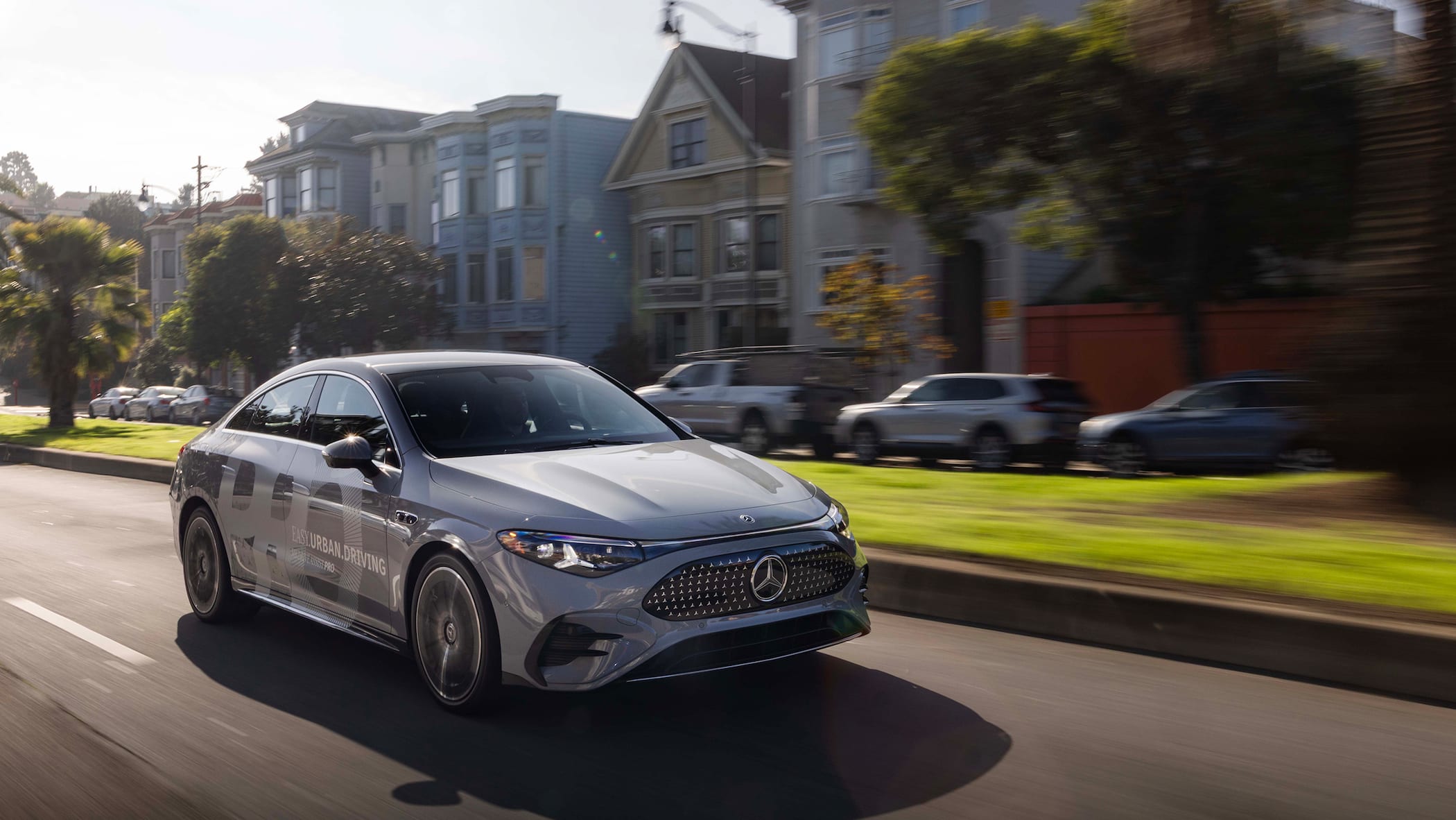
Driving in San Francisco can be a challenge. When Mercedes driver Christoph von Hugo – who is on the Development Advanced Driver Assistance Systems team – turns on the company's new MB.Drive Assist Pro I expect it to disengage within minutes. Instead, the 2027 electric CLA makes the same decisions most drivers would make. A pedestrian looks like they are about to walk into the street from the middle of the block. Immediately, the car reacts by moving over. It's subtle.
But don't call it autonomous driving. Mercedes says it's more of a co-driver.
After punching in a route, we're off. I lived in San Francisco for the better part of two decades and I'd driven, ridden, and walked every road along the vehicle's predetermined path. These are not the worst or most complex roads in the city. They are also not easy. Like most big cities, it can be chaotic for anyone (or anything) not accustomed to tight, mixed-use roads, double parking, and the regular person or vehicle doing something out of the ordinary.
Mercedes' MB.Drive Assist Pro tackled all of this on-road chaos (or normalcy if you live in an urban area) without issue. More importantly, it did so without requiring the driver to wrestle control away from the system when things go weird. Instead, according to Bolster, the steering requires the same effort to take control as you would if you were just driving. The battle against robot torque found in many Level 2 driver assistance vehicles is gone.

Like all Level 2 systems, the MB.Drive Assist Pro is a hands-on, eyes-on system. The driver should keep his hands on the wheel and their eyes on the road at all times. Ultimately, the driver is responsible. What's new here is that the system works in a city driving environment in conjunction with route planning and during the demonstration, Bolster's hands clasped the steering wheel gently ready to take over at any moment mostly to show off the abilities of the system.
Four-way stops? Not a problem. Even when someone decided not to obey the rules of the intersection, the CLA reacted accordingly and let the person go ahead of them. When someone was double parked the vehicle would drive around or wait until oncoming traffic passed before driving around the stopped vehicle.
The vehicle achieves this with an array of sensors. The vehicle is outfitted with 10 cameras, five radar sensors, and 12 ultrasonic sensors. At its core is an onboard NVIDIA computer and NVIDIA Drive AV software. The system is trained with information from vehicles currently on the road and uses multiple, redundant algorithms to determine the best course of action.
One trick the system has learned is to stick to the left lane when there are two lanes traveling in the same direction. In the right lane, there were more interactions with parked cars, pedestrians, cyclists, and double-parked vehicles.
Another helpful feature: The system recognizes the turn signals of other vehicles and reacts accordingly.
Mercedes does have a Level 3 driver assistance system on the road right now with the S-Class. The hands-off, eyes-off system is only available in California and Nevada due to the patchwork of laws regarding self-driving vehicles.
For the demonstration, Bolster said that the system is more than 90% complete. When completed, Bolster said that the vehicle doesn't necessarily need to manage 100% of driving situations as long as the customer understands it and can collaborate with the system.
"Sometimes I steer a little, sometimes I don't. Sometimes I speed up a little, sometimes I don't. After a while, you don't really notice anymore whether it's the car doing it or yourself," said Bolster.
The goal is remove the concerns about mode confusion (the driver unaware if the driver assistance system is active) and fighting with the system to take over. "It really feels like a coexistence," Bolster told SAE Media.
The vehicle needs to switch lanes in order to make a right turn. It enables the turn signal and an audible alert informs us that the vehicle is about to make a major move.
Unfortunately, I was unable to try the system for myself. It's not quite finished yet. But I look forward to setting a destination in San Francisco later this year and seeing how the vehicle handles urban chaos.
More From SAE Media Group
Automotive Engineering
Mobileye Ready to Meet FMVSS 127 with Vision-Only System
Tech Briefs
How Mercedes and NVIDIA Handle City Driving
Autonomous Vehicle Engineering
We Finally Have Some Data on ADAS!
Automotive Engineering
Ford Approved for Hands-Off Driving on German Autobahn
Automotive Engineering
Taking Aim at the Drowsy-driver Threat
Automotive Engineering
Fear and Loathing on the Path to Level 4 Driving
Automotive Engineering
Hands Off, Eyes Off, Brain Off
Off-Highway Engineering
New Mercedes-Benz Actros Loaded with ADAS, Active Safety Tech
Autonomous Vehicle Engineering
Detecting Pedestrians
Automotive Engineering
Setting Hyundai’s Safety Strategy
Autonomous Vehicle Engineering
Safety, Standards Crucial to AVs’ Advance
Off-Highway Engineering
Digital Tech a Las Vegas Headliner
Automotive Engineering
GM Announces SAE Level 3 Autonomy and SDV Technology
Automotive Engineering
The Future of “Core” Vehicle Systems

Automotive Engineering
Nvidia’s New Level 2+ Autonomy Platform Is Making Cars Safer Today
Autonomous Vehicle Engineering
Standards Play a Vital Role
Off-Highway Engineering
Stoneridge Innovation Truck Envisions a Digital-vision Future
Autonomous Vehicle Engineering
Defanging Driverless Cars
Autonomous Vehicle Engineering
When Steering Isn’t Steering Anymore
Autonomous Vehicle Engineering
Florida’s Babcock Ranch and the Future of Autonomous Communities

Autonomous Vehicle Engineering
AV Regulations: Feds Ready to Get Their Claws Back?
Automotive Engineering
Engineering AVs to ‘Play Nice’ With Humans
Autonomous Vehicle Engineering
Purpose, Perceptions for Driver-Assist Tech Solidify
Off-Highway Engineering
ADAS Features Expand Role, V2V Looms
Automotive Engineering
NHTSA Moves on Driver-Impairment Regulation
Off-Highway Engineering
Sensing Changes in Autonomous Trucks
Off-Highway Engineering
Freightliner’s Medium-Duty Makeover
Top Stories
INSIDERDefense
 New Raytheon and Lockheed Martin Agreements Expand Missile Defense Production
NewsAutomotive
 Ford Announces 48-Volt Architecture for Future Electric Truck
INSIDERManufacturing & Prototyping
 Active Strake System Cuts Cruise Drag, Boosts Flight Efficiency
ArticlesTransportation
 Accelerating Down the Road to Autonomy
INSIDERMaterials
 How Airbus is Using w-DED to 3D Print Larger Titanium Airplane Parts
Road ReadyTransportation
Webcasts
Electronics & Computers
 Cooling a New Generation of Aerospace and Defense Embedded...
Power
 Battery Abuse Testing: Pushing to Failure
Connectivity
 A FREE Two-Day Event Dedicated to Connected Mobility
Automotive
 Quiet, Please: NVH Improvement Opportunities in the Early Design Cycle
Transportation
 Advantages of Smart Power Distribution Unit Design for Automotive &...
Aerospace
 Sesame Solar's Nanogrid Tech Promises Major Gains in Drone Endurance