




Magna Fighting COVID-19 with Ozone
The Tier-1 supplier evaluates its proven Puro virus-killing technology for a potentially new role: sanitizing vehicle interiors.

An ozone-generating process that kills germs is being evaluated by supplier Magna for potential use in vehicle cabins, as the mobility industry seeks sustainable solutions for protecting passenger health. Magna’s Puro branded product, soon to enter volume production, is a portable, plastic container that sanitizes clothing, toys, stuffed animals or other items placed inside a latched and locked bin.
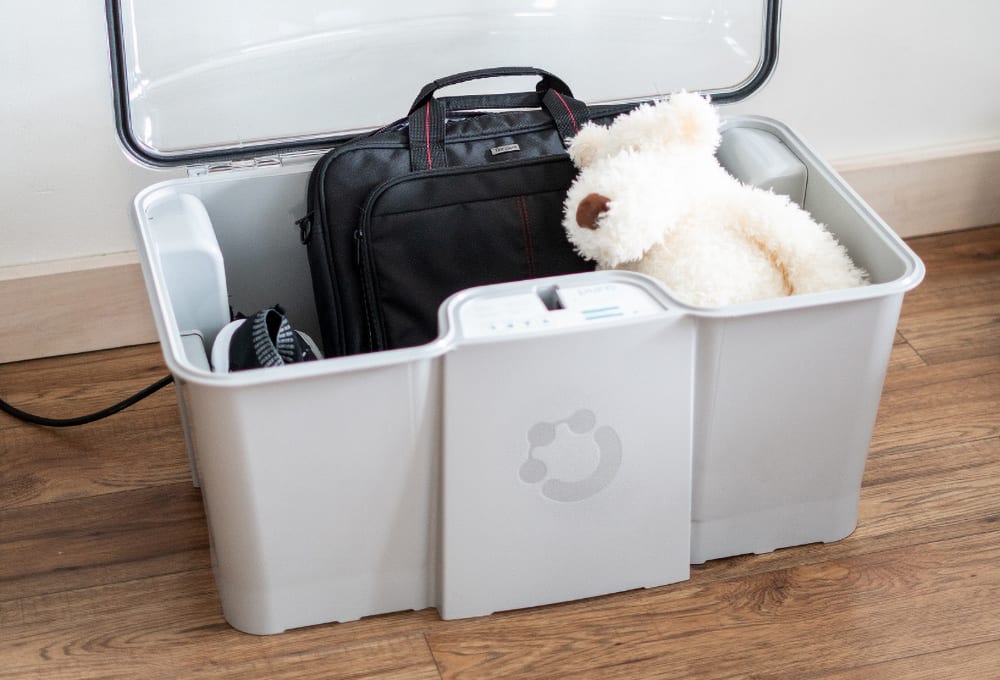
“Our immediate focus for our sanitizing technology is to help with the current personal protection equipment (PPE) shortage being experienced by our front-line coronavirus workers. That said, we hope to leverage this Magna technology to sanitize ride sharing vehicles and other future mobility applications,” Scott Mitchell, global director of New Technology & Innovation for Magna Mechatronics, told SAE’s Autonomous Vehicle Engineering.
A 25- or 45-minute sanitizing cycle is selected via the container’s LED user interface. Powered by a 120-volt outlet, all operational functions are governed by proprietary software developed by Magna. “Once the disinfection process is initiated, the sealed chamber generates a high ozone concentration by energizing the oxygen particles on the items inside the container,” Mitchell explained. “The ozone reverts back to oxygen before the cycle ends.”

According to Mitchell, ozone is a high-oxidizing agent proven to be very effective at killing many viruses. Magna’s process of generating and neutralizing the ozone is covered by patents. Although the current Puro sanitizing system is a small household appliance, Magna’s design and manufacturing capabilities for latching mechanisms, sealing systems, and electronics set the stage for a technology transfer to future vehicles.
“Although it’s still too early to say how we’d go about implementing a sanitizing method for a vehicle interior, we have lots of options on the table that are under review,” Mitchell said. The ozone-generating technique has a clear advantage over using concentrated ultraviolet (UV) light to disinfect surfaces, Mitchell noted. “Ozone technology is gaseous, so it can reach crevices and cracks and migrate freely throughout a vehicle cabin versus the line-of-sight that’s needed for sanitizing with UV light,” he said.
A longer timeframe is needed to complete an ozone-generating sanitation for porous materials. “As a system integrator, it’s part of our job to suggest materials for seat coverings and other high-touch points,” Mitchell said. For autonomous vehicles serving routes that have lengthy time gaps between new riders boarding, a 45-minute sanitizing time is not problematic. “The sanitizing process would occur when the vehicle is without occupants,” he said.
Germ-free, automated transportation for the masses is likely to be highly desirable. “In light of the current COVID-19 crisis and knowing that this ozone-generating product was proven to be effective against the MRSA – Methicillin-resistant Staphylococcus aureus – bacterium in third-party lab testing, we want to see if we might have something that can help save lives,” Mitchell said. “Testing is being conducted to determine how effective it is on COVID-19.”
More From SAE Media Group
Autonomous Vehicle Engineering
Supplier Tech Gets the Germs Out
Aerospace & Defense Tech Briefs
SAE International Extends Call for Abstracts, Seeks Submissions for AeroTech Conference
Aerospace & Defense Tech Briefs
Industry Invited to Participate in AeroTech Aerospace and Defense Technical Program
Off-Highway Engineering
Valeo Equips Buses with COVID-Killing Air-Sterilization System
Aerospace & Defense Tech Briefs
SAE International Issues, Revises Technical Reports for Aerospace Engineering
Automotive Engineering
Will ‘Recalls’ Become ‘Upgrades’?
Automotive Engineering
Talking SDVs and Zonal Architecture with TE Connectivity
Autonomous Vehicle Engineering
A Solution for Ice-Free Sensors
Automotive Engineering
Nvidia Partners with AdaCore to Secure Self-Driving Firmware
Automotive Engineering
Clean Is the New Safety Paradigm for AV Development
Autonomous Vehicle Engineering
The Future of Automated Vehicle Cabins
Autonomous Vehicle Engineering
'Level 2+': Making Automated Driving Profitable, Mainstream
Autonomous Vehicle Engineering
GM Announces Door-To-Door Ultra Cruise ADAS
Automotive Engineering
Xcelerating Innovation, Honda-Style
Off-Highway Engineering
Why Agriculture Will Automate Before On-Highway
Off-Highway Engineering
Mahle Advances 3D Printing Capabilities
Automotive Engineering
Faurecia Creates ‘Personal Bubbles’ for AVs

Automotive Engineering
Wireless Road Charging for EVs to Debut in 2023
Off-Highway Engineering
Not Quite Your Father’s Cab
Automotive Engineering
Power over Coaxial in Automotive: A Simplified Path to Advanced Vehicle Systems
Off-Highway Engineering
CES 2025: Oshkosh Puts AI, Autonomy and Electrification to Work
Automotive Engineering
The Transformative Power of Large-Format Additive Manufacturing for Automotive
Automotive Engineering
Electronic Stability Control Builds the Foundation for Safer Roads
Off-Highway Engineering
Shifting Design of Autonomous Architectures
Autonomous Vehicle Engineering
Hopeful but Closer Scrutiny for SAE Level 4 Automation
Off-Highway Engineering
U.S. DoT Chooses SAE J3016 for Vehicle-Autonomy Policy Guidance
Medical Design Briefs
Finding a Manufacturing System Upgrade to Match In-House Innovation
Automotive Engineering
Automated Vehicle Safety Series Addresses Design, Testing, Verification, and Validation
Automotive Engineering
Sharper Testing Delivers Better AV Performance
Top Stories
INSIDERManufacturing & Prototyping
 How Airbus is Using w-DED to 3D Print Larger Titanium Airplane Parts
INSIDERManned Systems
 FAA to Replace Aging Network of Ground-Based Radars
NewsTransportation
 CES 2026: Bosch is Ready to Bring AI to Your (Likely ICE-powered) Vehicle
NewsSoftware
 Accelerating Down the Road to Autonomy
EditorialDesign
 DarkSky One Wants to Make the World a Darker Place
INSIDERMaterials
 Can This Self-Healing Composite Make Airplane and Spacecraft Components Last...
Webcasts
Defense
 How Sift's Unified Observability Platform Accelerates Drone Innovation
Automotive
 E/E Architecture Redefined: Building Smarter, Safer, and Scalable...
Power
 Hydrogen Engines Are Heating Up for Heavy Duty
Electronics & Computers
 Advantages of Smart Power Distribution Unit Design for Automotive...
Unmanned Systems
 Quiet, Please: NVH Improvement Opportunities in the Early Design...
