




Army Develops First-of-Its Kind Phase-Coherent Fiber Laser Array System
The U.S. Army Research Laboratory's Computational and Information Science Directorate's Intelligent Optics Team, and partners, recently developed, engineered, demonstrated and delivered the world's first known working Adaptive Phase Coherent Fiber Laser Array system, which will better enable soldiers' directed energy weapons and laser communication systems on the battlefield. The development of the system spurred from a collaborative agreement between U.S. Army Research Laboratory (ARL), the Defense Advanced Research Projects Agency (DARPA), the Massachusetts Institute of Technology Lincoln Labs, Optonicus and various academic partners.
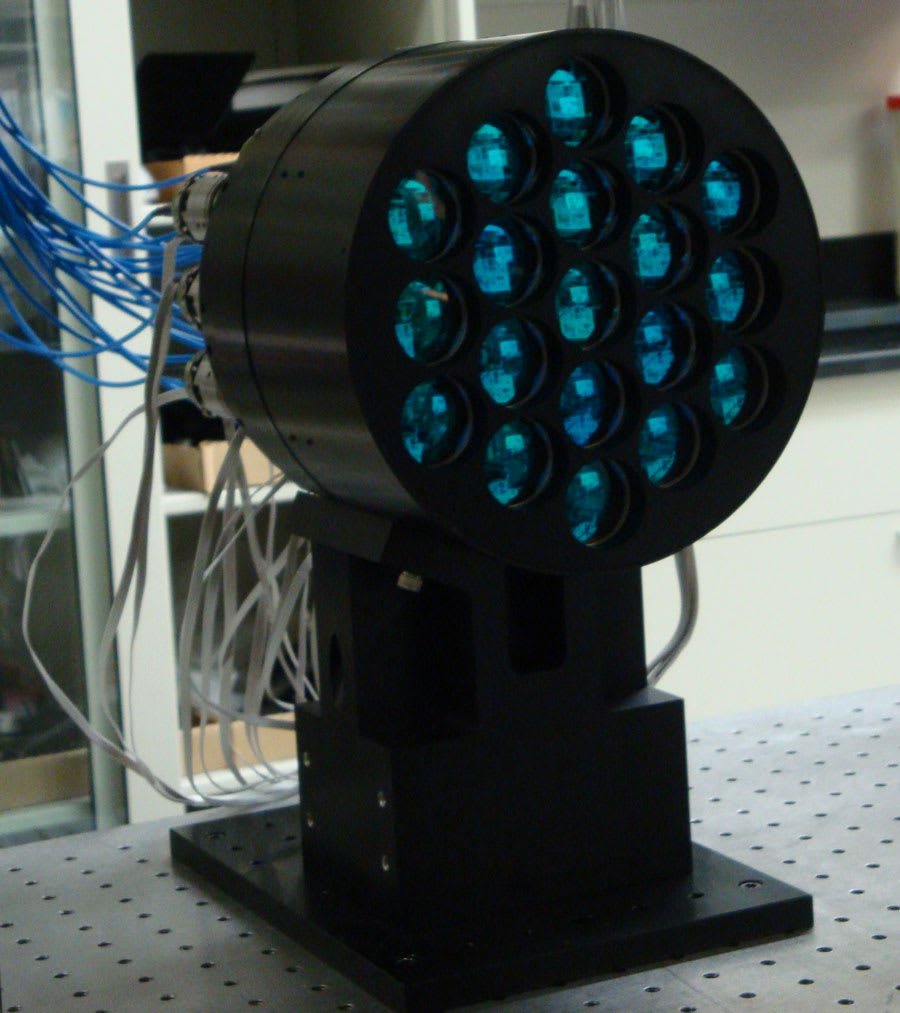
ARL's efforts were central to the recent successful Defense Advanced Research Projects Agency real-world development of a 21-element optical phased array system, of which ARL developed and provided the low-power and high-power fiber subapertures and other key components including control electronics and operation software. The demonstration was part of DARPA's Excalibur program, the overall goal of which is to develop coherent optical phased array technologies as an enabler for scalable laser weapons.
The fiber laser array system, developed after more than a decade of research and testing, consists of phase locking and beam combining for multichannel, 7 and 19, fiber laser sub-aperture arrays. An ARL patent and patents related to the system are currently pending. With this phase locking feature and compensation mechanism, physical disturbances such as vibration of the system and atmospheric turbulence will not affect the operation of the laser beams.
The system uses the internal interference feedback of multi-laser beam tails instead of using the conventional beam-splitter sensors placed on the output passage of the laser beams. This allows the system to deliver the same amount of total energy as a monolithic single-aperture laser, but the energy density is multiple times higher at the center of the combined beam. This architecture allows the system to be dramatically reduced in size, weight and cost by multiple times compared to existing laser weapon systems, all while delivering the same power. An innovative high-speed control algorithm "Stochastic Parallel Gradient Descent," is applied to control the beams and their phases coherently in addition to compensating the atmospheric turbulence, maximizing the laser irradiance. An ARL patent for this is pending as well.
In terms of benefits to soldiers on the battlefield, this one-of-a-kind system is making great strides. The system architecture will allow for more efficient, more lethal, and more mobile and deployable laser weapon systems, thus it can be widely used by the Army as a directed energy laser weapon system in all platforms including both ground and aerial. In addition, the output beam of the array can be used as a countermeasure system to quickly and accurately disable and destroy the incoming threat of missiles and other adversary reconnaissance.
Future tests of the system will be conducted to reach the ultimate goal of developing a 100-kilowatt-class laser system in a scalable size, weight and power optical phased array configuration compatible with existing weapon system platforms that will further enhance the capabilities of Soldiers on the battlefield.
More From SAE Media Group
Aerospace & Defense Tech Briefs
High-Energy Laser Weapon Systems
Aerospace & Defense Tech Briefs
H4 Palletized Laser Weapon

Defense INSIDER
Navy Gets Integrated Multi-Mission Laser Weapon System
Defense INSIDER
Army Developing Lasers That Pierce Fog, Dust to Destroy Targets
Defense INSIDER
Army Awards Combat Laser Weapon System Contract
Aerospace & Defense Tech Briefs
Making Laser Weapons a Reality
Aerospace & Defense Tech Briefs
A New Record for Optical Power Beaming
Aerospace & Defense Tech Briefs
British Army Completes First Test of Drone Killing Radio Frequency Weapon
Defense INSIDER
Raytheon Pairs Laser Weapon with NASAMS Air Defense System
Defense INSIDER
Researchers Test Cooling Solutions for Directed Energy Weapons
Aerospace & Defense Tech Briefs
New Diamond Super-Material Enhances Aircraft Survivability
Aerospace & Defense Tech Briefs
Developments in Adaptive Filtering and System Identification
Aerospace & Defense Tech Briefs
Cutting-Edge Drone Killer Radio Wave Weapon Developing at Pace
Aerospace INSIDER
Air Force Performs First Test of Microwave Counter Drone Weapon THOR
Photonics & Imaging Technology
Photonics West 2021 Preview
Aerospace & Defense Tech Briefs
Counter-Directed Energy Weapons: Defense of Air Assets
Aerospace & Defense Tech Briefs
AI Automates Drone Defense With High Energy Lasers
Aerospace & Defense Tech Briefs
Hardening Unmanned Aerial Systems Against High-Power Microwave Threats in Support of Forward Operations
Aerospace & Defense Tech Briefs
Advanced Airborne Defensive Laser for Incorporation on Strike Fighter Aircraft
Aerospace & Defense Tech Briefs
Navy Lasers, Railgun, and Hypervelocity Projectile: Background and Issues for Congress
Aerospace INSIDER
AFTC Gains New Test Capability
Aerospace & Defense Tech Briefs
Ghoul Tool: The Weapon-Mountable Counter UAS Transmitter
Aerospace & Defense Tech Briefs
Anti-Drone Jammer
Defense INSIDER
Armoring Satellites to Survive and Operate Through Attacks
Aerospace & Defense Tech Briefs
Weapon Fire Control System
Aerospace & Defense Tech Briefs
Integration of Adaptive Optics Into High-Energy Laser Modeling And Simulation
Aerospace INSIDER
How the Air Force's B-21 Raider is Advancing Across Test and Production

Aerospace & Defense Tech Briefs
Lasers Destroy Drones as Additive Manufacturing Builds Them
Top Stories
NewsRF & Microwave Electronics
 Microvision Aquires Luminar, Plans Relationship Restoration, Multi-industry Push
INSIDERAerospace
 A Next Generation Helmet System for Navy Pilots
INSIDERDesign
 New Raytheon and Lockheed Martin Agreements Expand Missile Defense Production
INSIDERMaterials
 How Airbus is Using w-DED to 3D Print Larger Titanium Airplane Parts
NewsPower
 Ford Announces 48-Volt Architecture for Future Electric Truck
ArticlesAR/AI

Webcasts
Electronics & Computers
 Cooling a New Generation of Aerospace and Defense Embedded...
Automotive
 Battery Abuse Testing: Pushing to Failure
Power
 A FREE Two-Day Event Dedicated to Connected Mobility
Unmanned Systems
 Quiet, Please: NVH Improvement Opportunities in the Early Design Cycle
Automotive
 Advantages of Smart Power Distribution Unit Design for Automotive &...
Energy
 Sesame Solar's Nanogrid Tech Promises Major Gains in Drone Endurance