




Developments in Adaptive Filtering and System Identification
Potential applications include optical communications, target tracking, and image processing.
Progress has been made on several fronts in a continuing program of research oriented toward the development of real-time algorithms, and computer and control systems that utilize the algorithms, for adaptive filtering, prediction, and system identification with improved efficiency and numerical stability in applications that involve large numbers of channels and high filter orders. Potential applications include adaptive optics, optical communications, target tracking, image processing, blind identification and deconvolution in wireless communications, and active control of noise and vibration.
The program has included three main subprograms supporting different aspects of research and development at the Air Force Research Laboratory on directed-energy weapons and laser communications:
- Control (more precisely, suppression) of laser-beam jitter.
In this subprogram, lattice-filter- based subspace system- identification and adaptive control algorithms were applied in laser- beam-steering experiments. It was shown that enhanced rejection of disturbances is achievable in laser-beam steering by use of modern optimal feedback controllers augmented with adaptive control loops that determine control gains that are optimal for the current disturbance acting on the laser beam. In each adaptive control loop, an adaptive lattice filter implicitly identifies disturbance statistics from real-time data on the relative orientation of the laser beam as measured by use of a quad cell.
The most important recent advances have included the development of a method of variable-order adaptive control, a method of frequency weighting in adaptive control, and adaptive control of a new class of liquid-crystal beam-steering devices. Variable-order adaptive control is important because higher-order controllers are usually necessary for optimal steady-state performance but require more data for adaptive identification of optimal gains and, hence, produce slower adaptation and, if adaptive loops are closed before nearly optimal gains are identified, often produce large transient responses. Since the fewer gains needed for lower order control laws can be identified from fewer data points, lower order control laws yield faster adaptation without generating large transients.
- Using new liquid-crystal devices to control laser beams.
Feedback and adaptive feedforward control have been applied to a family of liquid-crystal laser-beam-control devices being developed as actuators in jitter control and adaptive optics for applications to laser weapons and laser communications. In comparison with fast-steering-mirror laser-beam-control devices, the liquid-crystal devices offer the advantages of low power consumption and no moving parts. It was necessary to modify a prior adaptive control loop to accommodate nonlinearities in the liquid-crystal devices resulting from rate-limit and quantization effects not encountered in fast steering mirrors.
- Adaptive control and filtering in adaptive optics.
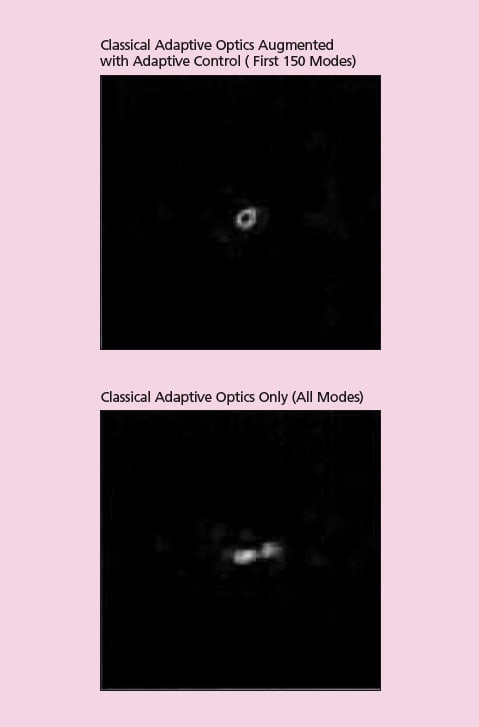
The classical adaptive-optics control loop in a prior adaptive-optics laboratory testbed used in development of directed-energy weapons was augmented with an adaptive control loop to enhance beam control and imaging in the presence of atmospheric turbulence. High-fidelity wave optics simulations predicted significant improvements in the Strehl ratio (a measure of on-target beam intensity) and tracking jitter. Improvements similar to those predicted have been confirmed by results of experiments: In the experiments, the first 150 modes from a set of frequency-weighted deformable mirror modes were used by the adaptive control loop. First, 3,000 wavefront-sensor frames were used to identify the adaptive filter gains, and then the performance of the adaptive controller was evaluated on 1,000 frames independent of those used for identification. For comparison, the same experiment was performed with only the classical adaptive-optics and tracking loops, using the same 1,000 frames for evaluation. For the turbulence scenario examined, the use of the adaptive controller was found to increase the Strehl ratio by nearly 50 percent and reduce the variability by more than 15 percent. The figure shows example images, acquired during the evaluation sequences, that illustrated the benefit afforded by the adaptive control loop.
This work was done by Steve Gibson, Nestor Perez, Pawel Orzechowski, Neil Chen, and T. C. Tsao of the University of California; Darryl Sanchez, Troy Rhoadarmer, Laura Klein, and Robert Vincent of the Air Force Research Laboratory; and Bruce Winker, Milind Mahajan, and Bing Wen of Teledyne Scientific Co. for the Office of Naval Research.
ONR-0001
This Brief includes a Technical Support Package (TSP).
Developments in Adaptive Filtering and System Identification
(reference ONR-0001) is currently available for download from the TSP library.
Don't have an account?
More From SAE Media Group
Photonics & Imaging Technology
Photonics West 2021 Preview
Photonics & Imaging Technology
SPIE Photonics West 2023 Preview

Photonics & Imaging Technology
SPIE Photonics West 2022 Preview
Photonics Tech Briefs
Atmospheric-Fade-Tolerant Tracking and Pointing in Wireless Optical Communication

Photonics & Imaging Technology
Optical Signal Amplifying Technique
Photonics & Imaging Technology
A First-Of-Its-Kind Integrated Optical Isolator
Tech Briefs
Products of Tomorrow

Photonics & Imaging Technology
A Laser That Could Reshape the Landscape of Integrated Photonics
Photonics & Imaging Technology
New Products
Photonics Tech Briefs
Adaptive Multiplexing for Free-Space Optical Communication
Photonics & Imaging Technology
Researchers Develop a Wide-Bandwidth, Low-Polarization Semiconductor Optical Amplifier
Tech Briefs
Sensitive Optical Receivers for Space
Photonics Tech Briefs
Active Correction of Aberrations of Low-Quality Telescope Optics
Tech Briefs
Nanoscale 3D Structure to Control Light
Photonics Tech Briefs
Two-Axis Reflective Device for Image Stabilization and Beamsteering

Sensor Technology
Breakthrough Lightweight AR Eyeglasses
Photonics & Imaging Technology
Unique Amplifier Could Change Optical Communication
Medical Design Briefs
Smart Contact Lens for Glaucoma Detection
Tech Briefs
Enabling High-Capacity Space Communication

Tech Briefs
Silicon Chip Improves LiDAR
Photonics Tech Briefs
Discrete Wavelength-Locked External Cavity Laser
Photonics Tech Briefs
Correcting for Atmospheric Effects in Optical Communication

Tech Briefs
Optical Signal Amplifying Technique
Overview
The document is a final report on a project focused on developing new real-time algorithms for adaptive filtering, prediction, and system identification, specifically tailored for applications in the Air Force. The research was conducted under the auspices of the Air Force Office of Scientific Research (AFOSR) and aimed to improve the efficiency and numerical stability of algorithms used in systems requiring high channel counts and filter orders, such as adaptive optics, laser communications, target tracking, and image processing.
The primary motivation for this research stems from the needs of advanced tactical laser systems, including the Advanced Tactical Laser (ATL) and the Airborne Laser (ABL). These systems require robust algorithms to manage the complexities of directed energy weapons and laser communications effectively. The report emphasizes the importance of adaptive control systems in enhancing the performance of these technologies.
Collaboration with the Air Force Research Laboratory (AFRL) and industry partners, including Teledyne Scientific Co., has been a significant aspect of the project. This collaboration has facilitated the integration of control system performance considerations into hardware design, leading to improved device capabilities. For instance, modifications to the driver for a two-axis liquid crystal device were based on insights gained from earlier experiments, resulting in higher bandwidths for adaptive control loops.
The report also discusses the experimental results obtained from various tests, including jitter control experiments conducted at UCLA's beam control laboratory. These experiments demonstrated the potential of liquid crystal devices in high-performance beam control systems, although challenges such as nonlinearities and rate limits were encountered. The adaptive control designs developed during this research were able to accommodate these nonlinearities without significant performance degradation.
In summary, the document outlines the objectives, methodologies, and collaborative efforts involved in advancing adaptive filtering and system identification techniques for military applications. It highlights the ongoing research and development efforts aimed at enhancing the capabilities of laser systems and other technologies critical to the Air Force's operational effectiveness. The findings suggest that further system identification of liquid crystal devices could lead to even greater improvements in dynamic modeling and control loop performance.
Top Stories
INSIDERDefense
 New Raytheon and Lockheed Martin Agreements Expand Missile Defense Production
NewsAutomotive
 Ford Announces 48-Volt Architecture for Future Electric Truck
INSIDERManufacturing & Prototyping
 Active Strake System Cuts Cruise Drag, Boosts Flight Efficiency
ArticlesTransportation
 Accelerating Down the Road to Autonomy
INSIDERMaterials
 How Airbus is Using w-DED to 3D Print Larger Titanium Airplane Parts
Road ReadyTransportation

Webcasts
Electronics & Computers
 Cooling a New Generation of Aerospace and Defense Embedded...
Power
 Battery Abuse Testing: Pushing to Failure
Connectivity
 A FREE Two-Day Event Dedicated to Connected Mobility
Automotive
 Quiet, Please: NVH Improvement Opportunities in the Early Design Cycle
Transportation
 Advantages of Smart Power Distribution Unit Design for Automotive &...
Aerospace
 Sesame Solar's Nanogrid Tech Promises Major Gains in Drone Endurance