




AFTC Gains New Test Capability
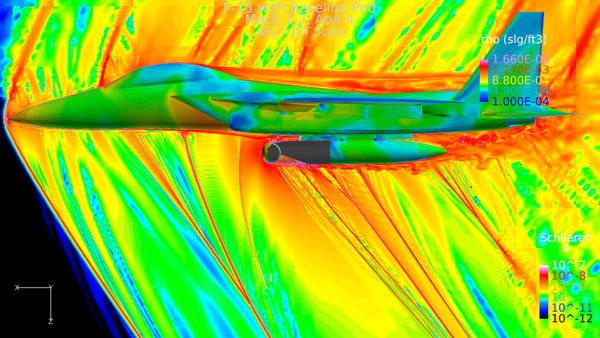
As weapon system designers continue to innovate for the defense of the nation, the Air Force Test Center must advance the test capabilities available to develop and prove the superiority of those systems needed to meet the demands of the National Defense Strategy.
Members of the 716th Test Squadron and Integrated Analysis Branch of the 804th Test Group of Arnold Engineering Development Complex, have done just that with the assistance of an industry partner through the Small Business Innovation Research and Commercialization Readiness Pilot programs. In March, a new aero-optical test capability was transitioned to the 716 TS after a successful demonstration of the technology.
AEDC contracted with MZA Associated Corp. through the SBIR and CRP programs to develop a system that can accurately obtain wavefront information anywhere around aircraft models in transonic and supersonic wind tunnels. Using the new system, the Integrated Directed Energy Aero-optical Surrogate, or IDEAS, combined with the Captive Trajectory Omni-directional Reflector, or CapTOR, will allow test personnel to characterize how a laser beam will behave and, if necessary, how to precondition it.
“IDEAS brings together MZA’s aero-optical diagnostic sensors along with our tracking and gimbal control software to provide full field-of-regard wavefront measurements,” said Dr. Matt Whiteley, vice president and senior scientist with MZA. “IDEAS allows for measurement geometries that are difficult to obtain using tunnel windows, including in the deep wake of the aircraft. It provides the complete picture of the environment in which a laser must operate.”
IDEAS and CapTOR build upon a test conducted last year of a portion of the system called Aero-Isolation Measurement Sensor (AIMS). AIMS utilized a miniaturized optical bench, and a laser directed through a window in the tunnel wall. IDEAS, used in conjunction with CapTOR, allows system instrumentation, including a target for tracking, to be contained within the tunnel, which enables improved accuracy and efficiency. The tracking ability allows test personnel to simulate laser sources or target locations.
More From SAE Media Group
Aerospace INSIDER
Optical Flow Visualization Applied to Jet Engine Testing

Photonics & Imaging Technology INSIDER
Miniaturized Infrared Detectors
Aerospace & Defense Tech Briefs
sUAS-Based Payload Development and Testing for Quantifying Optical Turbulence
Tech Briefs
Laser-Light-Based Accelerometer
Photonics & Imaging Technology INSIDER
Sapphire Fiber Could Enable Cleaner Energy and Air-Travel

Aerospace & Defense Tech Briefs
Beam Irradiance on Target System (BITS)
Aerospace INSIDER
Research Could Lead to Noise Reduction in Aircraft Engines
Photonics & Imaging Technology
Ray Optics Simulation of Inertial Navigation Systems
Photonics & Imaging Technology
New Products
Photonics & Imaging Technology INSIDER
A New Tool for Measuring Femtosecond Lasers
Photonics & Imaging Technology
How Double-Sided Polishing Can Revolutionize Optical Manufacturing
Photonics & Imaging Technology
Machine Vision Applications in Laser Measurement Systems
Aerospace & Defense Tech Briefs
High-Energy Laser Weapon Systems
Medical Design Briefs
Product Focus: Test & Measurement
Tech Briefs
Photoelectric Sensor Essentials
Photonics & Imaging Technology INSIDER
New Product Launches and Technologies to See at Photonics West 2025
Aerospace & Defense Tech Briefs
Bore Elevation and Azimuth Measurement System (Beams)
Medical Design Briefs
Winter 2022 Resource Guide
Aerospace & Defense Tech Briefs
Experimental Design of a UCAV-Based High-Energy Laser Weapon
Photonics & Imaging Technology INSIDER
AI Image Analysis, Li-Fi and Quantum Processor Among 2023 PRISM Awards Winners
Photonics & Imaging Technology
Measuring Blood Glucose Levels with Lasers
Photonics & Imaging Technology
Monitoring Additive Manufacturing with an Optical Microphone
Tech Briefs
Measuring Optical Null Lens Aberrations
Photonics & Imaging Technology INSIDER
Testing Sensors in Fog to Make Future Transportation Safer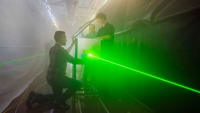

Photonics & Imaging Technology
Vision System Assures Glass Act at California Shop
NASA Spinoff
Giving Sensors Good Optics
Top Stories
NewsRF & Microwave Electronics
 Microvision Aquires Luminar, Plans Relationship Restoration, Multi-industry Push
INSIDERAerospace
 A Next Generation Helmet System for Navy Pilots
INSIDERDesign
 New Raytheon and Lockheed Martin Agreements Expand Missile Defense Production
INSIDERMaterials
 How Airbus is Using w-DED to 3D Print Larger Titanium Airplane Parts
NewsPower
 Ford Announces 48-Volt Architecture for Future Electric Truck
ArticlesAR/AI

Webcasts
Electronics & Computers
 Cooling a New Generation of Aerospace and Defense Embedded...
Automotive
 Battery Abuse Testing: Pushing to Failure
Power
 A FREE Two-Day Event Dedicated to Connected Mobility
Unmanned Systems
 Quiet, Please: NVH Improvement Opportunities in the Early Design Cycle
Automotive
 Advantages of Smart Power Distribution Unit Design for Automotive &...
Energy
 Sesame Solar's Nanogrid Tech Promises Major Gains in Drone Endurance