




Filtered Rayleigh Scattering Enables Laser-Optical Measurement of Turbofan Thrust
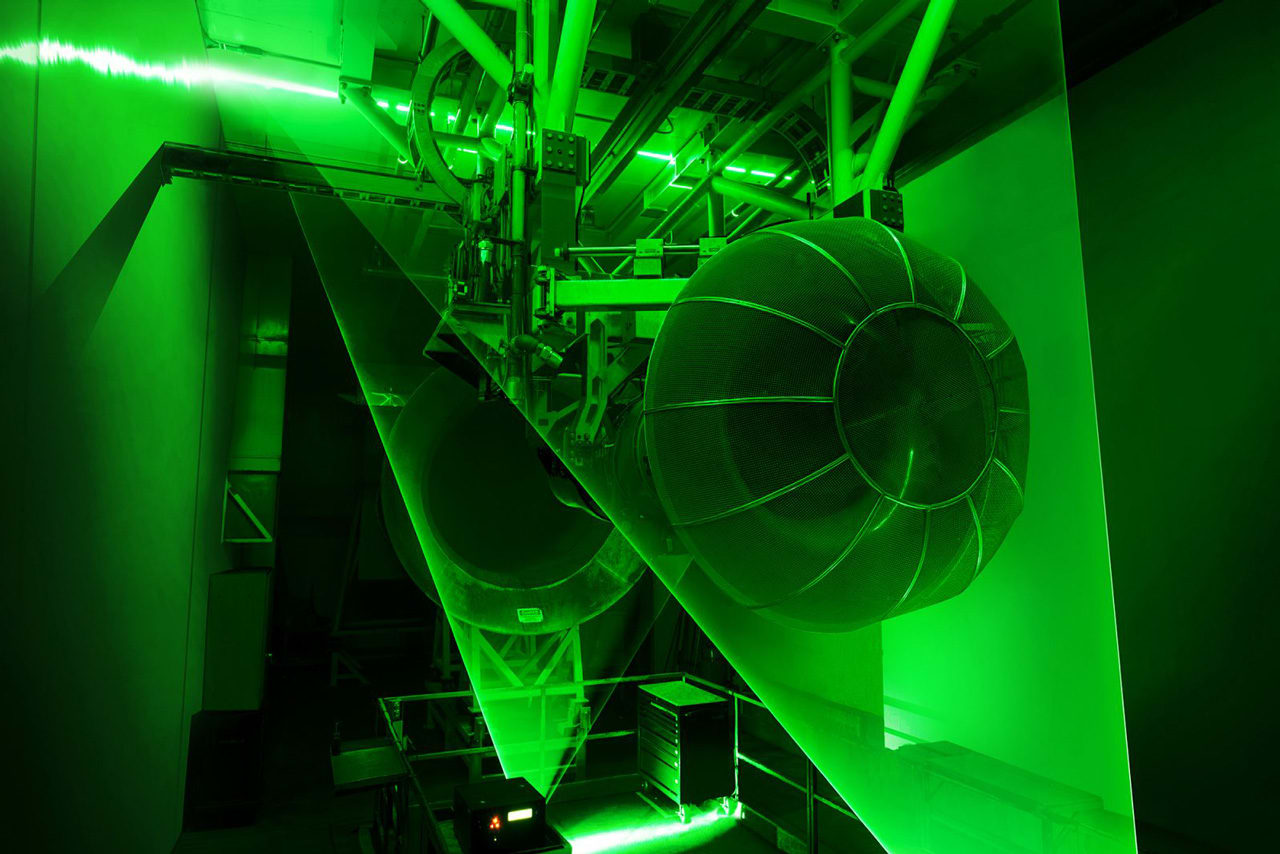
Pratt & Whitney and Virginia Tech announced a pioneering new technology for calculating thrust using lasers to enable high-fidelity measurement of key gas turbine engine parameters including velocity, temperature, and density.
Known as Filtered Rayleigh Scattering for Thrust measurement (FRST), this new optical instrumentation technique offers significant advantages compared to traditional sensors and probes, which will support the development of more efficient engine core technologies and could enable the measurement of non-CO2 particulate emissions in flight.
"The ability to use lasers and optical sensors represents a major step forward in engine instrumentation technology and is testament to the longstanding collaboration within the Pratt & Whitney Center of Excellence at Virginia Tech," said Geoff Hunt, Senior Vice President, Engineering and Technology, Pratt & Whitney. "FRST provides a less intrusive and more cost-effective method for measuring a range of engine metrics. We see exciting potential for FRST to help advance gas turbine propulsion technologies, particularly involving smaller and more thermally efficient engine cores, which are key to our next-generation military and sustainable commercial engines."
A patent-pending technology, FRST makes use of the ultraviolet light spectrum and relies on the principle that light scattering back from air molecules passing over a laser-illuminated area can provide information about the gas flow field, from which thrust can be derived. Applied to a turbofan engine, the light is provided by a laser beam directed across the turbine's gas path, while the resulting scatter is recorded by a high-performance camera and "filtered" for corruptions in the signal.
FRST optical instrumentation potentially eliminates the need for traditional sensors and probes, which can be difficult to install and cause flow blockage, particularly on smaller engine cores where space is limited. FRST also presents opportunities to measure non-CO2 particulate emissions, which could contribute to industry-wide efforts to understand and mitigate the environmental impact of those emissions, particularly with regard to contrail formation.
"Though the principle of Rayleigh scattering has been known for centuries, Pratt & Whitney and Virginia Tech engineers have harnessed recent advancements in computing power, laser and camera technology to demonstrate the first successful application on a turbofan engine," said Todd Lowe, Professor of Aerospace Engineering at Virginia Tech. "As we work towards in-flight demonstrations of FRST, we expect the technology will have other applications in the development and certification of aircraft engines."
Pratt & Whitney and Virginia Tech's joint research team successfully measured engine thrust using FRST optical techniques on a research engine in a test stand at Virginia Tech recording similar accuracy to that of traditional sensors and probes. The teams are working towards flight testing the technology.
Pratt & Whitney and Virginia Tech have a long-standing collaboration in propulsion technology development, with a focus on advanced instrumentation. The collaboration enables multiple graduate-level projects and internships at Virginia Tech and Pratt & Whitney.
More From SAE Media Group
Photonics & Imaging Technology
Pratt & Whitney, Virginia Tech Pioneer Laser-Optical Approach for Turbofan Engine Thrust Measurement
Photonics & Imaging Technology INSIDER
New Method Measures Super-Fast, Free Electron Laser Pulses
Aerospace INSIDER
Research Could Lead to Noise Reduction in Aircraft Engines
Photonics & Imaging Technology INSIDER
Sapphire Fiber Could Enable Cleaner Energy and Air-Travel
Photonics & Imaging Technology INSIDER
New Product Launches and Technologies to See at Photonics West 2025
Aerospace INSIDER
Optical Flow Visualization Applied to Jet Engine Testing
Photonics & Imaging Technology INSIDER
A Compact, Mid-Infrared Pulse Generator
Photonics & Imaging Technology
New Products
Photonics & Imaging Technology
SPIE Photonics West 2023 Preview
Photonics & Imaging Technology INSIDER
7 Finalists for SPIE Startup Challenge at Photonics West 2025
Photonics & Imaging Technology
Can Harmful Gas Detection Improve With a New Way of Generating Powerful Lasers?
Photonics & Imaging Technology
New Frequency Comb Can Identify Molecules in 20-Nanosecond Snapshots
Tech Briefs
Products of Tomorrow
Robotics & Automation INSIDER
Smallest Walking Robot Makes Microscale Measurements
Aerospace & Defense Tech Briefs
Overcoming Performance Limitations of Distributed Brillouin Fiber Laser Sensors
Photonics & Imaging Technology INSIDER
Tying Overlapping Laser Beams into Stable 'Optical Knots'
Photonics & Imaging Technology
OPO Lasers Put Optical Components to the Test
Medical Design Briefs
OPO Lasers: Putting Optical Components to the Test
Photonics & Imaging Technology
New Products
Photonics & Imaging Technology
2021 OEM Photonics & Imaging Directory
Aerospace INSIDER
AFTC Gains New Test Capability
Photonics & Imaging Technology INSIDER
How a Single-Shot Imaging System Unveils a Polarized World
Photonics & Imaging Technology INSIDER
Can This New Camera Enable Lower Cost High-Speed Imaging?
Tech Briefs
Laser-Light-Based Accelerometer

Photonics & Imaging Technology
Laser-Based System Detects Fires Even in Dusty, Harsh Environments

Photonics & Imaging Technology INSIDER
AI Image Analysis, Li-Fi and Quantum Processor Among 2023 PRISM Awards Winners
Top Stories
NewsRF & Microwave Electronics
 Microvision Aquires Luminar, Plans Relationship Restoration, Multi-industry Push
INSIDERAerospace
 A Next Generation Helmet System for Navy Pilots
INSIDERDesign
 New Raytheon and Lockheed Martin Agreements Expand Missile Defense Production
INSIDERMaterials
 How Airbus is Using w-DED to 3D Print Larger Titanium Airplane Parts
NewsPower
 Ford Announces 48-Volt Architecture for Future Electric Truck
ArticlesAR/AI

Webcasts
Electronics & Computers
 Cooling a New Generation of Aerospace and Defense Embedded...
Automotive
 Battery Abuse Testing: Pushing to Failure
Power
 A FREE Two-Day Event Dedicated to Connected Mobility
Unmanned Systems
 Quiet, Please: NVH Improvement Opportunities in the Early Design Cycle
Automotive
 Advantages of Smart Power Distribution Unit Design for Automotive &...
Energy
 Sesame Solar's Nanogrid Tech Promises Major Gains in Drone Endurance