




Experimental Design of a UCAV-Based High-Energy Laser Weapon
Until now, unmanned combat aerial vehicles (UCAV) have used only conventional missiles (i.e., Hellfire), but the rapid growth of laser weapon technology suggests that the day of the first deployable UCAV armed with a high-energy laser (HEL) weapon is not far away.
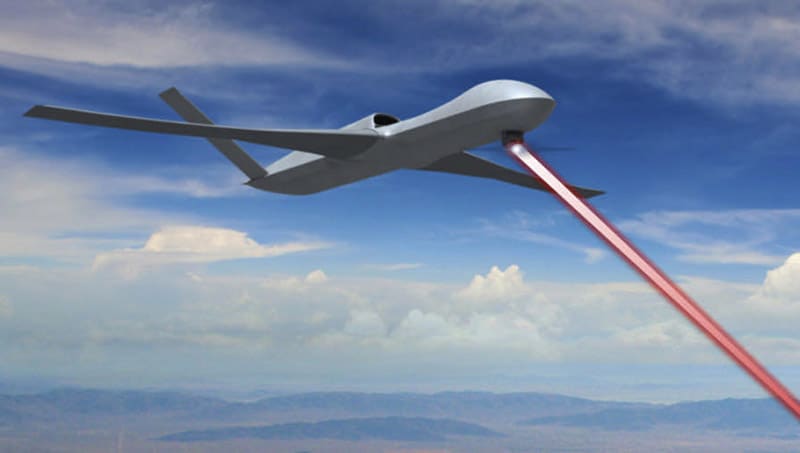
The deployment of an airborne platform armed with a High Energy Laser (HEL) weapon has been a major challenge for several decades. Attempts in the past included mounting a HEL weapon in large aircraft like a Boeing 747, mainly for strategic missions like defense against tactical ballistic missiles. Despite being very promising in their initial phases, these trial configurations presented various technical and economic issues that resulted in their cancellation.
Recently, the focus has shifted from strategic missions to tactical missions. That means that HEL weapons of lower power and, consequently, decreased size and weight would be sufficient for these missions while also being more suitable for airborne applications. Additionally, the improvements in laser weapon technology in terms of size, weight, and power (SWaP) promise that soon a HEL weapon could be deployable from an unmanned aerial vehicle (UAV).
The purpose of this research was to model a UAV-based HEL weapon by applying a model-based system engineering (MBSE) approach and simulate its performance. Two alternative HEL design configurations were selected, and their corresponding weight requirements were estimated. Finally, the endurance of the UAV for these different configurations was calculated.
Utilizing Vitech CORE software, the architecture of the UAV-HEL system was modeled, starting from the system capabilities required for a Close Air Support (CAS) mission execution along with the operational system requirements. Next came the functional and physical architecture, showing the functions that each physical component is to accomplish. Finally, the UAV's endurance and the HEL's lethality were identified as the technical performance measures of the overall system.
The first phase of the simulation experiment focused on exploring how the different operational tactics and HEL design configurations affect the lethality of the system as measured by the irradiance delivered to the target and the power accumulated in a bucket on the target's surface, with a radius of 5 cm and thickness of 3 mm. Exploring these parameters at the same time, rather than one factor at a time, called for application of the Design of Experiments (DOE), a well-structured mathematical process that allows for the determination of the significance of each factor and potential interactions among them by analyzing the simulation's experiment results. The selected parameters in this simulation are the HEL's power; the beam director size; and the UAV altitude, speed, and direction. Having defined the mission of the UAV, the target damage criteria was determined by calculating the required irradiance and power in bucket (PIB) for different dwell times. Specifically, it was found that for an aluminum surface target, an irradiance of 11 MJ/m2 and PIB of 85 kW for a dwell time of 6 seconds would be sufficient to melt the target.
The simulation results clearly showed the importance that the operating altitude of the UAV has on the HEL's lethality. The results showed that operating altitude has the greatest effect on both irradiance and PIB. Following altitude in importance is the beam director size and then output power. Speed and direction of UAV show no significant effect. Another important simulation result showed that under certain circumstances a 150 kW HEL deployed by a UAV flying at altitudes higher than 3000m could have the same performance as a 250 kW HEL operated from lower than 500m of altitude.
Having determined those two power levels as possible alternatives and measured their performance, the corresponding weight and power requirements were estimated for each alternative. These estimations, which were based on commercially developed systems and provided a nominal approximation, showed that a 150 kW HEL would weigh approximately 1670 kg whereas a 250 kW HEL would weigh 2635 kg. Therefore, both alternatives could be mounted and supported by a UAV similar in size and capability to the Predator B.
By consulting a subject matter expert on UAVs, it was determined that a simple mathematical relationship existed between the endurance of the UAV and its payload weight. Using this relationship, it was determined that the lower power HEL would allow an endurance of around 25.5 hours, whereas the bigger one would allow only for 23 hours, or a 10 percent decrease in endurance.
This work was done by Antonios Lionis for the Naval Postgraduate School. For more information, download the Technical Support Package below.
This Brief includes a Technical Support Package (TSP).
Experimental Design of a UCAV-Based High-Energy Laser Weapon
(reference NPS-0012) is currently available for download from the TSP library.
Don't have an account?
More From SAE Media Group
Aerospace & Defense Tech Briefs
sUAS-Based Payload Development and Testing for Quantifying Optical Turbulence
Aerospace & Defense Tech Briefs
Advanced Airborne Defensive Laser for Incorporation on Strike Fighter Aircraft
Aerospace & Defense Tech Briefs
Fighter Jet Armaments
Aerospace & Defense Tech Briefs
MUSHER Demonstrates Manned-Unmanned Aircraft Teaming Applications
Aerospace & Defense Tech Briefs
Counter-Directed Energy Weapons: Defense of Air Assets
Aerospace & Defense Tech Briefs
Navy Lasers, Railgun, and Hypervelocity Projectile: Background and Issues for Congress
Aerospace & Defense Tech Briefs
Autonomous Collaborative Platform
Aerospace & Defense Tech Briefs
Laser Detecting Systems
Aerospace & Defense Tech Briefs
Unmanned Aircraft Training Materials
Aerospace & Defense Tech Briefs
Industry Invited to Participate in AeroTech Aerospace and Defense Technical Program
Aerospace & Defense Tech Briefs
Assessment of Noncommercial Icing Prediction Capabilities for Army Applications
Tech Briefs
Algorithms Improve Quadrotor Drone Performance
Aerospace & Defense Tech Briefs
Mobile Counter Unmanned Aircraft System
Aerospace & Defense Tech Briefs
The New Airbus Wingman Aircraft
Tech Briefs
Air Traffic Simulation Tool
Aerospace & Defense Tech Briefs
Making Laser Weapons a Reality
Aerospace & Defense Tech Briefs
New Diamond Super-Material Enhances Aircraft Survivability
Aerospace & Defense Tech Briefs
H4 Palletized Laser Weapon
Aerospace & Defense Tech Briefs
High-Speed Data Cables for Fighter Aircraft
Aerospace & Defense Tech Briefs
PHASA-35 Stratospheric Flight
Aerospace & Defense Tech Briefs
Next Generation C-UAS Missile
Aerospace & Defense Tech Briefs
New Method to Measure Wind Speed Could Unlock Drones’ Potential
Aerospace & Defense Tech Briefs
Expendable Jet Engine Oil Tank
Aerospace & Defense Tech Briefs
Customizable Rocket Launchers
Aerospace & Defense Tech Briefs
Missile Protection System
Aerospace & Defense Tech Briefs
GOKBERK C-UAS Testing
Aerospace & Defense Tech Briefs
Leveraging COTS Products for Maneuverable Aerial Identification
Photonics & Imaging Technology
Tackling Aircraft Laser Strikes from the Ground
Aerospace & Defense Tech Briefs
AeroVironment Releases New Puma 3
Motion Design INSIDER
AI-Powered Vision System Helps Drones Navigate Safely
Overview
The document is a thesis authored by Antonios Lionis at the Naval Postgraduate School in December 2016, focusing on the experimental design of a high-energy laser weapon system mounted on an unmanned combat aerial vehicle (UCAV). The research addresses the growing interest in directed energy weapons, particularly high-energy lasers, as viable options for modern military applications.
The thesis begins by outlining the primary research questions that guide the analysis, emphasizing the need to understand the operational effectiveness of high-energy laser systems when integrated with UCAVs. It highlights the challenges associated with such integration, particularly concerning size, weight, and power (SWaP) constraints that are critical for the performance and feasibility of these systems in combat scenarios.
To tackle these challenges, the study employs the Design of Experiments (DOE) methodology, which allows for systematic exploration of the relationships between various design parameters and the overall effectiveness of the laser weapon system. By utilizing modeling and simulations, the research aims to identify optimal configurations that maximize the weapon's performance while adhering to the stringent limitations imposed by the UCAV platform.
The document also discusses the potential advantages of high-energy laser systems, such as precision targeting, reduced ammunition costs, and the ability to engage multiple targets rapidly. However, it does not shy away from addressing the technical and operational hurdles that must be overcome to make these systems practical for military use.
In summary, the thesis presents a comprehensive analysis of the integration of high-energy laser weapons with unmanned aerial systems, employing advanced experimental design techniques to evaluate performance metrics. It contributes to the broader understanding of directed energy weapons and their potential role in future warfare, providing insights that could inform both military strategy and technological development in this emerging field.
Top Stories
NewsSensors/Data Acquisition
 Microvision Aquires Luminar, Plans Relationship Restoration, Multi-industry Push
INSIDERRF & Microwave Electronics
 A Next Generation Helmet System for Navy Pilots
INSIDERWeapons Systems
 New Raytheon and Lockheed Martin Agreements Expand Missile Defense Production
NewsAutomotive
 Ford Announces 48-Volt Architecture for Future Electric Truck
INSIDERAerospace
 Active Strake System Cuts Cruise Drag, Boosts Flight Efficiency
ArticlesTransportation

Webcasts
Aerospace
 Cooling a New Generation of Aerospace and Defense Embedded...
Energy
 Battery Abuse Testing: Pushing to Failure
Power
 A FREE Two-Day Event Dedicated to Connected Mobility
Automotive
 Quiet, Please: NVH Improvement Opportunities in the Early Design Cycle
Electronics & Computers
 Advantages of Smart Power Distribution Unit Design for Automotive &...
Unmanned Systems
 Sesame Solar's Nanogrid Tech Promises Major Gains in Drone Endurance