




Bore Elevation and Azimuth Measurement System (Beams)
Newly developed laser apparatus verifies that the pointing accuracy requirement of a weapon’s fire control system is met.
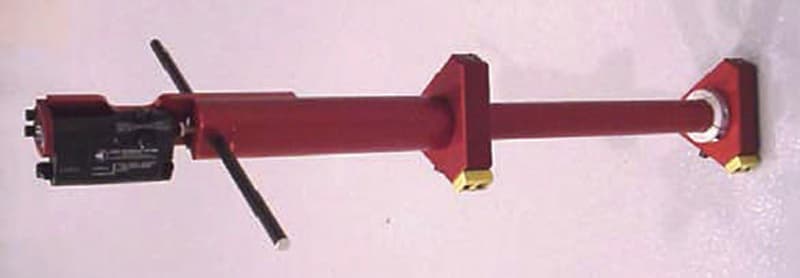
The U.S. Army Armament Research, Development and Engineering Center (ARDEC) engineers from the Fire Control Systems and Technology Directorate at Picatinny Arsenal in New Jersey developed, tested, and placed into practical application the Bore Elevation and Azimuth Measurement System (BEAMS). The BEAMS provides a means to accurately measure the pointing ability of fire control for mortars, artillery, and other weapon platforms.
Heretofore, verifying weapon pointing accuracy in an engineering environment has been, and continues to be, a problem at many government test facilities.
Current methods employed at Government Proving Grounds for artillery and mortar weapon azimuth pointing measurements generally make use of a fixture inserted into the weapon tube. The fixture is composed of two disks, which engage the diameter of the weapon bore. The disks support a mechanical rod structure that extends the tube axis beyond the end of the tube where it may be observed. The long-rod incorporates two conical alignment points, the tips of which are machined to be on axis with the long-rod. The long-rod is machined to be coaxial with the two disks. In operation, the weapon tube is positioned on the azimuth of interest and the apparatus inserted into the bore. A theodolite is then positioned at a location such that the vertical line intersects the tips of both conical alignment points. At that time, the theodolite would be positioned in exactly the same vertical plane as both conical points and therefore along horizontal projection of the azimuth of the weapon tube.
This is a subjective process and highly dependent upon the skill of the theodolite operator. Shortcomings of such approaches are the inability to quantify or calibrate the mechanical apparatus and to establish or remove bias from the measurement. Additionally, these approaches may measure azimuth, but not the elevation angle.
The BEAMS device offers a low-cost technique to verify in a field test environment that the elevation and azimuth pointing accuracy requirement of a weapon’s fire control system is met. The BEAMS laser apparatus incorporates interchangeable lobes that allow for use with any weapon tube caliber. The lobes support two non-marring brass pads and a spring-loaded plunger, which allows the apparatus to self-center on the weapon tube axis. The apparatus incorporates an eye-safe laser that provides a projection of the tube axis. Mechanical adjustments allow the laser aperture to be positioned on-axis with the weapon bore, and optical adjustments within the laser housing permit the beam to be made concentric with the actual tube axis. These features facilitate measurement and/or removal of bias from the fixture.
The BEAMS uses a dual theodolite approach employing conventional geodetic survey procedures to make three-dimensional measurements of the laser’s position. From these measurements, the elevation and azimuth of the laser line and subsequently the weapon tube can be computed with exceptional accuracy. The computations may be performed in a spreadsheet or through the use of dedicated computer software. A fully automated system may be implemented through the use of digital theodolites operating under computer control.
This work was done by Robert P. Pinto for the Army Armament Research, Development and Engineering Center. For more information, download the Technical Support Package (free white paper) below. ARDEC-0007
This Brief includes a Technical Support Package (TSP).
Bore Elevation and Azimuth Measurement System (Beams)
(reference ARDEC-0007) is currently available for download from the TSP library.
Don't have an account?
More From SAE Media Group
Aerospace & Defense Tech Briefs
sUAS-Based Payload Development and Testing for Quantifying Optical Turbulence
Aerospace & Defense Tech Briefs
High-Energy Laser Weapon Systems
Aerospace & Defense Tech Briefs
Laser Detecting Systems
Aerospace & Defense Tech Briefs
Nonlinear Effects in Transformation Optics-Based Metamaterial Shields for Counter Directed Energy Weapon Defense
Aerospace & Defense Tech Briefs
New Diamond Super-Material Enhances Aircraft Survivability
Aerospace & Defense Tech Briefs
Making Laser Weapons a Reality
Tech Briefs
Inductive Non-Contact Position Sensor
Aerospace & Defense Tech Briefs
Optical Seeker for Munitions Systems
Aerospace & Defense Tech Briefs
Counter-Directed Energy Weapons: Defense of Air Assets
Motion Design
Laser-Light-Based Accelerometer
Aerospace & Defense Tech Briefs
Calculation of Weapon Platform Attitude and Cant Using Available Sensor Feedback
Motion Design
Inductive Non-Contact Position Sensor
Aerospace & Defense Tech Briefs
Laser Guided Rocket System
Photonics & Imaging Technology
Optical Distance Measurement at Record-High Speed
Tech Briefs
Portable Laser-Guided Robotic Metrology (PLGRM)
Aerospace & Defense Tech Briefs
Advanced Airborne Defensive Laser for Incorporation on Strike Fighter Aircraft
Tech Briefs
Robot “Eye” Provides 360° Field of View
Aerospace & Defense Tech Briefs
Weapon Fire Control System
Aerospace & Defense Tech Briefs
Thermal Management for Directed Energy Weapons

Aerospace & Defense Tech Briefs
Armed Drone System
Aerospace & Defense Tech Briefs
Remote Weapon Station
Photonics & Imaging Technology
Machine Vision Applications in Laser Measurement Systems
Aerospace & Defense Tech Briefs
Streamlined Microcomb Design Provides Control With The Flip of a Switch
Aerospace & Defense Tech Briefs
Navy Lasers, Railgun, and Hypervelocity Projectile: Background and Issues for Congress
Sensor Technology
A Better Way to Measure Acceleration
Photonics & Imaging Technology
Tackling Aircraft Laser Strikes from the Ground
Tech Briefs
Long-Distance LADAR System and Method


Overview
The document titled "Bore Elevation and Azimuth Measurement System (BEAMS)" is a technical report authored by Robert P. Pinto, published in October 2018. It presents a comprehensive overview of the BEAMS technology developed by the U.S. Army Armament Research, Development and Engineering Center (ARDEC). The report is structured to provide insights into the system's components, calibration, operation, and applications.
The introduction outlines the purpose of BEAMS, which is designed to enhance the accuracy of bore elevation and azimuth measurements in military applications. The background section discusses the need for precise measurements in artillery and missile systems, emphasizing the importance of reliable data for effective targeting and operational success.
The report details the various components of BEAMS, including the laser apparatus, theodolite apparatus, and computation component. Each component plays a crucial role in ensuring accurate measurements. The laser apparatus is responsible for providing precise distance measurements, while the theodolite apparatus is used for angular measurements. The computation component processes the data collected from these instruments to produce usable results.
Calibration is a significant focus of the report, with dedicated sections on mechanical and laser calibration. Proper calibration is essential to maintain the accuracy and reliability of the measurements taken by the BEAMS system. The report outlines the procedures for calibrating each component, ensuring that users can achieve optimal performance.
The operation of BEAMS is described in detail, including setup and measurement techniques. The report also explores alternative measurement techniques and provides guidance on spreadsheet computations for data analysis. Worksheets for setup, calibration, and data collection are included to assist users in effectively utilizing the system.
Applications of BEAMS are discussed, highlighting its relevance in various military contexts, particularly in artillery and missile systems. The report concludes with recommendations for future improvements and further research, emphasizing the ongoing need for advancements in measurement technologies.
Overall, the BEAMS report serves as a valuable resource for military personnel and engineers involved in artillery and missile systems, providing essential information on the technology, its operation, and its applications. The document is unclassified and approved for public release, making it accessible for broader use and reference.
Top Stories
INSIDERManufacturing & Prototyping
 How Airbus is Using w-DED to 3D Print Larger Titanium Airplane Parts
INSIDERManned Systems
 FAA to Replace Aging Network of Ground-Based Radars
NewsTransportation
 CES 2026: Bosch is Ready to Bring AI to Your (Likely ICE-powered) Vehicle
NewsSoftware
 Accelerating Down the Road to Autonomy
EditorialDesign
 DarkSky One Wants to Make the World a Darker Place
INSIDERMaterials
 Can This Self-Healing Composite Make Airplane and Spacecraft Components Last...
Webcasts
Defense
 How Sift's Unified Observability Platform Accelerates Drone Innovation
Automotive
 E/E Architecture Redefined: Building Smarter, Safer, and Scalable...
Power
 Hydrogen Engines Are Heating Up for Heavy Duty
Electronics & Computers
 Advantages of Smart Power Distribution Unit Design for Automotive...
Unmanned Systems
 Quiet, Please: NVH Improvement Opportunities in the Early Design...
