




Fundamental Interaction Between Gold Nanoparticles and DNA
Applications include gene therapy, drug delivery to DNA, and improved methods of decoding DNA.
Quantum dots (QDs) and nanoparticles (NPs) are made of metal and/or semiconductor materials with diameters ranging from 5 to 100 nm. The properties of these nanomaterials, which depend on their size and the material they are made from, are usually completely different than the properties of their corresponding bulk materials. There may be anywhere from 1 to 1,000 electrons in a single QD, providing numerous possibilities for their opti-
cal and electrical properties.
The unique optical properties of NPs can be beneficial to their biological applications. NPs have broad absorption spectra, ranging from the visible region into the ultraviolet, and narrow, size-tunable photoluminescence spectra. Both of these spectra depend on the size of the NPs. The most attractive optical properties in NPs, from a biological aspect, appear in those that are approximately 10 nm in diameter or smaller. When illuminated with ultraviolet (UV) light, such NPs emit extremely bright fluorescent light.
NPs have been used to sense deoxyri-bonucleicacid (DNA). Positively charged NP-DNA complexes have been created as probes themselves, for the detection of nucleic acids. However, the fundamentals of the interactions between NPs themselves — without any mediating linker — and DNA have yet to be fully understood. Given the vast optical, magnetic, and electrical properties of NPs, knowledge of their interaction with DNA will create new insight into the world of nanobiotechnology.
In this research, the interactions between gold (Au) NPs and single-strand DNA were studied to develop a fundamental understanding and to identify potential future applications for NP-DNA complexes. These applications include gene therapy, drug delivery to DNA, and an improved method for decoding DNA. A detailed study of NP interactions with DNA is also expected to provide an enhanced understanding of NP interactions with other biomolecules, such as ribonucleic acid (RNA), proteins, and enzymes.
Colloidal Au NPs were synthesized by reducing hydroaurochloric acid by trisodium citrate dihydrate. The suspended NPs were sonicated for 15 minutes to obtain a uniform distribution and cluster-free nanoparticles. Fairly uniform-sized Au NPs capped by citrate ions were obtained. About 25 μl of the suspension was spin-coated at a rate of 120 rpm for 6 minutes onto a silicon substrate and dried in a dessicator under a clean environment. A 1 mM DNA solution was prepared using 5 ml of phosphate buffer. One drop of the solution was then spin-coated onto an Au substrate at a rate of 120 rpm for 3 minutes. The surface characterization of the 3 Au substrate with DNA was performed using tapping mode atomic force microscopy (AFM).
The Au NP and the DNA solutions were mixed at a 1:1 ratio and spin-coated on a freshly cleaved mica substrate. The dried substrate containing the NPs and DNA was imaged using tapping-mode AFM. A series of images was obtained that showed prominent interaction between Au NPs and DNA.
The broad and overlapping emission spectra of Au NPs and DNA reveal that Au NPs at lower intensity have strong affinity to DNA. The possible reason of positive shift in the wavelengths of both Au NPs and DNA for Au NP-DNA mixture is unknown and requires further investigation. However, the broad and overlapping emission spectra of Au NPs and DNA reveal the strong interaction between the Au and DNA.
The morphology and surface properties of the Au NPs, DNA, and the Au NP-DNA complex on different substrates reveal the uniform heights; the diameter, however, varied considerably. The heights of the NPs ranged between 2 and 6 nm, with average height to be 4 nm. The diameter ranged between 30 and 250 nm, with an average of 100 nm. This observation suggested the clustering/agglomeration of small NPs and nanorods into larger particles. Similarly, the height and the diameter of the single-strand DNA ranged between 1 and 3 nm and 25 to 75 nm, respectively, suggesting that there were possibility of more than one single-stranded DNA lined parallel to each other. It is also worth noting that AFM tends to exaggerate the measurement in the x or y direction due to the x-y movement of the scanner.
The Au NP-DNA sample showed both Au NPs and DNA oligomer strands. AFM images show that the DNA and Au NPs do, indeed, interact with one another. The DNA appears to link to larger Au NPs of an overall average size of 150 nm. Smaller NPs appear more frequently in the images than Au NP-DNA linked complexes.
The results indicate that the citrate-capped Au NPs naturally link with single-strand DNA. The exact nature of the interaction needs to be determined, though it can be speculated that the attractive forces between the Au NPs and single-strand DNA are a type of intermolecular attractive force, rather than a type of chemical bond.
This work was done by Molly Karna, Govind Mallick, and Shashi P. Karna of the Army Research Laboratory. For more information, download the Technical Support Package (free white paper) at www.defensetechbriefs.com/tsp under the Materials category. ARL-0112
This Brief includes a Technical Support Package (TSP).
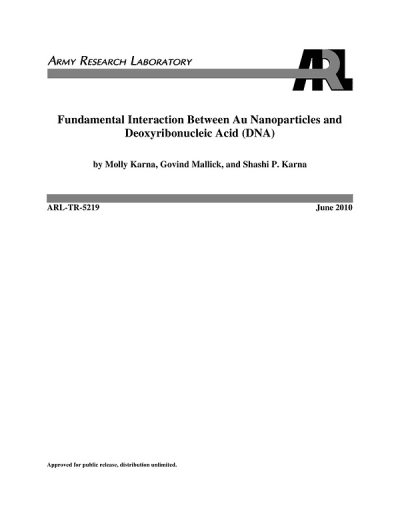
Fundamental Interaction Between Au Nanoparticles and Deoxyribonucleic Acid (DNA)
(reference ARL-0112) is currently available for download from the TSP library.
Don't have an account?
More From SAE Media Group
Photonics & Imaging Technology
New Blue Light Technique Could Enable Advances in Understanding Nanoscale Technologies
Aerospace & Defense Tech Briefs
Abrasion Testing of Products Containing Nanomaterials
Photonics & Imaging Technology
A Sharper Look at the Interior of Semiconductors
Photonics & Imaging Technology
New Electron Microscopy Technique Offers First Look at Previously Hidden Processes
Aerospace & Defense Tech Briefs
Templated Synthesis of Aluminum Nanoparticles for Stable Energetic Materials

Aerospace & Defense Tech Briefs
Gold-Based Nanoparticle Liquids for Electronic Applications


Aerospace & Defense Tech Briefs
Cluster-Assembled Soft Magnets for Power Electronics Applications

Aerospace & Defense Tech Briefs
Phonon Confinement Effect in TiO₂ Nanoparticles as Thermosensor Materials
Aerospace & Defense Tech Briefs
Electro-Optic Materials Research
Tech Briefs
Synthesizing Complex Optical Materials

Photonics & Imaging Technology
Nanoscale Machines Convert Light into Work
Medical Design Briefs
Simple Method Developed for 3D Biofabrication Based on Bacterial Cellulose
Medical Design Briefs
‘Seeing’ Nonuniformities in 2D Materials May Lead to New Medical Sensors
Medical Design Briefs
Convergence Nanoparticles for Multi-Modal Biomedical Imaging
Aerospace & Defense Tech Briefs
Formation and Characterization of Gold Nanoparticles
Tech Briefs
Building a New 3D Material with DNA
Medical Design Briefs
New Thermofluidic Improves Lab-On-a-Chip Applications
Tech Briefs
Sound Waves Power Advances in Smart Materials
Tech Briefs
Scaling Up Nano for Sustainable Manufacturing


Overview
The document titled "Fundamental Interaction Between Au Nanoparticles and Deoxyribonucleic Acid (DNA)" presents research focused on the interactions between gold nanoparticles (Au NPs) and DNA, highlighting their potential applications in biological sensing and imaging. The study is motivated by the growing interest in semiconductor quantum dots and metal nanoparticles within the biology community, particularly for their roles as fluorescent labels and sensors.
The abstract outlines that the optical properties of nanoparticles enable them to serve as effective imaging agents for biomolecules. The research emphasizes the importance of understanding the fundamental interactions between nanoparticles and biomolecules, particularly DNA, to develop novel applications beyond mere labeling and sensing. The study aims to investigate these interactions directly, rather than relying on intermediary linkers that are commonly used to attach nanoparticles to DNA.
The document is structured into several sections, including an introduction, materials and methods, results and discussion, summary and conclusions, and references. The introduction provides background information on the significance of nanoparticles in biological applications, while the materials and methods section details the experimental approaches used to study the interactions.
Results and discussion focus on spectral and microscopic analyses, which are critical for understanding how Au NPs interact with DNA at a fundamental level. The findings suggest that size-controlled nanoparticles can enhance the sensitivity and specificity of DNA detection, which is crucial for applications in diagnostics and biosensing.
The report concludes with a summary of the key findings and their implications for future research and applications in the field of nanobiotechnology. The authors, Molly Karna, Govind Mallick, and Shashi P. Karna, emphasize the need for further exploration of NP-DNA complexes to unlock their full potential in various scientific and medical applications.
Overall, the document contributes valuable insights into the interactions between gold nanoparticles and DNA, paving the way for advancements in biosensing technologies and the development of innovative applications in the life sciences. The research is unclassified and approved for public release, indicating its relevance and accessibility to the broader scientific community.
Top Stories
INSIDERManufacturing & Prototyping
 How Airbus is Using w-DED to 3D Print Larger Titanium Airplane Parts
NewsAutomotive
 Microvision Aquires Luminar, Plans Relationship Restoration, Multi-industry Push
INSIDERAerospace
 A Next Generation Helmet System for Navy Pilots
INSIDERDesign
 New Raytheon and Lockheed Martin Agreements Expand Missile Defense Production
ArticlesAR/AI
 CES 2026: Bosch is Ready to Bring AI to Your (Likely ICE-powered) Vehicle
Road ReadyDesign

Webcasts
Semiconductors & ICs
 Advantages of Smart Power Distribution Unit Design for Automotive...
Unmanned Systems
 Quiet, Please: NVH Improvement Opportunities in the Early Design...
Electronics & Computers
 Cooling a New Generation of Aerospace and Defense Embedded...
Power
 Battery Abuse Testing: Pushing to Failure
AR/AI
 A FREE Two-Day Event Dedicated to Connected Mobility
