




Phonon Confinement Effect in TiO₂ Nanoparticles as Thermosensor Materials
Thermal sensors have the unique ability to forensically retain the complete thermal history (spatial and temporal variation) of an event under extreme conditions.
TiO2 or ZnO nanoparticles (NPs) have a very strong finite-size dependency in their Raman spectra or photoluminescence (PL) spectra due to the phonon confinement effect or the quantum confinement effect. Together with a fast grain growth kinetics and a high stability under high temperature and pressure, they can forensically retain the complete thermal history of an event. By spatially distributing these NPs during thermal events such as blasts or weapon tests, a spatially and temporally non-uniform thermal environment can be determined by a direct read off their Raman or PL spectra at various locations.
These thermosensors can also be used in non-defense applications such as for detecting the transient heating in electronics and measuring the rapid energy release during catastrophic fractures. The protocols developed in this research can be easily extended to the design of other thermosensors where a grain growth or phase transition at lower temperatures is needed to characterize the thermal environment on the biological or cellular level.
Therefore, the objective of this research was to utilize the phonon/quantum confinement effect in Raman/PL spectra and grain growth kinetics in NPs to create thermosensor materials with the ability to forensically retain the complete thermal history (spatial and temporal variation) of a thermal event under extreme conditions.
NPs and substrates chosen for use as thermosensor materials had to meet the following requirements:
NPs:
Strong phonon/quantum confinement effect;
Fast growth kinetics;
Easy synthesis to get spherical NPs;
High thermal and mechanical stability.
Substrates as NPs’ carrier and protector:
High thermal and mechanical stability;
High thermal conductivity.
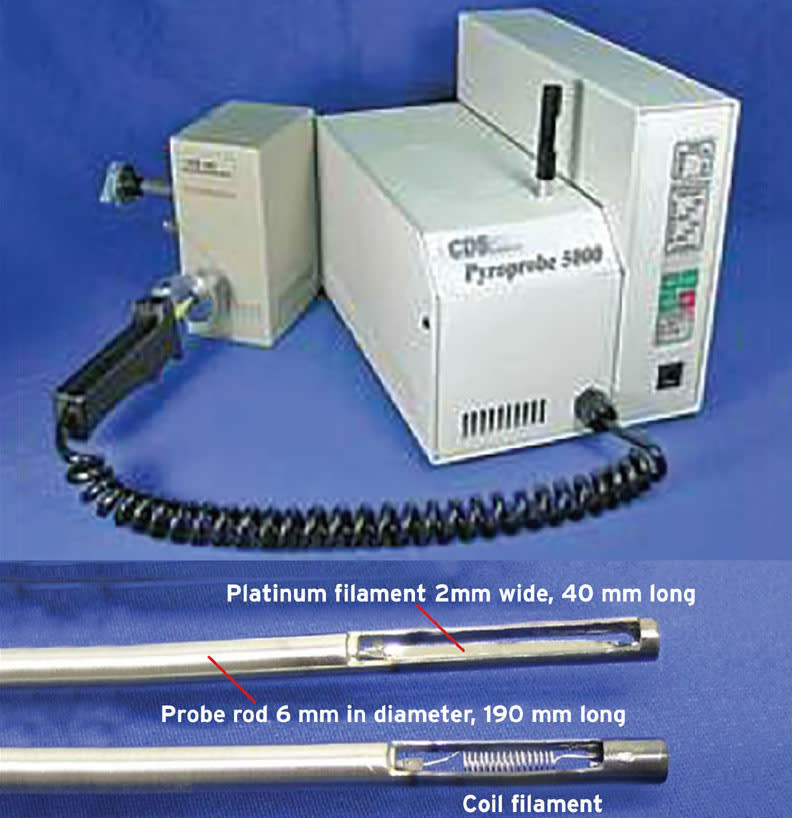
Small and monodisperse TiO2 and ZnO NPs of 5-6 nm in size were synthesized and loaded onto SBA-15 or graphite nanoplatelets (GNPs) substrates. Raman and PL spectrometers were used to establish the particle size versus the Raman/PL peak position master curves. Systematic isothermal and temperature-dependent heat treatments of NPs using a ribbon pyroprobe microheater (see figures) were carried out to study their grain growth kinetics.
This work was done by Liping Huang, Rensselaer Polytechnic Institute, for the Defense Threat Reduction Agency. DTRA-0008
This Brief includes a Technical Support Package (TSP).
Phonon Confinement Effect in TiO2 Nanoparticles as Thermosensor Materials
(reference DTRA-0008) is currently available for download from the TSP library.
Don't have an account?
More From SAE Media Group
Aerospace & Defense Tech Briefs
Luminescence Materials as Nanoparticle Thermal Sensors

Tech Briefs
Nanoscale Pillars Act as Memory Foam
Tech Briefs
Sound Waves Power Advances in Smart Materials

Tech Briefs
A Novel Way to Convert Heat to Electricity
Photonics & Imaging Technology
Nanoscale Machines Convert Light into Work
Tech Briefs
Nanosheets of Borophane are Stronger Than Steel
Tech Briefs
New Method to Determine How 2D Materials Expand
Tech Briefs
Nanoprecipitates Toughen Structural Alloys
Tech Briefs
Scaling Up Nano for Sustainable Manufacturing
Tech Briefs
VaCNT Makes Up a Promising Membrane Material

Medical Design Briefs
FDA Adopts Three Nanotechnology Standards
Aerospace & Defense Tech Briefs
Development of Hydrophobic Coatings for Water-Repellent Surfaces Using Hybrid Methodology

Medical Design Briefs
Surface Waves Help Nanostructured Devices Keep Cool

Electronics & Sensors INSIDER
Record-Breaking Heat Conduction Material Will Save Computer Chips

Medical Design Briefs
Hybrid Material Enables Next-Gen E-Skin

Medical Manufacturing and Machining
Atomic Blasting Creates New Devices to Measure Nanoparticles

Photonics & Imaging Technology
New Electron Microscopy Technique Offers First Look at Previously Hidden Processes
Aerospace & Defense Tech Briefs
Design of New Piezoelectric Composites Using Nanocellulose
Overview
The document titled "Phonon Confinement Effect in TiO2 Nanoparticles as Thermosensor Materials" is a technical report prepared by Liping Huang from Rensselaer Polytechnic Institute, published in January 2018 under the Defense Threat Reduction Agency (DTRA). The report investigates the unique properties of titanium dioxide (TiO2) and zinc oxide (ZnO) nanoparticles, particularly focusing on their phonon confinement and quantum confinement effects, which significantly influence their Raman and photoluminescence (PL) spectra.
The abstract highlights that TiO2 and ZnO nanoparticles exhibit strong finite-size dependencies in their spectral characteristics due to these confinement effects. This phenomenon is crucial for understanding how the size of nanoparticles affects their thermal sensing capabilities. The report emphasizes the potential of these nanoparticles as effective thermosensor materials, which can be synthesized into spherical forms, making them suitable for various applications.
The document includes experimental work that explores the thermal sensing properties of bare TiO2 and ZnO nanoparticles. It describes the synthesis process and the characterization of these nanoparticles, showcasing their strong phonon confinement in Raman spectra and quantum confinement in PL spectra. The report also features figures, including images of the nanoparticles obtained through scanning electron microscopy (SEM) and transmission electron microscopy (TEM), illustrating their morphology and size.
Additionally, the report discusses the use of a ribbon pyroprobe microheater capable of heating from room temperature to 1400°C, with rapid heating rates, which is essential for testing the thermal response of the nanoparticles. The findings suggest that the unique properties of TiO2 and ZnO nanoparticles make them promising candidates for advanced thermosensor applications, potentially enhancing the sensitivity and accuracy of temperature measurements in various fields.
Overall, the report provides valuable insights into the phonon and quantum confinement effects in TiO2 and ZnO nanoparticles, laying the groundwork for future research and development in thermosensing technologies. The distribution of the report is approved for public release, ensuring that the findings can contribute to broader scientific and technological advancements.
Top Stories
NewsRF & Microwave Electronics
 Microvision Aquires Luminar, Plans Relationship Restoration, Multi-industry Push
INSIDERAerospace
 A Next Generation Helmet System for Navy Pilots
INSIDERDesign
 New Raytheon and Lockheed Martin Agreements Expand Missile Defense Production
INSIDERMaterials
 How Airbus is Using w-DED to 3D Print Larger Titanium Airplane Parts
NewsPower
 Ford Announces 48-Volt Architecture for Future Electric Truck
ArticlesAR/AI

Webcasts
Electronics & Computers
 Cooling a New Generation of Aerospace and Defense Embedded...
Automotive
 Battery Abuse Testing: Pushing to Failure
Power
 A FREE Two-Day Event Dedicated to Connected Mobility
Unmanned Systems
 Quiet, Please: NVH Improvement Opportunities in the Early Design Cycle
Automotive
 Advantages of Smart Power Distribution Unit Design for Automotive &...
Energy
 Sesame Solar's Nanogrid Tech Promises Major Gains in Drone Endurance