




Seeking Ways to Make Better Computer Crashes
New models and simulations help improve safety as software and hardware provide more realism to iterate designs more quickly.

Although dramatic improvements in models and simulations have made them the primary means for determining the crashworthiness of vehicles, developers are pursuing many avenues to make virtual crashes even more realistic. Algorithms are being tuned to run on multiple processors, adding resolution while shortening the time it takes to full-vehicle simulations.
“As the quality and accuracy of simulation models have increased, the number of repeat tests of actual vehicles has been dramatically reduced and the rate of successful first-time actual tests has increased,” said Eric DeHoff, Principal Engineer/CAE Technical Leader for Vehicle Structures Research at Honda.

As these simulations are growing in size they have become more realistic. Though there’s more data in a today’s simulated crashes, the amount of time needed to run them is declining. Computing horsepower has increased while software techniques help streamline processing.
“When we’re running a full vehicle model for a front-end crash, running a model size of five to 10 million elements for a simulation time of up to 120 milliseconds, a 32-CPU system can run it in 10-12 hours,” said Yangwook Choi, Simulia Technical Solutions Director at Dassault Systemes. “That’s improved a lot, even though model sizes have increased, because hardware and algorithms have both improved.”

Design-tool providers and automakers alike are finding new ways to make simulations more lifelike, accounting for many different parameters. For example, Toyota recently upgraded its total human model for safety (THUMS) virtual human model software to account for precrash actions taken by drivers. These include sudden braking or steering as well as bracing and stiffening by vehicle occupants.
Going forward, modeling and simulation tools will have to address even more parameters. Increasingly, metal components are being replaced by plastics and composites. Software must account for connecting techniques as it’s adapted for the characteristics of new materials.
“Modeling complexity will continue to increase with the challenges of predicting the performance of vehicles built from many different materials like aluminum and fiber-reinforced plastics joined to steel with new connections like adhesives, rivets, and screws,” DeHoff said.
Many facets
Another huge benefit of simulated crashes is that automakers can test many variations instead of simply crashing a car into a wall. Angles and speeds can be changed, and simulations can account for the many different ways drivers find to crash vehicles.

Models are also being improved to add realism to human injury results. University researchers in Virginia Tech’s medical school are analyzing actual collisions, working with automakers and suppliers to help them determine ways to enhance safety.
“We have 9000 downloads of real crashes using the data recorder in the airbag controller,” said H. Clay Gabler of Virginia Tech’s Center for Injury Biomechanics. “Our role is to find out how systems work in the real world. People have some strange crashes. Someone will depart the road and hit the curb, then hit a telephone pole. It’s difficult to know when to deploy the airbag in that scenario.”
The Insurance Institute for Highway Safety (IIHS), which relies primarily on performing real-world collisions, is also looking at ways to augment existing techniques for determining how to make vehicles safer. IIHS uses injury records to help understand what happens during crashes. These data are shared with automakers and tool developers.
“We are continually going back to the data to see how occupants are being seriously injured or killed in vehicles that otherwise earn good ratings in the crash tests,” said Raul Arbelaez, Vice President of the IIHS Vehicle Research Center. “This research led to our small overlap frontal offset test that we launched in 2012. Right now, we are conducting research to look at passenger-side protection in small overlap crashes. We are also doing research on side-impact crashes to see whether the IIHS test should be changed to reflect other side-impact crash scenarios.”

Thinking inside the box
Advances in computing technology play a critical role in the snowballing growth in simulation quality. Programmers are taking advantage of the ability to employ several computers to speed up virtual tests.
“A few years ago, simulations ran on six CPUs,” Choi said. “Now they’re running on 128.”
When they run full vehicle tests, automakers are ganging many computers together, taking advantage of multicore processors. All aspects of computing technology come into play when automakers run a broad range of tests, using multiple models and many crash scenarios.
“Current state-of-the-art high-performance computing involves using hundreds to thousands of processors to solve virtual models,” DeHoff said. “Each model uses hundreds of processors to calculate the result. It is typical to run several hundred models each month, which means thousands of processors in total are needed for throughput. The amount of memory needed has increased dramatically due to the details included in each model. Each model generates gigabytes of data, and overall data storage has reached into the hundreds of terabytes.”
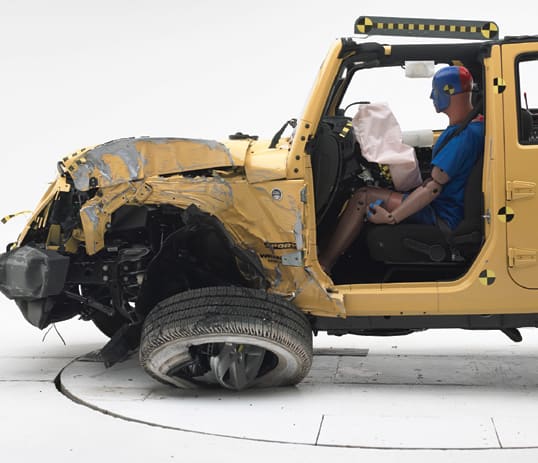
Full-vehicle simulations are quite large, so it’s challenging to process all the information at a constant rate. Programmers have devised techniques that balance loads, collapsing some sections and splitting models into smaller segments.
“Some companies divide the car into four sections,” Choi said. “We need to develop a load-balancing scheme. During computations, we check the domains to see which have more loads, making adjustments so all the domains have the same level of computing power.”
Simulations allow vehicle engineers to refine their designs to the point that some automakers rarely run physical tests. However, groups like IIHS feel that virtual crashes will never totally replace real-world tests.
“Ultimately, the vehicle needs to be tested because the models aren’t perfect,” Arbelaez said. “Once the vehicle is built, there can be differences between preproduction models used for development crash tests and the finished product coming off the assembly line. A good example of this is the Suzuki Verona. When we tested the 2004 Verona we found that the 1st and 2nd stages for the driver frontal airbag were wired backward, so the 2nd stage deployed first.”
More From SAE Media Group
Automotive Engineering
The Next Wave of Crash Simulation
Autonomous Vehicle Engineering
Making the Strategic Move into AV Testing
Tech Briefs
Vehicle Design with System-Level Modeling
Tech Briefs
Disrupting the Automobile Design Process

Aerospace & Defense Tech Briefs
The Future of Aircraft Electrification

Automotive Engineering
BMW, Classiq Find Better Architectures Through Quantum Computing
Automotive Engineering
To Serve and Protect

Automotive Engineering
MAGNA Say Some Hurdles of Seat-reconfiguration System to Be Addressed by OEMs
Off-Highway Engineering
Autonomous Quarry Haulage in High Demand
Aerospace & Defense Tech Briefs
Developing a 6DoF Aircraft Munitions Optical Tracking System
Automotive Engineering
Roush Opens Advanced Durability Lab
Automotive Engineering
IAA 2025: Qualcomm’s Superbrains Are Here to Help With Automated Driving
Off-Highway Engineering
Commercial Vehicle ADAS: Testing, Testing and More Testing

Automotive Engineering
CES 2026: Qualcomm Expands Partnerships For More Snapdragons
Automotive Engineering
Engineering at the New NVH Frontier

Battery Technology
An Immersive Solution for Thermally Safer EV Batteries
Aerospace & Defense Tech Briefs
Space Industry Test Challenges
Automotive Engineering
Zero Prototype Summit 2024: The Future Is Closer Than Ever


Automotive Engineering
E Pluribus Unum
Automotive Engineering
Accelerating Down the Road to Autonomy
Aerospace & Defense Tech Briefs
A Supercomputer for Aerospace and Defense Systems Modeling and Simulation
Off-Highway Engineering
Advanced Simulation Techniques Drive Powertrain Design
Top Stories
INSIDERManufacturing & Prototyping
 How Airbus is Using w-DED to 3D Print Larger Titanium Airplane Parts
INSIDERManned Systems
 FAA to Replace Aging Network of Ground-Based Radars
NewsTransportation
 CES 2026: Bosch is Ready to Bring AI to Your (Likely ICE-powered) Vehicle
NewsSoftware
 Accelerating Down the Road to Autonomy
EditorialDesign
 DarkSky One Wants to Make the World a Darker Place
INSIDERMaterials
 Can This Self-Healing Composite Make Airplane and Spacecraft Components Last...
Webcasts
Defense
 How Sift's Unified Observability Platform Accelerates Drone Innovation
Automotive
 E/E Architecture Redefined: Building Smarter, Safer, and Scalable...
Power
 Hydrogen Engines Are Heating Up for Heavy Duty
Electronics & Computers
 Advantages of Smart Power Distribution Unit Design for Automotive...
Unmanned Systems
 Quiet, Please: NVH Improvement Opportunities in the Early Design...
