




The Next Wave of Crash Simulation
As computing speed has improved and software itself has made significant speed and performance gains with each release, modeling tools are now quick enough to build high-quality, large, high-detail vehicle models in a very efficient manner.
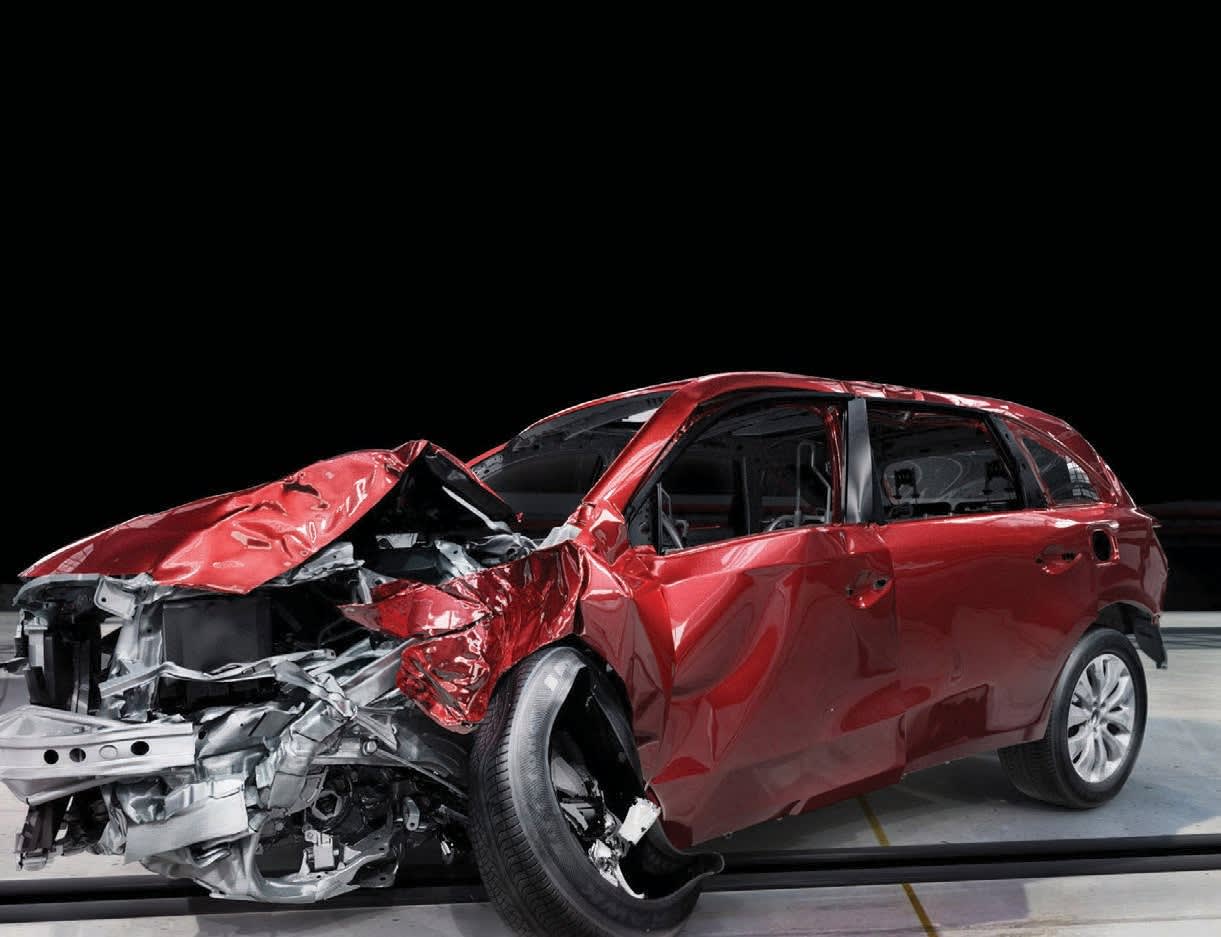
Although most vehicle crash tests are typically done at 35-40 mph (56-64 km/h), the speed at which crash simulations are run continues to accelerate. As computing speed continually improves, engineers are able to perform more investigative studies and explore alternatives relating to weight, materials, and performance.
“We’re always searching for speed, accuracy, robustness, and the quality of the results,” said David Mason, Vice President Global Automotive, Altair. “There are trade-offs amongst those, so if we make some assumptions we can run the simulation faster. Computers keep getting faster each year, so we’re able to model more and more, but we can make some assumptions and they can run the simulations faster. If we want to be more accurate then the simulation takes longer to run and it lessens the amount of simulations we can do in order to try different countermeasures, etc.”

Speed has always been at the forefront of development for Troy, MI-based Altair Engineering Inc., which in 2010 was among the first software providers to compress the time required to mesh, assemble, and simulate a full-vehicle crash finite-element model to just 24 h.
“As the speed of computers has come along and the performance of the software itself has continued to make significant speed and performance gains in each release, it’s just become a point in time where the modeling tools are quick enough so you can build these high-quality, large, high-detail models in a very efficient manner and then you can solve them also. The OEMs typically are looking to solve within an over-night cycle.”
Ken Bonello, Senior Manager, Vehicle Safety Performance Integration, General Motors, can attest to the growth of high-performance computing power and the impact it has had on the ability to build more complex and more detailed FE models.
“As an example, maybe 10 or 12 years ago, a finite-element crash model may have consisted of a million elements, and today for a typical vehicle crash model we’re in the 3 million to 5 million element model range, depending on the specific vehicle,” Bonello said. “The level of detail that we’re able to apply and the computing power that we have is enabling us to run these crash simulations literally overnight.”

Gaining confidence
Confidence in virtual models continues to improve, and manufacturers such as GM are now often only running a physical test at the end of a program to get final confirmation/validation of performance, rather than running continual loops of testing, which is both expensive and time consuming.
However, new tests such as the IIHS small overlap front crash test, first introduced in 2012, have proved challenging for mini and small cars and midsize SUVs. Therefore, additional learning and development are required to be able to predict the physical performance with the same confidence as more established test conditions.

“There’s a case where the vehicle impact is in a way that’s different than the way we’ve designed the main energy-absorbing structure of the vehicle,” Mason said. “So you see a lot of use of high airbags to help in that case. You need very accurate airbag modeling, which models the whole process — the firing mechanism, the filling of air, and how that bag deploys geometrically within the vehicle over time — so we put a lot of work in our FDM method in order to improve the accuracy of that airbag deployment throughout all phases of it.”
With an added emphasis on lightweighting to meet new CAFE (Corporate Average Fuel Economy) standards, automakers are expanding the use of nontraditional materials. High-strength steels, aluminum, magnesium, and composites are playing a larger role in vehicle structures, therefore a lot of research is currently being done to predict the failure mechanism within the material and accurately simulate it.
“There’s a lot of work going into getting accurate prediction of composites,” Mason said. “As you see automakers trying to lightweight and using some of these new materials, it’s requiring a lot of work on the software side to make sure that we can predict with the same accuracy and robustness those materials vs. the traditional mild steels of the past. They want to build more accurate models and still develop them in the same amount of time.”

Accurately modeling the connection of these materials, either through welding, bolted joints, or adhesives, is important when determining the cause of a failure in a crash event. Software providers are updating connection modeling techniques and material models for more accuracy.
“The modeling of the joints is very important for us to be as accurate as possible,” Bonello said. “We do need to pay specific attention to accurately capturing the weld locations and understanding weld capacity for the different types of materials we’re using in our vehicles.”
Making sense of massive models
As models become larger and more detailed, the number of elements within a vehicle model is expected to climb from the tens of millions to hundreds of millions.
“To do that, we’re required to have a highly parallel efficient solver,” Mason said. “Up to thousands of cores being used on the computer side, which is very challenging from a software perspective to take advantage of that.”
As models become more complex, it becomes increasingly important to be able to understand exactly what is happening during a crash simulation. With this in mind, Honda recently pioneered a new 3-D, crash-simulation visualization technology as a plug-in to DeltaGen, the visualization solution of Dassault Systèmes’ 3DXCITE (formerly RTT).
“With finite element, you’re looking at 100 time steps within a crash sequence; it’s like 100 photographs as that car is going through the crash event, and each of those time steps represents between 1 GB and 1.5 GB of data,” said Tim Ventura, Senior Manager of Business Development, Dassault Systèmes. “So when you look at 100 time steps, you’re looking at 100-150 GB of data. To take it into a visualization environment, that’s truly the major challenge.”
The visualization software, co-developed by Honda R&D Americas Inc., takes the output from LS-DYNA and renders it in a 3-D presentation, enabling engineers to more easily study the results of a crash simulation, test different design approaches, and implement design changes.
“When you look at the rudimentary models, their predictive analysis they feel they’re 90-95% accurate with their models,” Ventura said. “When you add shadow, light, and definition through the use of the colors, they start to see some deflections and reactions that they don’t normally see in those models. It creates, for them, a very good engineering tool to really analyze as much of that event up front as possible with high definition.”
Honda engineers are able to manipulate the rendering, rotate the view in any direction, and strip away parts of the vehicle to isolate a section or component for more thorough analysis. The crash barrier can also be rendered transparent in the virtual environment so the immediate effects of a crash can be viewed from multiple points of view, including the driver’s seat.
“The elephant in the room for them was when they went into a management meeting, they had these key milestones where they would sit down and look at all of the elements of the predictive analysis on the crashworthiness side of things,” Ventura said. “What they were finding was they would spend a lot of time in those events and really half the people would truly understand what was going on or cared about what was taking place in those events. So they wanted a better way of doing a more interactive review process with their management teams that kept them engaged in what they were actually talking about. So instead of talking about charts and graphs, they wanted to treat it as if I was grabbing their hand and walking them through the entire crash event with a real model.”
Honda R&D has been utilizing LS-DYNA non-linear crash simulation technology since 1998 as part of its new-model development process and has used the technology to help develop new safety designs, including its Advanced Compatibility Engineering (ACE) body structure.
“Past efforts at creating this kind of highly realistic rendering involved weeks of concentrated effort by engineers and rendering specialists and would result in a single simulation with fixed viewing parameters,” said Eric DeHoff, Technical Leader for CAE in the Crash Safety Group of Honda R&D Americas Inc. “With this new technology we can create and manipulate the simulation at the push of a button, and we can do it in hours instead of weeks.”
More From SAE Media Group
Tech Briefs
Vehicle Design with System-Level Modeling
Automotive Engineering
Seeking Ways to Make Better Computer Crashes

Automotive Engineering
Zero Prototype Summit 2024: The Future Is Closer Than Ever
Tech Briefs
Disrupting the Automobile Design Process
Automotive Engineering
Racetrack Simulation Hits the (Public) Road
Battery & Electrification Technology
Hydropower Technology Swaps Dams with Electric Trucks
Tech Briefs
SAE 2015 World Congress Preview

Tech Briefs
Flies’ Vision Mimicked to Control Robots
Automotive Engineering
Auto, Tech Industries Launch PAVE Coalition for Autonomous-Vehicle Education
ADAS & Autonomous Vehicle Engineering
Automated Driving in Italy’s 1,000 Miglia Rally
Off-Highway Engineering
CV Autonomy: Picking the 'Low-Hanging Fruit'
Automotive Engineering
Simulating Forward Motion at VI-Grade’s Zero Prototypes Day
Autonomous Vehicle Engineering
German University Installing Advanced Simulator to Study Autonomous-Vehicle Handover
ADAS & Autonomous Vehicle Engineering
The Road to Zero Prototypes
Automotive Engineering
Four SAE Student Members Among Finalists for Coveted F1 Engineering Role
Automotive Engineering
Toyota Improves ‘Little Things’ to Refine 2020 Highlander Manufacturing
Automotive Engineering
Nissan’s Reed Is Not Your Typical R&D Boss
Automotive Engineering
BMW, Classiq Find Better Architectures Through Quantum Computing
Automotive Engineering
2016 Honda Civic Targets Audi A3, Drives New Modular-Engineering Strategy
Tech Briefs
SAE WCX Preview: Staying Ahead of the Curve
Automotive Engineering
FCA Claims North America’s Most-Advanced Driving Simulator
Autonomous Vehicle Engineering
‘Software, Start Your Engines’
ADAS & Autonomous Vehicle Engineering
Simulation Vs. Organizational Inertia
Automotive Engineering
Extending the ICE Age: Ford’s Dave Filipe Has Some Powerful Choices to Make
Automotive Engineering
Sharper Testing Delivers Better AV Performance

Off-Highway Engineering
Heavy-Duty Engine Design
Transcript
00:00:00 crash simulation helps us analyze many design aspects and gives you the opportunity to test many many designs instead of just one physical car Honda's been using crash simulation software and doing Advanced simulations for well over a decade now but the results that come out of it and that we look at are little rudimentary compared to a real test
00:00:27 video as a CA engineer My ultimate goal is is to make the virtual model represent the physical world this technology is being applied in marketing commercials video games nobody had ever done it with crash results so Honda pioneered and led this development with 3D excite and their Delta gen real impact software with this new technology instead of just in
00:00:49 generating movies and images we can actually interactively use it to spin the model around we can hide Parts isolate Parts whole systems structures to really explain what is going on during the event the ultimate purpose of this is to get the best image of vehicle performance before we build the car and test it with this new technology
00:01:10 everybody understands what's going on much more clearly and efficiently because it looks so real
Top Stories
NewsSensors/Data Acquisition
 Microvision Aquires Luminar, Plans Relationship Restoration, Multi-industry Push
INSIDERRF & Microwave Electronics
 A Next Generation Helmet System for Navy Pilots
INSIDERWeapons Systems
 New Raytheon and Lockheed Martin Agreements Expand Missile Defense Production
NewsAutomotive
 Ford Announces 48-Volt Architecture for Future Electric Truck
INSIDERAerospace
 Active Strake System Cuts Cruise Drag, Boosts Flight Efficiency
ArticlesTransportation

Webcasts
Aerospace
 Cooling a New Generation of Aerospace and Defense Embedded...
Energy
 Battery Abuse Testing: Pushing to Failure
Power
 A FREE Two-Day Event Dedicated to Connected Mobility
Automotive
 Quiet, Please: NVH Improvement Opportunities in the Early Design Cycle
Electronics & Computers
 Advantages of Smart Power Distribution Unit Design for Automotive &...
Unmanned Systems
 Sesame Solar's Nanogrid Tech Promises Major Gains in Drone Endurance