




Simulating Forward Motion at VI-Grade’s Zero Prototypes Day
The HexaRev is VI-grade’s latest tool, but the 6-degree-of-freedom motion platform was only one of several simulation technologies showcased at an event at Multimatic in Novi, Michigan.
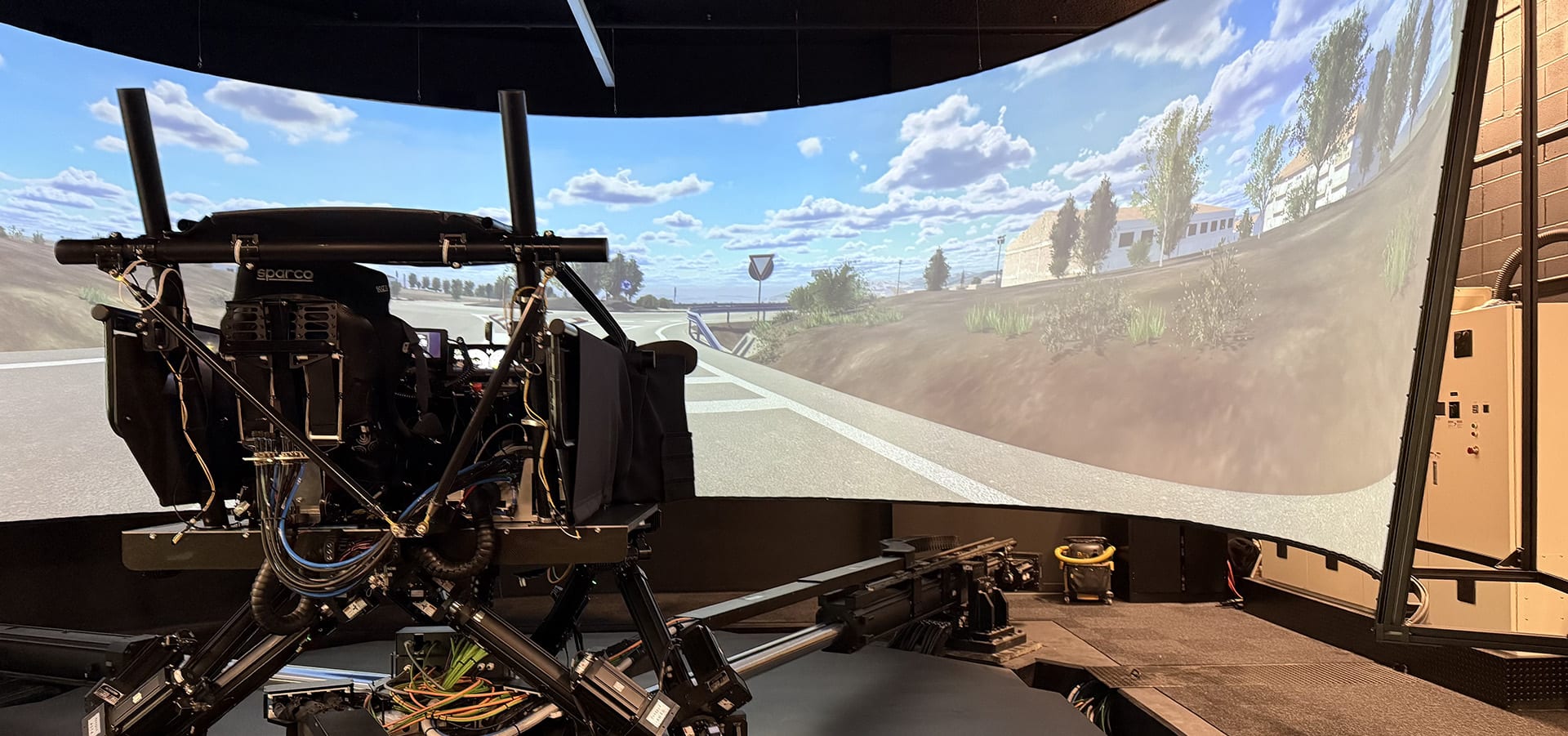
VI-grade doesn’t rest much. New software for its simulations, new simulators to run that software, and new HiL solutions mean there’s always something new happening. And much of this was on hand at the company’s 2025 North American Zero Prototypes Day, held in Novi, Michigan, over the summer.
Earlier this year, VI-grade announced its latest addition, the HexaRev, a new 6-degree-of-freedom motion platform that was designed to outperform traditional hexapods. The simple design uses six motors “essentially connected directly” to the cockpit without ball screws, gears, belts or chains,” according to David Bogema, senior director of product management at VI-grade, “nothing that can create extra noise or vibration or add mechanical latency to the system.” The HexaRev also has a larger overall motion envelope for combined motions than traditional six-degree systems.
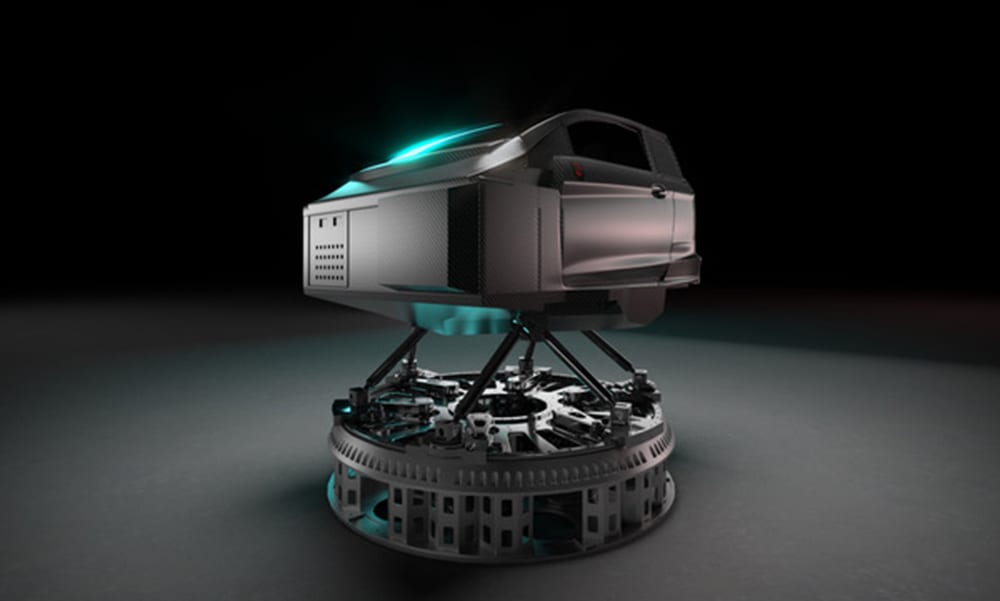
“If you combine the HexaRev with the HyperDock, which is our carbon fiber cockpit that we launched last year, this turns it into a [Full Spectrum Dynamic Simulator] simulator, able to simulate that whole range from zero to 20 kilohertz,” he said. “This gives you an incredibly immersive system. It really is a watershed moment in terms of motion simulation.”
VI-grade also updated its cloud data service with VI-DataDrive Cloud, which integrates with VI-CarRealTime to deal with the ever-growing mounds of digital data that vehicle testing generates. Previously, the standard way to use VI-CarRealTime was at a workstation, building models, designing tests and running simulations locally. Now, these parameters can be uploaded to the cloud, where simulations can run in parallel and team members can share the data.
“What this enables you to do is process a lot more data,” Bogema said. “And if you’re doing things like match performance events that take a lot of time, this enables you to do far more than you could ever do on one workstation. It really takes the limits off.
“Today, when we’re developing vehicles, they’re more complex than ever, but we have to develop them faster than ever. We’re developing these vehicles with more and more tests, faster and faster, but we need to be able to get insights into that data, understand that data.”
Helping Honda
One automaker taking advantage of some of these new tools is Honda, which uses VI-Grade simulators at R&D multiple locations, including DiM250 and DiM300 simulators and desktop simulators in Germany and Japan, and a COMPACT NVH Simulator at Honda’s Automotive Development Center (ADC) in Ohio. The simulators help Honda produce vehicles faster by improving development efficiency, but the real trick, according to Josh George, principal engineer at ADC, who spoke at ZPS, was finding a sweet spot with the immersion levels that users feel while using the simulator to test for noise and vibration issues.
“At first, we were trying to incorporate a VR headset to get the person fully immersed into the virtual environment, but we actually found in this case it was a distraction from the NV,” he said. “We do use VI-WorldSim [integrated graphic environment] for some of our evaluations, but in a lot of cases, we actually prefer to use playback of our actual track. Our technical experts are very used to the track and they’re used to the lengths. It’s a familiar scene, and so it puts them in the mindset of being on our actual NV track.”
Along with videos of the real-world track, Honda added a physical start button from a Pilot instead of a simple on-off switch to the unit at ADC. Another added feature is a custom GUI that includes a list of icons of different OEMs so that users can easily change which simulated vehicle is active while moving down the digital road surfaces. Tactile and digital details like this can make a real difference for evaluators who are not as familiar with a specific simulator.
“We try to find ways to avoid wasting our evaluators ’time,” George said. “When they come down, we want them to be able to instantly digest what the simulation is about instead of having to take a lot of time to explain all of the limitations of the simulator and to set the stage for the evaluation.”
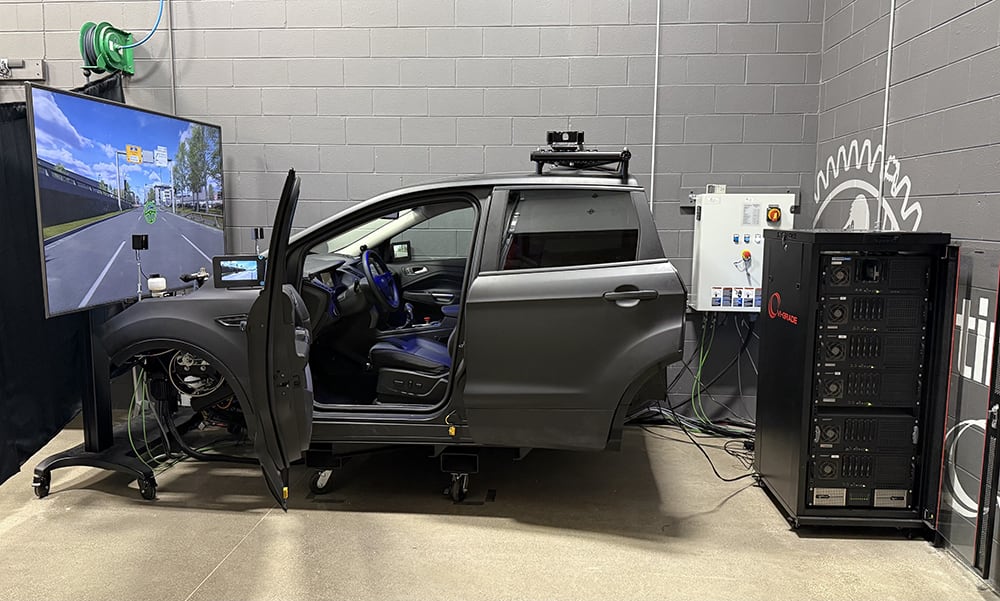
The custom GUI can be created in PowerPoint, which gives evaluators the ability to easily provide the testing team with details about the vehicle to be tested ahead of the scheduled test.
“We essentially create these selectable icons that we can overlay over the image from PowerPoint, so when they touch those it will actually first compile - it uses an Assembly Switcher JavaScript to compile what the simulator is expecting to be able to switch the vehicle – and then that gets passed through a port, UDP sends that, and then VI-NVHSim switches the active car.
“This might look like a very subtle thing, but this has actually completely changed our evaluations,” he said. “We can paint the picture that our evaluators expect to see that they’re used to seeing, and it makes it very easy for them to switch vehicles.”
High-res Wolfsburg
It’s not all serious, accurate sim work at ZPD. While there, I was able to drive around Wolfsburg, Germany - well, a high-resolution digital version, anyway - in a STATIC Simulator set up to mimic a BMW 2 Series. OEMs can use this type of simulator to test HMI tasks – new dashboard layouts, whether the mirrors are in the right spot – as well as NVH, ADAS and AV features, but it doesn’t always have to be totally serious.
All of the demos at ZPD this year used the 2025.2 version of the VI-grade software suite. Among its many updates are more accurate VI-WorldSim Headlights, the company’s headlight simulation module. On the road in virtual Germany, I noticed a VI-grade vanity plate on a Smart
ForTwo and was surprised to see a NAVYA electric shuttle with Mcity branding cruising through fake Wolfsburg. Touches like these suggest that whatever VI-grade is working on, there’s still enough time and energy for engineers to throw a few lighthearted easter eggs into the mix. That’s a good thing.
More From SAE Media Group
Off-Highway Engineering
New CM Labs Excavator Simulator Training Offers GPS Guidance, HMI Experience
Automotive Engineering
NVH Simulation Meets Realism
ADAS & Autonomous Vehicle Engineering
Simulation Vs. Organizational Inertia
Medical Design Briefs
Virtual Reality Blood Flow Simulation to Improve Cardiovascular Interventions
Tech Briefs
Space-Shuttle Emulator Software
Automotive Engineering
Engineering at the New NVH Frontier

Aerospace & Defense Tech Briefs
HTX Labs Adapts Its VR Platform for the Air Force Pilot Training Next Initiative
Automotive Engineering
Zero Prototype Summit 2024: The Future Is Closer Than Ever

Automotive Engineering
Volvo Cars Mixes Virtual with Real-World Testing
Tech Briefs
Vehicle Design with System-Level Modeling
Aerospace & Defense Tech Briefs
Chrono: A Parallel Physics Library for Rigid-Body, Flexible-Body, and Fluid Dynamics
Automotive Engineering
Luminary Cloud Takes CAE to the Cloud
Off-Highway Engineering
Digitalization of Product Engineering
ADAS & Autonomous Vehicle Engineering
The Road to Zero Prototypes
Tech Briefs
NASA Awards 2008 Software of the Year
Software Tech Briefs
SIM_EXPLORE: Software for Directed Exploration of Complex Systems
Autonomous Vehicle Engineering
Accelerating AV Training Data and Testing
Aerospace & Defense Tech Briefs
T-45 Virtual/Augmented Reality Training Technology

Autonomous Vehicle Engineering
The Vehicle as a Gaming Device
Tech Briefs
Improving Weapons with Simulation
Top Stories
NewsSensors/Data Acquisition
 Microvision Aquires Luminar, Plans Relationship Restoration, Multi-industry Push
INSIDERRF & Microwave Electronics
 A Next Generation Helmet System for Navy Pilots
INSIDERWeapons Systems
 New Raytheon and Lockheed Martin Agreements Expand Missile Defense Production
NewsAutomotive
 Ford Announces 48-Volt Architecture for Future Electric Truck
INSIDERAerospace
 Active Strake System Cuts Cruise Drag, Boosts Flight Efficiency
ArticlesTransportation

Webcasts
Aerospace
 Cooling a New Generation of Aerospace and Defense Embedded...
Energy
 Battery Abuse Testing: Pushing to Failure
Power
 A FREE Two-Day Event Dedicated to Connected Mobility
Automotive
 Quiet, Please: NVH Improvement Opportunities in the Early Design Cycle
Electronics & Computers
 Advantages of Smart Power Distribution Unit Design for Automotive &...
Unmanned Systems
 Sesame Solar's Nanogrid Tech Promises Major Gains in Drone Endurance