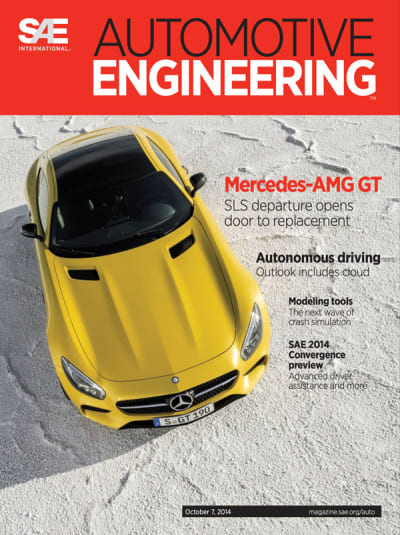
Automotive Engineering - October 2014
Inside this issue
Overview
The October 2014 issue of Automotive Engineering presents a comprehensive overview of significant advancements and trends in the automotive industry, focusing on performance, technology, and innovation.
One of the key highlights is the transition from the iconic Mercedes-AMG SLS to its successor, the Mercedes-AMG GT. This new model is designed to be more practical and cost-effective while still embodying the high-performance characteristics expected from a super sports car. The GT features a classic coupe design with a front/mid-engine layout, rear-wheel drive, and a double wishbone suspension system. It is powered by a new biturbo 4.0-liter V8 engine, available in two variants: the standard GT with 456 hp and the GT S with 503 hp. The GT achieves impressive performance metrics, including a 0-100 km/h time of just 3.8 seconds and a top speed of 311 km/h (193 mph), thanks to its lightweight aluminum construction and advanced engineering.
In addition to the GT, the issue discusses the broader implications of automotive engineering, particularly in the context of connectivity and autonomous driving. The integration of advanced infotainment systems, such as the InControl system in Jaguar vehicles, showcases the industry's shift towards enhanced user experience. Features like an 8-inch touchscreen and "plain speech" voice control are becoming standard, allowing drivers to interact with their vehicles more intuitively. Furthermore, the ability for cars to act as Wi-Fi hotspots reflects the growing importance of connectivity in modern vehicles, enabling multiple devices to access the internet seamlessly.
The magazine also delves into the ongoing investment in automotive manufacturing, highlighting Jaguar Land Rover's £1.5 billion investment in a new facility in Solihull, England. This investment underscores the commitment to innovation and production efficiency within the industry, as manufacturers strive to meet the demands of a rapidly evolving market.
Another significant topic covered is the advancements in crash simulation technology. The issue emphasizes the importance of accurate simulations in enhancing vehicle safety and performance. By utilizing sophisticated modeling techniques, engineers can predict how vehicles will behave in various crash scenarios, leading to improved designs and safety features.
The magazine also addresses the future of mobility, particularly the role of electric and hybrid vehicles. As the industry moves towards more sustainable solutions, the development of new powertrains and energy-efficient technologies is crucial. The issue features insights into the latest trends in vehicle electrification, including the introduction of electric models like the Kia Soul EV and innovations in battery technology.
Moreover, the issue highlights the significance of lightweight materials in automotive design. As manufacturers seek to improve fuel efficiency and reduce emissions, the use of advanced materials such as composites and aluminum is becoming increasingly prevalent. The magazine discusses how these materials contribute to overall vehicle performance and sustainability.
In the realm of advanced driver assistance systems (ADAS), the issue explores the latest developments in technology that enhance vehicle safety and driver convenience. Features such as adaptive cruise control, lane-keeping assistance, and automated parking are becoming more common, paving the way for a future where fully autonomous vehicles may be a reality.
The magazine also includes a section on upcoming events and publications from SAE International, providing readers with information on future trends and innovations in the automotive sector. This includes a variety of technology eNewsletters focusing on topics such as hybrid and electric vehicles, vehicle electrification, and engine design efficiency.
In summary, the October 2014 issue of Automotive Engineering encapsulates the dynamic nature of the automotive industry, highlighting the transition to new performance models, the integration of advanced technologies, and the ongoing commitment to safety and sustainability. With a focus on innovation and engineering excellence, this issue serves as a valuable resource for professionals and enthusiasts alike, offering insights into the future of mobility and the challenges and opportunities that lie ahead.
Features
-
Articles
Regulars
-
Global Vehicles
-
Technology Reports
Climate Control Engineers Face New CAFE Test
Flywheel Hybrids Offer New Efficiency Potential
Toyota Ups Funding for Collaborative Safety Research Center
In Search of the Lightweight, Multi-Material Car
Mercedes-AMG’s SLS Departure Opens Door to New GT
-
Product Briefs
Stories
-
News
Discovery Sport Is First of Land Rover's New Discovery Family
Lotus Appoints Engineering Director
Toyota Beefs up Research on Connected- and Automated-Vehicle Safety
Delphi Forms Technical Advisory Council
Analyst Firm Doubtful of Tesla Gigafactory Value
China–U.S. ZEV Policy Lab Formed
SAE Eye on Engineering Quick Take: Super Driving Supercar
Book Examines Autonomous Technologies
Lexus Equips NX Entry-Level SUV with New Turbo Gasoline Engine
Ford’s Market 'Fusion' Creates Mondeo for Europe
2015 VW Golf GTE Plug-In Hybrid Is a Smooth Operator
OEMs Planning Major Platform Consolidations by 2021, Says IHS
Mechatronic System Production on the Uptick at Brose's Michigan Plant
Automotive Technology Handbook
Mazda Takes Wraps off 2016 MX-5 Miata
TRW to Operate as Separate Business Under ZF Acquisition Terms
Top Stories
INSIDERManufacturing & Prototyping
 How Airbus is Using w-DED to 3D Print Larger Titanium Airplane Parts
INSIDERManned Systems
 FAA to Replace Aging Network of Ground-Based Radars
NewsTransportation
 CES 2026: Bosch is Ready to Bring AI to Your (Likely ICE-powered) Vehicle
NewsSoftware
 Accelerating Down the Road to Autonomy
EditorialDesign
 DarkSky One Wants to Make the World a Darker Place
INSIDERMaterials
 Can This Self-Healing Composite Make Airplane and Spacecraft Components Last...
Webcasts
Defense
 How Sift's Unified Observability Platform Accelerates Drone Innovation
Automotive
 E/E Architecture Redefined: Building Smarter, Safer, and Scalable...
Power
 Hydrogen Engines Are Heating Up for Heavy Duty
Electronics & Computers
 Advantages of Smart Power Distribution Unit Design for Automotive...
Unmanned Systems
 Quiet, Please: NVH Improvement Opportunities in the Early Design...
Power

Similar Stories
Q&AMaterials
 Accelerating Racecar Innovation
NewsMaterials
 In Search of the Lightweight, Multi-Material Car
NewsTransportation
 The Next Wave of Crash Simulation
Technology ReportElectronics & Computers
 Toyota Ups Funding for Collaborative Safety Research Center
Technology ReportMaterials
 Mercedes Shows Its Metal and Chooses Steel over Aluminum