




Automotive Engineering - September 2015
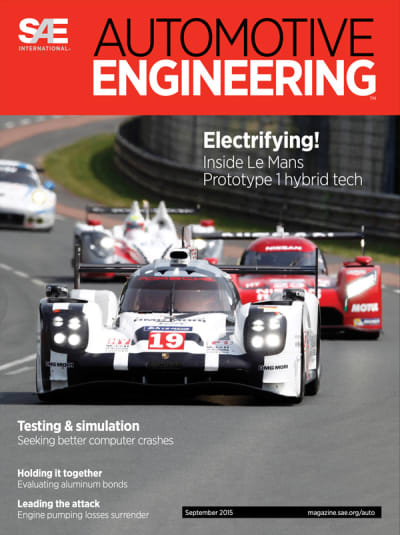
Inside this issue
Overview
The September 2015 issue of Automotive Engineering presents a comprehensive overview of the latest advancements and trends in the automotive industry, focusing on technology, safety, and efficiency. This issue highlights various innovations and research efforts aimed at enhancing vehicle performance and sustainability.
Key Highlights:
-
ZF's 100-Year Legacy: The issue opens with a feature on ZF, a global leader in driveline and chassis technology, celebrating its centenary. ZF emphasizes its commitment to providing technologies that address future megatrends, including automated driving and safety. The company showcased its innovations at the IAA 2015 in Frankfurt, highlighting its role in shaping the future of mobility.
-
Electrification and Hybrid Technology: A significant focus of this issue is on electrification, particularly in the context of the Le Mans Prototype 1 category, which mandates hybrid-electric drive. The magazine discusses the creative solutions manufacturers are employing to balance combustion and electric power, showcasing the competitive landscape of the 24 Hours of Le Mans race.
-
Powertrain Innovations: The issue features an article on Ford's testing of cylinder deactivation technology in its 1.0-L EcoBoost engine. This technology aims to improve fuel economy by allowing the engine to deactivate cylinders under certain conditions, thus enhancing efficiency without sacrificing performance.
-
Advancements in Testing and Simulation: The magazine delves into the importance of testing and simulation in automotive engineering. It discusses new models and simulations that improve safety by providing more realistic crash scenarios, which help engineers iterate designs more quickly and effectively. This is crucial as the industry moves towards more complex vehicle systems.
Chassis Enhancements: Hyundai's re-engineered suspension for the 2016 Tucson is highlighted, showcasing a 'world first' dual-member damper housing that enhances noise, vibration, and harshness (NVH) performance. This innovation reflects the industry's ongoing efforts to improve ride quality and comfort for consumers.
-
Material Science and Manufacturing: The issue also addresses challenges in manufacturing, particularly with aluminum bonds. Ford researchers present a modified technique for inspecting adhesively joined aluminum alloy sheets, which are increasingly used in vehicle construction due to their lightweight properties. This research is vital for ensuring the integrity and safety of modern vehicles.
-
Engine Efficiency: An article discusses the ongoing battle against engine pumping losses, emphasizing the role of cylinder deactivation in achieving real-world fuel economy gains. This technology is becoming increasingly important as automakers strive to meet stringent fuel efficiency standards.
-
Autonomous Driving Support: The magazine features a report on road-surface modeling aimed at supporting autonomous driving technologies. This research is essential for developing systems that can navigate complex driving environments safely and effectively.
-
Global Automotive Landscape: The issue provides insights into the competitive dynamics among automakers, particularly in the context of the Le Mans race. It highlights how different manufacturers are approaching hybrid technology and the unique solutions they are implementing to gain a competitive edge.
-
Future of Automotive Engineering: The editorial section reflects on the challenges facing automotive powertrain engineers today, emphasizing the need for innovation in propulsion options. As the industry evolves, engineers must adapt to new technologies and consumer demands for more efficient and sustainable vehicles.
In summary, the September 2015 issue of Automotive Engineering encapsulates the rapid advancements in automotive technology, focusing on electrification, safety, and efficiency. It highlights the collaborative efforts of manufacturers, researchers, and engineers to push the boundaries of what is possible in vehicle design and performance. As the industry faces increasing pressure to innovate, this issue serves as a valuable resource for understanding the current trends and future directions in automotive engineering.
Features
Regulars
-
Global Vehicles
-
Technology Reports
Mitsubishi Electric Shows New FLEXConnect Technologies
Accelerated Testing of Embedded Software Code Leverages AUTOSAR and Virtual Validation
Road-Surface Modeling Aims to Support Autonomous Driving
Ford Tests Cylinder Deactivation on Its 1.0-L EcoBoost Triple
Stories
Top Stories
NewsSensors/Data Acquisition
 Microvision Aquires Luminar, Plans Relationship Restoration, Multi-industry Push
INSIDERRF & Microwave Electronics
 A Next Generation Helmet System for Navy Pilots
INSIDERWeapons Systems
 New Raytheon and Lockheed Martin Agreements Expand Missile Defense Production
NewsAutomotive
 Ford Announces 48-Volt Architecture for Future Electric Truck
INSIDERAerospace
 Active Strake System Cuts Cruise Drag, Boosts Flight Efficiency
ArticlesTransportation

Webcasts
Aerospace
 Cooling a New Generation of Aerospace and Defense Embedded...
Energy
 Battery Abuse Testing: Pushing to Failure
Power
 A FREE Two-Day Event Dedicated to Connected Mobility
Automotive
 Quiet, Please: NVH Improvement Opportunities in the Early Design Cycle
Electronics & Computers
 Advantages of Smart Power Distribution Unit Design for Automotive &...
Unmanned Systems
 Sesame Solar's Nanogrid Tech Promises Major Gains in Drone Endurance