




Mitsubishi Electric Shows New FLEXConnect Technologies
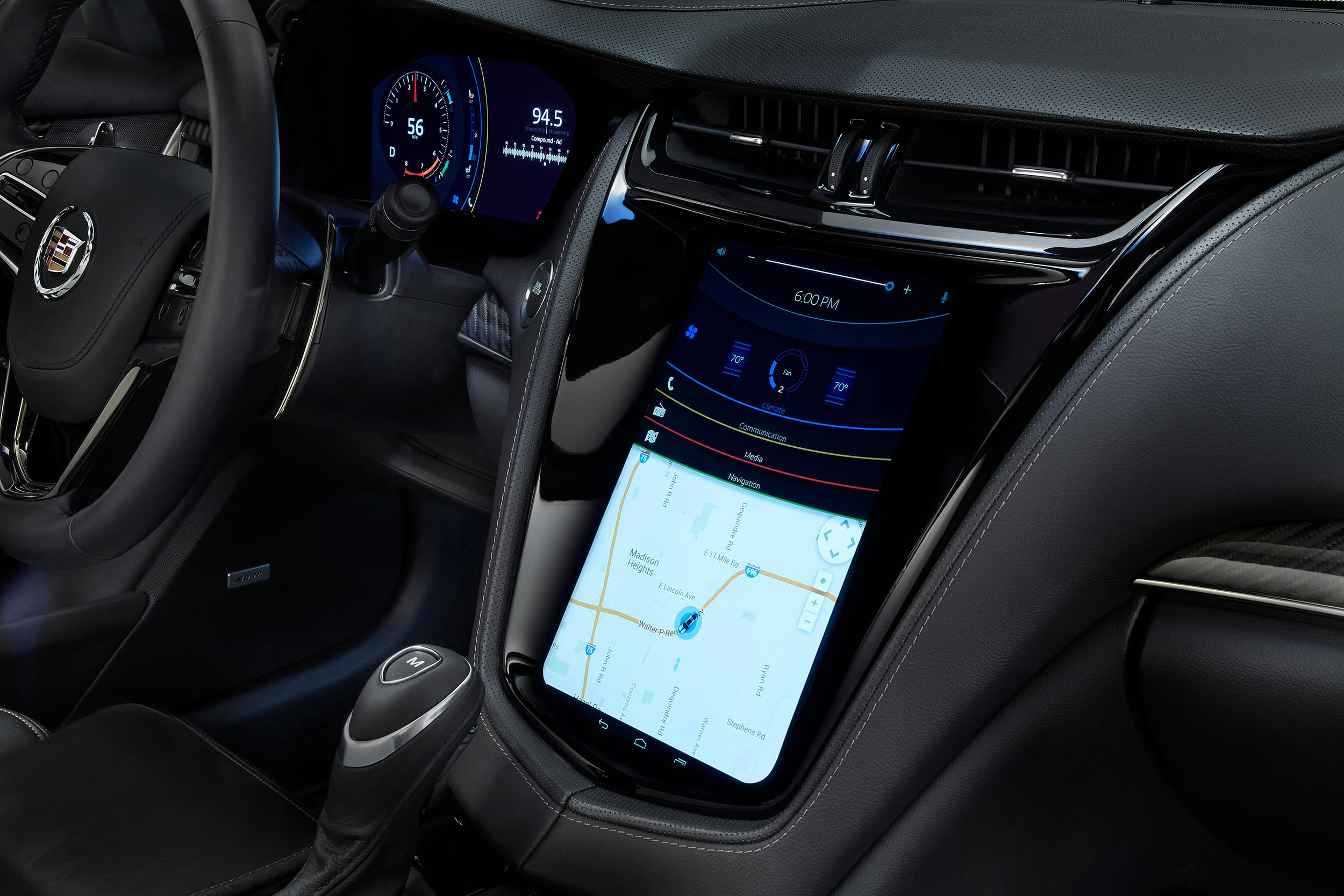
Hand gesture transfer of information from the center console screen to the head-up display or instrument cluster display is a featured capability in a Mitsubishi Electric demonstration vehicle.
“The FLEXConnect In-Vehicle Infotainment (IVI) system could reach production application as early as the 2017 model year. We already have business in place for certain aspects of the system,” said Doug Ray, Mitsubishi Electric’s Director of Sales, Quality and Engineering for Audio, Video & Communications, in an Automotive Engineering interview.
This next-generation technology as well as the supplier’s advanced active noise cancellation (ANC) system were shown to the media during a May 18 event in Berkley, MI.
A luxury sedan retrofitted with the FLEXConnect.IVI employs an Google Android operating system and a 12.1-in, 1280 x 800 resolution center console touchscreen. The user can access as many as three portals (navigation, media, and climate) via a full-screen, a half-screen, or a one-third screen on the center console, said Gareth Williams, Strategic Technologies Manager for Audio, Video & Communications at Mitsubishi Electric.
“If you want to move content from the center console to the gauge cluster or head-up display, you touch the screen, then swipe. A swipe-left gets content from the center stack to the cluster. A swipe-right takes it from the cluster back to the center stack. A swipe-up takes content to the head-up display, and a swipe-down takes it from the head-up display to the center stack,” Williams explained.
The three in-cabin displays are powered by a single Texas Instruments Jacinto 6 automotive processor. “That same processor is going into production this year,” said Williams.
Like Apple iPads and other tablets, the center console display is an in-plane switching (IPS) screen. “We feel that you get really good color off-axis with this display, and for the in-vehicle environment that’s really important,” said Williams.
Center console display content can be moved to the cluster display or the head-up display by the driver or the front passenger. “There are different ways to prevent the passenger from moving content, such as having infrared sensors around the display to detect if the swipe is coming from the passenger. But we haven’t addressed that issue on this demonstration vehicle,” said Williams.
The ability for either front seat occupant to interact with display content is especially relevant on an autonomous vehicle application.
“Even if you’re sitting in the driver’s seat, you become a passenger in an autonomous vehicle. Going forward, we see a blending of functionality where both front-seat passengers can interact with audio, HVAC, and other in-vehicle controls,” Williams said.
Mitsubishi Electric also demonstrated its FLEXConnect.ANC. The system uses Mentor Graphics’ electronic noise cancellation software, according to Ray. “In the demonstration hybrid-electric car, the system can cancel unwanted engine whine,” said Ray, ”Using the wide-band ANC also makes it possible to cancel in real time road and other unwanted noise.”
According to Williams, the advanced ANC technology addresses unwanted sub-500 Hz noise.
Mitsubishi Electric introduced its FLEXConnect series in 2014 with rear-seat entertainment. The production-ready FLEXConnect.RSE infotainment system features three rear-seat screens that allow the user to stream multiple contents while operating as independent units controlled through the Ethernet audio-video bridging architecture.
More From SAE Media Group
Automotive Engineering
Google, Apple Join Battle for Infotainment Management
Automotive Engineering
Ford's Sync 3 Is on the Way
Automotive Engineering
Next-Generation Infotainment System Envisioned by Mitsubishi Electric
Automotive Engineering
Multi-Screen Infotainment System for Multiple Content Streams
Automotive Engineering
High-Speed Camera
Automotive Engineering
CES Rollouts Extend Connectivity, App Integration
Automotive Engineering
Infotainment at CES Shows Rapid Evolution
Automotive Engineering
Automakers See Possibilities, Limits for Gesture Controls
Aerospace & Defense Tech Briefs
How SpaceVPX is Influencing the Design of Next Generation Spacecraft Avionics
Automotive Engineering
‘Zonal’ for the Win

Automotive Engineering
Mitsubishi Electric Introduces Advanced HMI
Off-Highway Engineering
Rugged Handheld
Aerospace & Defense Tech Briefs
Curtiss-Wright Upgrades AVDU Rugged LCD Touchscreen Display Software for Greater Flexibility, Reliability
Automotive Engineering
Nvidia Chipset to Enable Greater Autonomy
Automotive Engineering
Digital and Reconfigurable Instrument Cluster
Automotive Engineering
NFC Looks to Score Big in Cars
Automotive Engineering
Thumbs up for Gesturing with Time-Of-Flight Cameras?
Automotive Engineering
Harman's Google Glass Application Sees Danger Ahead
Off-Highway Engineering
Robust Controller Board
Aerospace Manufacturing and Machining INSIDER
Army Launches CMOSS Prototyping Competition for Computer Chassis and Cards
Off-Highway Engineering
‘Smart’ Oil Cap Brings Low-Cost Connectivity to Perkins Engines
Automotive Engineering
Haptic Feedback for Gesture-Control HMI
Automotive Engineering
Road Rules, a San Francisco Start-Up, Explores World of Car APIs
Off-Highway Engineering
Microcontroller-Based Display
Automotive Engineering
HMI’s Simple Challenge: Control Everything Possible Without Any Difficulty
Automotive Engineering
Audio Network Analysis
Automotive Engineering
High-Speed Entertainment
Automotive Engineering
Chevy to Offer 'Performance' Data Recorder for MY2015 Corvette
Automotive Engineering
Hyundai Activates Its Own Cloud Server for Blue Link
Top Stories
INSIDERManufacturing & Prototyping
 How Airbus is Using w-DED to 3D Print Larger Titanium Airplane Parts
INSIDERManned Systems
 FAA to Replace Aging Network of Ground-Based Radars
NewsTransportation
 CES 2026: Bosch is Ready to Bring AI to Your (Likely ICE-powered) Vehicle
NewsSoftware
 Accelerating Down the Road to Autonomy
EditorialDesign
 DarkSky One Wants to Make the World a Darker Place
INSIDERMaterials
 Can This Self-Healing Composite Make Airplane and Spacecraft Components Last...
Webcasts
Defense
 How Sift's Unified Observability Platform Accelerates Drone Innovation
Automotive
 E/E Architecture Redefined: Building Smarter, Safer, and Scalable...
Power
 Hydrogen Engines Are Heating Up for Heavy Duty
Electronics & Computers
 Advantages of Smart Power Distribution Unit Design for Automotive...
Unmanned Systems
 Quiet, Please: NVH Improvement Opportunities in the Early Design...
