




Innovations for Lightweighting: Magna and Ford test carbon-fiber subframes
Tough fuel-economy bogies for 2021 and beyond are driving new approaches to materials use, as seen in these examples.
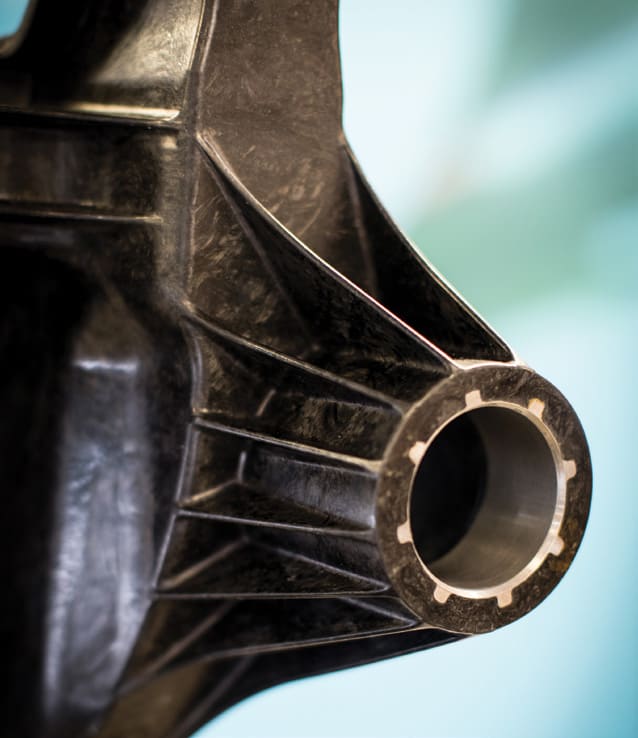
Carbon-fiber reinforced polymers are the yin and yang of automotive lightweighting. Their strength-to-weight ratio handily outperforms chrome-moly steel, heat-treated aluminum alloys and magnesium. The aerospace industry gobbles the strong, stiff and light composite for use in wing spars and plans to use it in entire primary structures (SpaceX’s next-gen heavy launch vehicle) in the future. But CFRP’s slow part-to-part cycle rates, relatively complex processing and unique failure modes have kept it from being a player in volumes of more than 150,000 units per year for automotive structural applications.
Magna International and Ford Motor Co. believe CFRP holds promise in vehicle structures—specifically front and rear subframes. The companies are preparing to test a batch of prototype CFRP front subframes they developed collaboratively over the last two years. The prototype cradle, now being installed in Ford unibody development mules, is 34% lighter than a comparable steel fabrication typically used in passenger vehicles. It is 16% lighter than a comparable aluminum fabrication.
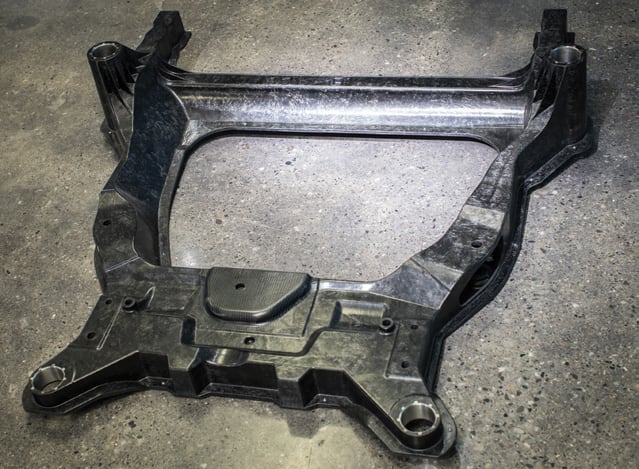
Comprising two main pieces—upper and lower moldings bonded and riveted together, along with four overmolded body-mount bushings—the CFRP cradle replaces 45 stamped-and-joined components in a benchmarked steel subframe. The bill of materials is reduced by 87%.
“Ford challenged us with this concept, which is a continuation of our collaboration on the Multi-Materials Lightweight Vehicle project,” explained Grahame Burrow, President, Magna Exteriors. His team and Magna’s Cosma chassis group worked closely with a Ford Research and Advanced Engineering team under Mike Whitens, in the subframe design. Magna orchestrated tooling and unveiled the first ‘shots’ at the 2017 JEC World composites show.
Burrow expects subframe testing to proceed through 4Q17 when “real results from real vehicles” will be available. From an FEA perspective, “all the tests to date have performed at or better than a steel subframe,” noted Brian Krull, Magna Exteriors’ Global Director of Innovation. “We’re hoping to see those same results in physical testing.” He described the material’s NVH performance as “excellent.”
Beyond the initial CAE work, the vehicle-level phase will evaluate corrosion, stone chipping and bolt-load retention and crash performance. The project team also will develop a recommended design, manufacturing and assembly process with the experience gained during the prototype build and subsequent testing.
Subframe “perfect” for CFRP

While Magna has extensive experience in carbon-fiber components for production, including the grille-opening reinforcement for Ford’s Mustang Shelby Cobra GT500 and the hood of Cadillac’s V-series sedans, the subframe project is the largest and most complex CFRP component yet developed, according to Burrow.
CFRP has for years tantalized chassis engineers looking to take mass out of vehicle frame structures. In the late 1990s, General Motors enlisted lightweight-aircraft pioneer Burt Rutan to co-develop a CFRP ladder frame aimed at full-size SUVs and Corvette. Interviewed by the author at the time, GM R&D boss Larry Burns said the project’s cost targeting ratio was $20 per pound removed, compared with a steel frame. The prototype CFRP frame reduced mass by 200 lb (91 kg) but steel remained the industry’s chassis and subframe material of choice.
The sheet-molding compound (SMC) that is used in the Ford CFRP project is a new material that was developed by Magna specifically for structural applications, according to Andrew Swikoski, Global Product Line Director, Lightweight Composites.
“The front subframe was a perfect application for it,” he told Automotive Engineering, adding that two materials were developed for the subframe: one is a chopped-carbon-fiber SMC and the other is a continuous fiber that is strategically placed in the parts that need a boost in properties. “Both materials were under development and Ford was cognizant of that; it was one reason they brought us into this development project,” Swikoski said.
Magna purchases the carbon fiber from Zoltek, part of the Toray Group. It then compounds the material in house. Swikoski noted that CFRP has directional-strength properties that rely on the orientation and proportion of the fibers relative to the polymer. Typically, chopped carbon fiber’s potential strength is limited because the material is scattered within the final part. Continuous carbon fiber offers greater potential strength because the thousands of carbon fibers are bundled in long strands.
Scaling for high volumes
According to Burrow and Krull, the two-piece prototype cradle could potentially evolve into a single-piece molding in future development.
“Given a clean-sheet approach, if we could be alongside vehicle architects from scratch, there could be opportunity to do this cradle in a single component,” Burrow said.
“What you don’t see underneath the close-out panels are a significant number of ribs underneath to handle the load path. This was one of the great achievements in this project, the amount of ribbing that’s integral to the component,” Krull noted. “Based on the structural ribs, I think a single piece is very feasible.”
The Magna engineers admitted that driving cost out of CFRP components has taken on greater urgency, driven by the more stringent global regulations for vehicle emissions. Their company’s manufacturing expertise is helping the subframe development teams innovate solutions on the plant side.
“We were working under the constraints of the existing MMLV; the new subframe had to fit that vehicle,” Krull explained. “If we had a clean-sheet approach we could potentially bring in some new innovations that would drive ease of assembly moving forward.”
Materials experts note that compression molding helps speed manufacture of the CFRP workpiece. A two-piece (male/female) mold is pressed together, with the CF fabric and resin between the two. BMW has claimed its production methods for the CFRP-intense i3 and i8 cars enable a new part to be cycled every 80 seconds. The process, however, is a high-cost investment due to high-precision CNC machining used to make the molds.
“Our target cycle time for this technology on this type of product is the range of three minutes,” Krull asserted. “It depends on part complexity and size. Cure time depends on thickness. We have quite a bit of automation we can throw at this for the loading and unloading. That’s what Magna is really good at.
“We can scale this for mass production—100,000 to 200,000 vehicles per year is certainly in the realm of possible,” he opined. “That’s exciting for us; it takes this material out of the ‘niche’ area.”
More From SAE Media Group
Automotive Engineering
Hyundai, Ford Pursue Structural Composites Despite Challenges
Automotive Engineering
Innovations for Lightweighting: Audi brings CFRP to 2018 A8
Automotive Engineering
Aluminum: Toward 50% Body Content
Automotive Engineering
Audi Reveals New A8 Technologies, Tightens Links with Porsche
Automotive Engineering
Stuck on Structural Adhesives
Automotive Engineering
3M, GM Collaborate on Aftermarket Adhesive for Multi-Material Structures
Automotive Engineering
2015 F-150: Ford Drops an Aluminum Blockbuster
Automotive Engineering
Altair Honors Lightweight Advances
Automotive Engineering
Innovations for Lightweighting: FCA slashes Pacifica mass with magnesium, hot-stamped steel
Automotive Engineering
Innovation More Than Skin Deep
Off-Highway Engineering
Carbon-Fiber Concept Trailer from Great Dane Cuts Weight by 4000 Lb
Automotive Engineering
Gearing Up Drive Axle Innovations
Automotive Engineering
Mass-Reducing Innovations Honored by Altair
Automotive Engineering
In Search of the Lightweight, Multi-Material Car
Automotive Engineering
Aluminum Frame Rails, New Alloy Castings from Alcoa Help Cut 2500 Lb from Tractor-Trailers
Automotive Engineering
Cadillac Pursues Aluminum/steel Mix for New CT6 Luxury Sedan
Automotive Engineering
Graphene: Living in a Stronger Material World?
Automotive Engineering
Cetim, Momentive Develop Composite Crashbox Concept
Automotive Engineering
Innovations for Lightweighting: Eaton’s “hybrid” materials replace metal
Automotive Engineering
Nissan Develops High-Volume, Fully Recyclable Composite Liftgate
Aerospace & Defense Tech Briefs
Additive Manufacturing Adoption Up, Growing Rapidly in Aerospace
Tech Briefs
Pros & Cons of Advanced Lightweighting Materials
Automotive Engineering
Self-Piercing Rivets Shoot for Vehicle-Lightweighting Applications Beyond Aluminum
Automotive Engineering
Engineering Chevy's Lighter, Stronger CUV
Automotive Engineering
Lightweighting, Friction Reduction Drive DSM's Plastics Development
Automotive Engineering
Multi-material Structures Move mpg Upward
Aerospace & Defense Tech Briefs
SAE International Issues First Technical Standards for Aerospace Additive Manufacturing
Automotive Engineering
High-Strength Sheet Steel That Bends
Automotive Engineering
Steel Targets EV Structures, Battery Boxes
Automotive Engineering
2019’s Best Automotive Plastics Innovations
Top Stories
NewsSensors/Data Acquisition
 Microvision Aquires Luminar, Plans Relationship Restoration, Multi-industry Push
INSIDERRF & Microwave Electronics
 A Next Generation Helmet System for Navy Pilots
INSIDERWeapons Systems
 New Raytheon and Lockheed Martin Agreements Expand Missile Defense Production
NewsAutomotive
 Ford Announces 48-Volt Architecture for Future Electric Truck
INSIDERAerospace
 Active Strake System Cuts Cruise Drag, Boosts Flight Efficiency
ArticlesTransportation

Webcasts
Aerospace
 Cooling a New Generation of Aerospace and Defense Embedded...
Energy
 Battery Abuse Testing: Pushing to Failure
Power
 A FREE Two-Day Event Dedicated to Connected Mobility
Automotive
 Quiet, Please: NVH Improvement Opportunities in the Early Design Cycle
Electronics & Computers
 Advantages of Smart Power Distribution Unit Design for Automotive &...
Unmanned Systems
 Sesame Solar's Nanogrid Tech Promises Major Gains in Drone Endurance